
Trending
In the world of antiques, "Handel" is synonymous with lamps. The company, which began as the decorating firm Eydam and Handel in Meriden, Connecticut, in 1885 and changed its name to Handel & Company in 1898, started making leaded glass lamps in 1904 as a less expensive alternative to Tiffany lamps. Of course, now some Handel lamps can reach prices just as high!
Handel & Company, which changed its name again to The Handel Company in 1903, had a foundry, opened in 1902, to produce its own lamp bases, but the glass shades were always the stars. Handel made several types of glass lampshades. In addition to leaded shades reminiscent of Tiffany, they used marbled slag glass, cameo glass, and reverse painting.
The reverse painted lampshades may be their most famous products, especially when the outside of the glass had Handel's patented chipped-ice texture. A well-known line called "Teroma" has a chipped ice surface and reverse painting, usually of naturalistic scenes. The company used many of the same decorating techniques on its other glass products, like vases, bowls, and jars. They are not as well-known as the lamps and generally sell for slightly less at auctions.
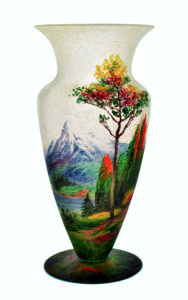
A Handel Teroma vase depicting a colorful scene with a mountain peak in the background sold for $1,750 at Fontaine's Auction Gallery. It is marked for Handel and signed by decorator John Bailey, who also worked on the company's reverse-painted lamps.
------
Q: I inherited a seven-piece dining set with a round pedestal table with a leaf and six re-upholstered chairs. There is a metal label that reads "Quaint Furniture -- Stickley Bros. Co. -- Grand Rapids, Mich." I was wondering about the value.
A: The Stickley Brothers Company was founded by Albert and John George Stickley in Grand Rapids, Michigan, in 1891. The company introduced its Quaint Furniture line in 1902, inspired by English Arts and Crafts furniture, and continued making it until about 1920.
Round pedestal tables were popular at the time, and the pedestal style used by the Stickley Brothers company helps to distinguish their work from that of their oldest brother Gustav Stickley, whose Craftsman company produced what may be the definitive examples of American Arts and Crafts furniture.
However, Stickley Brothers furniture, which was mass-produced, usually sells for lower prices than Gustav Stickley's Craftsman pieces. Quaint Furniture dining sets like yours have sold for about $1,500 to $2,000 at auction.
------
Q: My antique china dish is marked "Sevres" and "Bavaria." I always thought Sevres porcelain was made in France. Can you tell me why the dish is marked for two places?
A: Sevres, France, has been home to many porcelain manufacturers since the 1760s, but not every piece marked "Sevres" is from there. Their marks have been copied by porcelain factories in other countries. There was an unrelated Sevres China Company active in East Liverpool, Ohio, in the early 20th century.
Several companies have used "Sevres" as a name for a pattern or product line. The F. Thomas Porcelain Factory in Bavaria, originally the Thomas & Ens Porcelain Factory, was one of them. This factory used a shield-shaped mark, usually with "Thomas" inside. Pieces from their Sevres line are usually marked with the word "Sevres" in quotation marks and "Bavaria" underneath.
The company was later bought by Rosenthal, another Bavaria porcelain factory. They continued making the Sevres line; there are pieces marked with the Rosenthal crown and crossed lines, along with "Sevres" and "Bavaria." As if that's not confusing enough, porcelain manufacturers in both Sevres and Bavaria have made blanks that were sent to other factories for decoration. They can be marked for both the maker and the decorator.
------
TIP: Reverse-painted lampshades should never be washed. Just dust them.
------
Kovels answers readers' questions sent to the column. Send a letter with one question describing the size, material (glass, pottery) and what you know about the item. Include only two pictures: the object and a close-up of any marks or damage. Be sure your name and return address are included. By sending a question, you give full permission for use in any Kovel product. Names, addresses or email addresses will not be published. We do not guarantee the return of photographs, but if a stamped envelope is included, we will try. Questions that are answered will appear in Kovels Publications. Write to Kovels, (Name of this newspaper), King Features Syndicate, 300 W. 57th Street, 41st Floor, New York, NY 10019, or email us at collectorsgallery@kovels.com.