
Trending
Tennis, anyone? How about table tennis? The tabletop version of the sport is believed to have begun in Victorian England as a parlor game played by the upper class. Early equipment was improvised; instead of a net, players are said to have lined up a row of books across a table and hit a golf ball, or possibly a champagne cork, over it. Cigar boxes or more books were used as paddles. The game caught on quickly. Companies started making and selling nets, paddles, and balls for indoor use.
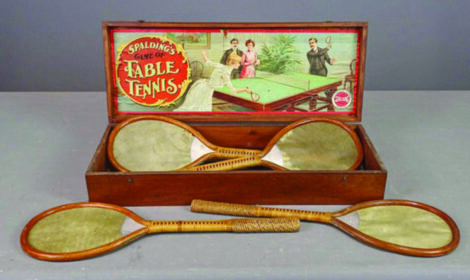
An early set of four rattan rackets in a wooden box marked for "Spalding's Game of Table Tennis" on the interior lid sold for $531 at Copake Auction Inc., against an estimate of $50 to $75, evidence of the game's continuing appeal. The colorful scene on the label of elegantly dressed players in a furnished parlor reflects its origins in the homes of the upper class and helps date it to the 19th century.
Other companies called the game by other names. For J. Jacques & Son Ltd. in England, it was "Ping Pong." To avoid trademark infringement, other manufacturers used names like "Gossima," "Whiff Whaff," and "Parlor Tennis," but "table tennis" remained the generic name.
The International Table Tennis Federation was founded in the 1920s, leading to the first World Table Tennis Championships. The game's popularity continued to grow as a leisure activity and a competitive sport. In 1972, Atari created Pong, an electronic version of table tennis, that paved the way for modern video games, which today include virtual reality table tennis. Table tennis became an Olympic sport in 1988, and, according to the International Olympic Committee, it has the most participants worldwide of any sport.
------
Q. I have a set of small animal carvings that I received as a gift a long time ago. I believe they are made of ivory. How can I tell? If they are, is it legal to keep them or sell them?
A: Many materials, including bone, horn, and plastic, can be mistaken for ivory. In fact, celluloid, one of the first plastics, was invented as a synthetic ivory. Ivory is smooth and cool to the touch and develops a yellowish or brownish patina over time. Take a close look at the grain on your carvings. Genuine ivory has a random grain. The grain on artificial ivory will have a repeating pattern. The World Wildlife Fund (worldwildlife.org) has an online guide with more advice on identifying ivory.
There are no laws against owning legally acquired ivory. Laws concerning the sale of ivory are complicated and have changed over the years. If you can prove the ivory is more than 100 years old, it is legal to sell. If you are planning to sell your ivory, be sure to check the U.S. Fish & Wildlife Service for the current laws and requirements, as well as your state laws. If your ivory is not legal to sell, you may be able to donate it.
------
Q: Can you help me find out about an old lamp that has been in my family for years? It has a half-dome shade made of squares of glass. The glass is swirled and translucent. The base is dark metal and shaped like a tree trunk.
A: The swirled translucent glass in your lamp's shade is called slag glass. It was extremely popular in shades for electric lamps in the early 20th century, when light bulbs had a harsh, bright light that needed to be softened. Cast-metal bases were popular at about the same time. The tree trunk shape you described indicates it was made in the art nouveau period of the 1900s to 1910s, when designs had ornate lines and were inspired by nature.
Many American companies made lamps like yours at the time. The "big three" among collectors are Handel, Pairpoint, and, of course, Tiffany. Check your lamp, both the shade and the base, for a maker's mark. Lamps like yours by unknown makers can sell for anywhere from about $50 to $500, depending on the quality of the design and the type of metal used for the base. Identifying the maker will increase the value. Lamps by the "big three" can be worth thousands of dollars.
------
TIP: A tennis ball can be used to rub out scuff marks on vintage linoleum tiles -- the kind often used in houses before the 1960s.
------
Kovels answers readers' questions sent to the column. Send a letter with one question describing the size, material (glass, pottery) and what you know about the item. Include only two pictures: the object and a close-up of any marks or damage. Be sure your name and return address are included. By sending a question, you give full permission for use in any Kovel product. Names, addresses or email addresses will not be published. We do not guarantee the return of photographs, but if a stamped envelope is included, we will try. Questions that are answered will appear in Kovels Publications. Write to Kovels, (Name of this newspaper), King Features Syndicate, 300 W. 57th Street, 41st Floor, New York, NY 10019, or email us at collectorsgallery@kovels.com.