
Trending
"Art for art's sake" was the rallying cry of the Aesthetic Movement. Born in the mid-1800s in Britain, the movement was a response to the Industrial Revolution and the perceived ugliness and loss of craftsmanship that was the price for increased production and convenience. There was considerable overlap with the Arts and Crafts movement; William Morris is considered a proponent of both. Like Arts and Crafts, the Aesthetic Movement drew inspiration from the past (for example, the pre-Raphaelite painters) and from foreign influences, like Japanese art. Both movements also promoted beauty in all aspects of everyday life.
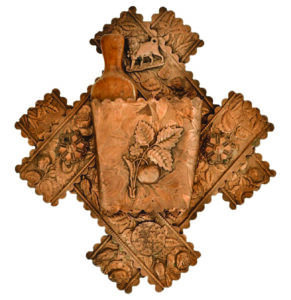
Morris was known to say, "Have nothing in your houses that you do not know to be useful or believe to be beautiful." An Aesthetic Movement copper whisk broom holder, whisk broom included, that sold for $625 at Fontaine's Auction Gallery is an excellent example of this philosophy. It serves a practical, decidedly unromantic purpose, but it features elaborate decorations that show off skilled craft and design. Its elaborate designs, including all-over relief flowers, leaves, and even a pug dog, plus scalloped edges, place it in the Aesthetic Movement rather than Arts and Crafts. While Arts and Crafts celebrated the beauty of tradition, simplicity, and craftsmanship, Aesthetic Movement design tends to be more ornate.
------
Q: I have a small ceramic pitcher with a pattern of gold leaves. There is a diamond-shaped mark on the base with a large capital "R" in the center and a bow and arrow next to it. Can you help me find out where it is from and what it might be worth?
A: A diamond mark with an "R" in the center sounds like an English Registry mark, which was used by the English patent office from 1842 to 1883. They can be found on ceramics, metal, and other materials, and you can use them to determine the date your item was made. There are many guides to reading English registry marks online, including on kovels.com.
The bow-and-arrow mark was used by the Ridgways of Shelton pottery, which was founded in 1866 in Hanley in the famous pottery manufacturing district of Staffordshire, England. Ridgways is known for transfer-decorated earthenware. We have seen their pitchers sell for about $50 to $150. Your value will depend on its size, the rarity of the pattern and its condition. The Transferware Collectors Club (transferwarecollectorsclub.org), which specializes in transfer-decorated British ceramics, may be able to help you find more information, including pattern identification and value.
------
Q: How can I clean a cloudy glass decanter? I have tried vinegar and water overnight several times to no avail. We also tried denture tablets, but that didn't work either.
A: There are a few possibilities for what happened to your decanter. The stains may be caused by mineral deposits from hard water. In that case, letting it soak for several days, not just overnight, in a solution of water and vinegar (we have read three parts water to one part vinegar) may help. Another possibility is to try a mild abrasive.
If the cloudiness is on the interior of the decanter, put some uncooked rice in it, along with warm water and 1/2 teaspoon of liquid detergent. Shake well, then empty it and rinse. Some glass collectors have had success with bathroom cleaners designed to remove calcium deposits from glass shower doors. If you use some on your decanter, be sure to follow any safety precautions, such as wearing gloves, and don't let the chemicals stay on your decanter for too long. No matter what treatment you use on your glass, wash it afterward and rinse with lukewarm water. To dry the interior, roll up a paper towel and insert it into the neck so it is about an inch from the bottom. Leave a few inches sticking out the top. Let it dry for a day or two.
If your decanter is still cloudy, it may be what collectors call "sick" glass, which can happen to antique glass (usually 19th-century or older) with an unstable composition. Alkali can leach out of the glass over time and react to moisture in the air, causing cloudiness. High humidity, high temperatures, and direct sunlight exposure can make the condition worse. Sick glass usually cannot be restored by cleaning and requires polishing by an expert, which is expensive and may be risky. If the decanter is for display only, you may be able to hide the cloudiness by swirling some clear baby oil or mineral oil inside.
------
TIP: Polish brass, copper or pewter only once or twice a year.
------
Kovels answers readers' questions sent to the column. Send a letter with one question describing the size, material (glass, pottery) and what you know about the item. Include only two pictures: the object and a close-up of any marks or damage. Be sure your name and return address are included. By sending a question, you give full permission for use in any Kovel product. Names, addresses or email addresses will not be published. We do not guarantee the return of photographs, but if a stamped envelope is included, we will try. Questions that are answered will appear in Kovels Publications. Write to Kovels, (Name of this newspaper), King Features Syndicate, 300 W. 57th Street, 41st Floor, New York, NY 10019, or email us at collectorsgallery@kovels.com.