
Trending
Ice cream and carnivals are two of summer's best treats, but, for glass collectors, they are a delight any time of the year. Ice cream bowls are a favorite type of carnival glass; their size and shape make them an excellent showcase for the rich colors, pressed patterns, and iridescence.
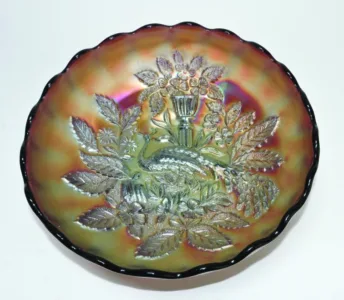
A nine-inch carnival glass ice cream bowl by Northwood, depicting the Peacock and Urn pattern in a vibrant amethyst purple, sold for $130 at Strawser Auction Group. Carnival glass was made in the early 20th century as an inexpensive version of Tiffany iridescent glass. Pressed glass was sprayed with liquid metallic salts to create an iridescent effect.
The name "carnival glass" came about because fairs and carnivals gave out pieces as prizes. The vivid colors and iridescence may evoke the bright lights, colorful signs, and lively atmosphere of carnivals, too. Rare colors and patterns can sell for thousands of dollars, but most carnival glass today is fairly inexpensive. It is still a well-loved collectible, with many collectors' clubs across the United States, auctions dedicated to it, and plenty of published guides to the many makers and patterns. But beware; its popularity also means that there are many recent reproductions.
------
Q: I have a set of two porcelain figures and am trying to identify the maker. There is no name on the base, but there is a blue mark that looks like a circle divided into six wedges. Can you help?
A: This mark was used by the Hochst porcelain factory (also spelled Hoechst), which was founded in 1746 in Mainz, which was part of the Holy Roman Empire at the time and is now a city in western Germany.
The mark, sometimes described as a wheel with six spokes, is called the Mainz wheel. Some versions of the mark include a crown on top of the wheel or the name or initial of the factory that produced the molds. The original factory closed in 1796 and sold its molds to other porcelain manufacturers. Another Hochst factory operated from 1947 to the 1960s, and a third in 1965. This factory is still operating. They still use the wheel mark, although modern pieces often include the name "Hochst."
Modern Hochst figurines can be worth anywhere from about $25 to $100. Pieces from the 18th century can be very valuable. Figurines usually sell for over $100. Some rare pieces can be worth thousands of dollars. An 18th-century Hochst porcelain group consisting of a wild boar chased by hunting dogs, with the blue wheel mark on the base, sold for $4,500 at an auction earlier this year.
------
Q: Can you help me identify an item that was given to me years ago? It is 3 1/2 inches long with a pin on the back of the metal base. There is a line of eight carved elephants, trunk to tail. The largest elephant, which is at the head of the line, is 1/2 inch tall, and the smallest is 1/4 inch tall.
It appears that they are all one piece with the base they stand on, and then it is attached in some way to the metal base. There are no identifying marks.
A: Your item is a popular design that is often called the Elephant Bridge. They have been made in Asia (particularly China, Japan, and India) and Africa and were popular souvenirs for tourists in the late 19th and early 20th centuries.
Traditionally, they were carved from an elephant's tusk, which gave the bridge its curved shape, but they have been made in other materials like bone or wood. There are some variations among designs, such as the number of elephants or their poses; for example, some give the elephants raised trunks. The elephants and bridge are usually carved as one piece, but may be mounted on a base, usually wood, that is sometimes carved to resemble water.
They can be made in various sizes; at 3 1/2 inches, yours is especially small. It may have been intended to be a piece of jewelry, like a brooch, a hair ornament, or a clip. The value of Elephant Bridge carvings usually depends on the item's size, material, and the quality of the carving. Pieces like yours have sold for about $150 to $200.
------
TIP: Do not display carnival glass made before 1910 in direct sunlight. The glass will turn purple or brown and the iridescent finish may fade.
------
Kovels answers readers' questions sent to the column. Send a letter with one question describing the size, material (glass, pottery) and what you know about the item. Include only two pictures: the object and a close-up of any marks or damage. Be sure your name and return address are included. By sending a question, you give full permission for use in any Kovel product. Names, addresses or email addresses will not be published. We do not guarantee the return of photographs, but if a stamped envelope is included, we will try. Questions that are answered will appear in Kovels Publications. Write to Kovels, (Name of this newspaper), King Features Syndicate, 300 W. 57th Street, 41st Floor, New York, NY 10019, or email us at collectorsgallery@kovels.com.