
Trending
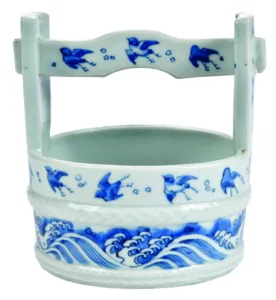
Blue and white ceramics have been made all over the world, from Chinese porcelain to Dutch delft to the cobalt blue decorations on American stoneware. One type, Hirado ware, comes from Japan. Its name comes from the Hirado Domain, which lasted from 1587 until 1871, when the domain system was abolished. It is still made today and is also known as Mikawachi ware, after the kilns that produced it. It is available in several styles and colors, including all-white pieces, but the blue-and-white designs are the most famous -- and most collectible.
They usually feature natural themes and often include additional details such as pierced panels or three-dimensional decorations, further demonstrating the ceramicists' skills. As is often the case, simpler designs tend to be less expensive. For instance, a 7-inch-tall, well-shaped Hirado ware basket from the late 19th or early 20th century sold for $125 at Brunk Auctions.
------
Q: Can you tell me the value of a 1950 Aladdin lamp?
A: The Aladdin lamp was made by the Mantle Lamp Company in the early 1900s, based on a kerosene lamp with a new type of mantle invented in 1905. The Mantle Lamp Company merged with Aladdin Industries, Inc., in 1949, and the brand was purchased by Crownplace Brands, Ltd., in 2015. The company is still selling lamps and lamp parts.
Aladdin lamps have been made in many types, including kerosene and electric, and in different materials, such as brass or glass. The most popular among collectors are kerosene mantle lamps with pressed-glass bases. They can sell for anywhere from about $50 to thousands of dollars, depending on the condition of the lamp, model of burner, and color and pattern of the base. Lamps with the Model "B" burner, introduced in the 1930s, are among the most desirable and can fetch high prices.
Determining the value of an Aladdin lamp requires information such as its fuel type (kerosene or electric), the material of the base, and, if it has a glass base, the color and pattern. There are plenty of resources available for collectors. A collector's club like the National Association of Aladdin Lamp Collectors, Inc. (aladdincollectors.org) or AladdinCollector (aladdincollector.com) may have information that can help you. You may also want to check your library for reference books like "Aladdin, The Magic Name in Lamps" by J.W. Courter.
------
Q: I bought a picture at a thrift store that reads, "B.F. Reinhardt in 1873." It also reads, "From the American Agriculturalist," then across the bottom, "Offered According to Act of Congress A.D. 1873 By Orange Judd Association in the Office of the LIBRArian of Congress at Washington." Then, just above "Washington," it reads "Bencke & Scott Chroma N.Y."
It measures just over 11 by 14 inches. There is no frame. I have seen a picture of the same print on an antique site for more than $500, but eBay has one that looks like it for less than $100. Can you help me?
A: You have a print of a painting by Benjamin Franklin Reinhardt (1829-1885), an American artist known for genre scenes and portraits. You are fortunate that the print includes plenty of identifying information. The print was copyrighted in 1873 and printed by Bencke & Scott. It was an illustration for the American Agriculturalist magazine, owned by Orange Judd & Co.
This information can help you determine its value. There are many online databases, like Artnet and ARTBnk, where you can look up the value of a work of art. They require subscriptions, but you may be able to access them at a library or museum in your area. You could also contact an art gallery or an auction house that deals in prints and artwork. Some book dealers also handle prints.
As you have seen, looking at prices online can be confusing. One of the most important things to remember is that you might be looking at the asking prices, not the sold prices. Just because a seller asks for a certain price does not always mean a buyer will pay it. For a more realistic idea of an item's value, be sure to look at sold prices. You can search for sold prices on eBay under "Advanced Search."
------
TIP: To find a small crack in porcelain or glass, try this. Put the piece on a table. Tap it with your fingernail. A cracked piece gives off a dull thud; a perfect piece will "ring." Learn to recognize the sound by practicing on some pieces you know are broken.