
Trending
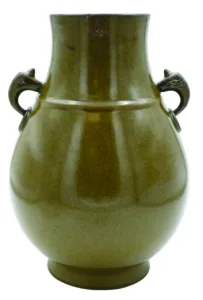
The richly colored glazes of Chinese porcelains have enthralled collectors and inspired artists for hundreds of years. They are often given descriptive names, like the dark red "sang de boeuf" or "oxblood"; the famous peachbloom that inspired the late Victorian craze for two-tone pink glass; or the speckled olive shade called tea dust.
Tea dust glaze was first used in the Tang dynasty (618-906). It may not be a coincidence that Chinese "tea culture" emerged in the same era, although tea plants had been cultivated in China and the leaves consumed as food, drink, or medicine for thousands of years by then. Perhaps the creation of tea dust glaze, named for its resemblance in color and texture to ground tea leaves, reflected the increasing significance of tea as a cultural institution. The earliest tea dust glazed ceramics were stoneware.
The glaze was used on porcelain by the Ming dynasty (1368-1644). The tea dust glazed porcelain of the Qing dynasty (1644-1912) is generally considered the highest quality. Pieces can sell for high prices today; a Qing-style tea dust glaze vase with elephant's head handles sold for $2,440 at Nadeau's Auction Gallery. Note that the auction house described it as the style of the Qing dynasty. Dating Chinese porcelains can be difficult because artists frequently copied earlier designs, even the marks. Some historians believe that this reverence for earlier art relates to the appeal of tea dust glaze: its color and texture suggest ancient bronze, evoking artworks even older than porcelain.
------
Q: Can you help me find out about a strange, old tool? It is metal and looks like a pair of pliers with round jaws. The handles are connected at the ends. It is about 6 inches long. The name "GILMER" is engraved at the pivot point. It looks like there is a patent date, too, but it is too scratched to read. Do you know anything about the Gilmer brand, or what this tool was used for?
A: It sounds like you have a tool that was patented by George Walker Gilmer, Jr., in 1913. He called it a "combination tool" or "combination pliers and spreader." It was made for repairing rubber tires. The jaws held a cut or torn spot in the tire open so the repairer could clean it and repair it with new rubber.
We haven't found much information about Gilmer himself other than that he worked in Philadelphia, patented two versions of his combination tool, and went bankrupt from advertising them. Other companies were making similar tools, so he faced competition. But today's antique tool collectors appreciate his invention. Sometimes, obsolete tools or companies are all the more interesting. A Gilmer combination tool sold on eBay earlier this year for about $20.
------
Q: I have some antique jewelry in a box marked for "Jurgens & Anderson Co. Chicago." Can you tell me about the company?
A: Paul Jurgens (also spelled Juergens) and Sebastian Andersen were both born in Germany, trained as silversmiths, and immigrated to the United States in the 1850s. They met in Chicago, where they established their company. Their first shop was destroyed in the Great Chicago Fire of 1871, but they were able to salvage some of their gold and silver and open another shop. Their company was incorporated as Jurgens & Andersen in 1893, and it continued expanding, establishing a European office by the early 1900s. They made fine jewelry, gifts, and personal care items out of silver, gold, and gemstones.
Personalized or commemorative items, such as silver christening cups engraved with the baby's name and the date, were popular. The company introduced its trademark Add-A-Pearl Necklace in 1915. Customers initially purchase a necklace with a single pearl as a gift for a baby or child and have additional pearls added to celebrate milestones. The company is still active in Chicago, selling Add-A-Pearl necklaces, charms, and other silver, gold, and pearl jewelry.
* * *
TIP: Always wash antique china in a sink lined with a rubber mat or towels. This helps prevent chipping. Wash one piece at a time. Rinse and let it air dry. If you suspect a piece has been repaired, do not wash it. Clean with a soft brush dampened in a solution of ammonia and water.