
Trending
Murano glass is one of the best demonstrations of how the old lives on in the new. The island of Murano, just off Venice, Italy, became a center for glassmaking in 1291 and has been ever since. Beautiful glassware has been there for export in various colors and patterns, starting with beads, mirrors, and candleholders; and now, anything from glass tableware to complex works of art. The glassworks and their history, not to mention the island's location and climate, make it popular with tourists, so Murano glassmakers also make plenty of small, fairly inexpensive souvenirs.
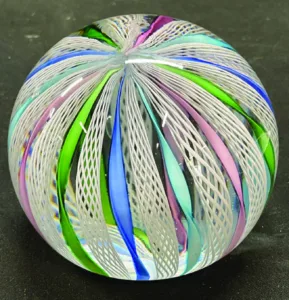
Regardless of its age, quality, or price, Murano glass can be recognized by its striking colors and use of complex techniques. For example, a paperweight that sold for $64 at The Benefit Shop Foundation Inc., a low price when compared to masterpieces from famous factories, includes colorful twisting ribbons alternating with zanfirico glass. Zanfirico, invented by Murano glassmakers in the 16th century, involves stretching and twisting fine glass canes into delicate lattice patterns. It is a difficult process that requires a highly skilled glassmaker. The paperweight is attributed to Fratelli Toso, a glassworks that six brothers (from the Toso family, of course) opened in the 1850s. Its glass pieces from the mid-20th century are especially popular among collectors.
------
Q: There is a pair of Arts & Crafts candlesticks that has been in my family for years. I am trying to find out more about them. They are made of metal, but they don't have a maker's mark. They are mixed metal; it looks like there is brass and copper or bronze in them. Are there ways to find out who made them and what they might be worth?
A: The Arts & Crafts movement began in England in the late 1800s as a reaction to the increased industrialization of the time and soon spread into the United States and the rest of Europe. The movement promoted work environments where skilled craftsmanship flourished, and the maker of an object was involved in every step of the process. Although the movement was more of a philosophy than a style, it is associated with simple lines, linear shapes, quality materials, and influence from Japanese and medieval European art.
Many Arts & Crafts metalsmiths had distinctive styles, like Dirk van Erp's heavy copper pieces, Tiffany's long, slim organic shapes, Roycroft's hammered finishes, or the intricate pewter designs sold by Liberty & Co. Remember that the major workshops had imitators, too, so style isn't always a guarantee of the maker. However, being "in the style of" a famous maker can sometimes add to the value of a piece.
To find out more about your candlesticks and a possible maker, we recommend getting familiar with as much Arts & Crafts metalwork as you can. Several major art museums have online guides to the Arts & Crafts movement with plenty of pictures. Look up books about Arts & Crafts, especially metalwork, at your library. A local art museum's library may be especially helpful here. Pairs of Arts & Crafts metal candlesticks by unidentified makers can sell for about $50 to $200 depending on their size, material, design, and quality.
------
Q: I am downsizing and don't know what to do with a collection of old German bisque dolls. Can you help me find out their value, and where to find buyers?
A: Bisque dolls, or bisque head dolls, with heads made of unglazed porcelain, were first made in the mid-19th century in France and Germany. Some of the most famous German makers include Gebruder Heubach, J.D. Kestner (J.D.K.), Armand Marseille (A.M.), Simon & Halbig, and Kammer & Reinhardt (K.R.). Some of them also supplied bisque heads to other doll companies in France and the United States.
Bisque head dolls by these companies can easily sell for over $200, and some can be worth thousands of dollars. It helps to be able to identify the maker and mold number. The doll is usually marked with them on the back of the head. Doll collectors are devoted to their hobby, and there are a great many resources available. You will probably get the best prices for your dolls at a doll show or through a specialty auction house.
You may want to contact a collector's club like the United Federation of Doll Clubs (ufdc.org) or an auction house that specializes in antique dolls, such as Fraher's or Theriault's. Some auction houses may be able to appraise your dolls if you send photos. Condition is extremely important to a doll's value.
------
TIP: Be careful about displaying paperweights or other heavy objects on glass shelves. With each new purchase, you add more weight to the display shelf, until one day, there is a crash and the shelf and weights are damaged. It may seem safe for years, but a slight jar from a slamming door may be enough to cause the glass to crack.