
Trending
As summer winds down and a new school year begins, it's time to take on some intellectual challenges. That doesn't mean giving up fun and games. Some of the earliest manufactured toys, dating to the 18th century, had educational purposes. These included "Sunday toys" that taught Bible stories or imparted moral lessons. Other toys and games helped children practice subjects like arithmetic, spelling, and geography.
Even conventional board games that aren't overtly educational can provide an intellectual challenge; for example, chess. Card and dice games combine strategy with probability. Checkers, often considered a fairly simple game, can teach valuable skills.
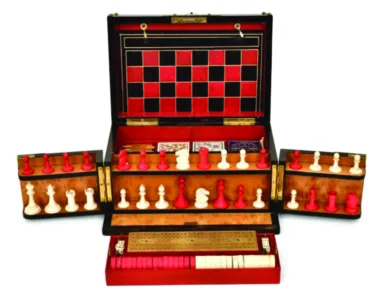
The Royal Cabinet of Games, made in the late 19th century by London company Chapman, Son & Co., packed a game board, chess pieces, checkers, dice, cards, a cribbage scoreboard, and more into an approximately 7x13x9-inch box, ensuring endless ways for players to challenge each other-or themselves. Perhaps some players exercised their creativity by combining pieces to invent new games of their own. The game set was available in a variety of wood boxes, and one example sold for $1,050 at Fontaine's Auction Gallery.
------
Q: I am trying to find out about an antique set of dishes that is marked "Melba Bone China Made in England." When I looked up Melba Bone China, I found out that several different companies used the name. How can I find out which one made mine?
A: Four potteries in the Staffordshire district of England used the name "Melba": Ridgways, Mayer & Sherratt, H.A. Wain, and Melba China Co. Mayer & Sherratt and Melba China Co. made bone china. Ridgways had a pattern called "Melba," and H.A. Wain had a line of earthenware they called "Melba Ware."
Your dishes are probably by Mayer & Sherratt. They used a mark that reads "Melba Bone China Made in England" (or "Guaranteed Made in England") after 1921. The company was in operation until 1941. Melba China Co., which was in business from 1946 to 1952, was marked with "Melba China Co Ltd."
Based on the company name, your dishes must have been made between 1921 and 1941. Even before identifying the maker, the words in your mark can give you some clues to the age of your dishes. "Bone china" first appeared in marks in 1915. Dishes imported to the U.S. were required to be marked with their country of origin in 1891. The words "Made In" were not typically used until after 1915.
------
Q: I have a set of antique silverware that belonged to my grandmother. I don't use it much, but I keep it for the family connection. What is a good way to store it?
A: Silver tableware requires special storage and handling. Do not store it in cardboard, wrap it in newspaper, or secure wrapping with rubber bands. These will cause discoloration. Latex paint, unsealed wood, felt, wool, and velvet will tarnish silver.
We recommend storing silver in Mylar or polyethylene bags and keeping it in a drawer or cabinet in a room with regulated temperature and humidity. There are tarnish-preventing bags that you can buy at hardware or jewelry supply stores. They also have anti-tarnish strips or cloths to store with your silver. Another way to help prevent tarnishing is to store a piece of white chalk wrapped in tissue paper with your silver.
The ideal humidity is 40% to 45%. Extreme heat is harmful to silver, so it is usually best not to store it in your attic (which can get hot in the summer), even if you rarely use it. In fact, one of the best ways to keep your silver in good shape is to use it! Frequent use and proper cleaning afterward helps prevent tarnish and reduce the need for polishing. Just be sure to rinse your silver immediately after using and let it dry thoroughly after washing. Eggs, salt, and acidic foods are especially harmful to silver. Handwashing is best; silver can get damaged in the dishwasher.
------
TIP: Printed game boards from the 1940s to 1960s fade very quickly. Older printing seems to be damaged less by exposure to ultraviolet light.