
Trending
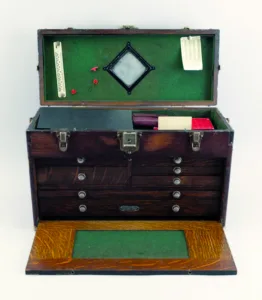
Labor Day is a great time to take a look at the tools and trades of yesteryear. Some of them are still around. For example, an H. Gerstner & Sons oak machinist's chest from the early 20th century sold for $512 at an auction by Eldred's. H. Gerstner & Sons is still operating, although it is now called Gerstner.
Harry Gerstner, who made his own tool chests for his job as a patternmaker in Dayton, Ohio, founded the company in 1906, so the chest that sold at Eldred's may be one of their earliest pieces. But, while tools and technology have changed dramatically since then, whether they are for professional machinists or amateurs doing home repairs, the company knows what works and sticks with it. Gerstner still makes similar chests out of hardwood with a fold-out front panel, fitted drawers, green felt lining, and a hinged lid with a diamond-shaped mirror on the interior.
The company takes pride in its history, making new chests based on antique designs, selling supplies to repair and restore their products, and providing an online guide to dating vintage pieces. They also honor the hard work and skilled craftsmanship that goes into making their tool chests, from Harry Gerstner constructing his own woodworking tools to their present-day employees hand-finishing their products.
------
Q: I have a carnival glass pitcher and six glasses and a large berry bowl with eight small bowls in the Singing Bird pattern. Can you tell me the value?
A: The Singing Bird carnival glass pattern was made by the Northwood Glass Company starting in 1912. The company closed in 1925. The pattern was made in several colors of carnival glass, including amethyst, marigold, green, and blue, as well as clear pressed glass, including a variety with blue birds. The color and condition of the glass pieces will influence their value.
Marigold pieces appear to be the most common and generally sell for lower prices. Singing Bird water sets consisting of a pitcher and six tumblers have sold for $200 to $400 at recent auctions. The pitcher can be worth about $60 on its own. Similar berry sets have sold for about $150, and large berry bowls are usually worth about $50. For more information, you may want to contact an auction house that specializes in glass or a collector's club like the American Carnival Glass Association (myacga.com) or the Early American Pattern Glass Society (eapgs.net).
------
Q: How can I tell if my Buddy Lee doll is an original from the 1920s?
A: Buddy Lee is an advertising doll introduced by the H.D. Lee Company, maker of Lee jeans, in 1920. The original dolls were 12 1/2 inches tall and made of composition. In 1948, the company changed to a 13-inch-tall doll made of hard plastic. The dolls are marked "Buddy Lee" on the back. The earliest dolls have the name in a triangular mark.
It is believed that, at one point, Buddy Lee was the second highest-selling doll in the United States. However, the dolls were no longer profitable by 1962, so the company discontinued them. The original Buddy Lee advertising dolls were dressed in Lee overalls, of course, with a fabric label including the words "Union Made." A hole in the doll's left boot allowed a metal rod to attach it to a store display. Later, the company made dolls for retail sale as well as advertising displays. These included dolls dressed in uniforms for different professions, including a railroad worker, cowboy, gas station attendant, and football player. They also represented different brands, such as Coca-Cola and John Deere. Dolls with the Coca-Cola uniform, a Texaco uniform, and a Route 66 gas station uniform have been reproduced.
Chubby Kid dolls, made by the Gem Toy Company in the 1920s, are sometimes confused for Buddy Lee. They were also 12 1/2 inches tall with jointed shoulders, painted side glancing eyes, and painted shoes or boots. Unlike Buddy Lee dolls, they were unmarked (they had a paper label on the sole of the foot), had mohair wigs (Buddy Lee dolls always have molded hair), and were also made in larger sizes.
------
TIP: If the screw holding a hinge is loose, try this old-fashioned remedy. Break the heads off several large wooden kitchen matches. Put the wooden strips in the hole with some glue, then screw the old screw back into place.
------
Kovels answers readers' questions sent to the column. Send a letter with one question describing the size, material (glass, pottery) and what you know about the item. Include only two pictures: the object and a close-up of any marks or damage. Be sure your name and return address are included. By sending a question, you give full permission for use in any Kovel product. Names, addresses or email addresses will not be published. We do not guarantee the return of photographs, but if a stamped envelope is included, we will try. Questions that are answered will appear in Kovels Publications. Write to Kovels, (Name of this newspaper), King Features Syndicate, 300 W. 57th Street, 41st Floor, New York, NY 10019, or email us at collectorsgallery@kovels.com.