
Trending
Cold-painted bronze figures were fashionable in the late 19th to early 20th centuries. The most famous were made in Vienna, Austria, and Franz Xavier Bergmann (1861-1936) is regarded as a master of the craft. Using his middle name helps distinguish him from his father, also named Franz Bergmann, who founded a bronze factory in 1860.
The younger Bergmann inherited the factory and used some of his father's designs but created a distinctive style all his own. Although he is sometimes described as a sculptor, it is more accurate to call him a foundry owner. He did not sculpt his figures but cast them in bronze; his foundry employees did the actual sculpting. His figures are usually marked with an urn shape or with the name "Namgreb," based on his surname spelled backward. Popular subjects include figures in romanticized foreign costumes, especially Arabian; dancing women in art nouveau or art deco styles; and whimsical animals. Many bronze figures were functional, with lamps or bells built in.
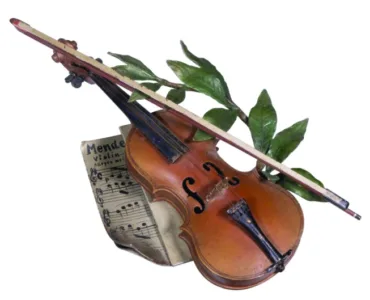
A bronze figure by Bergmann that sold for $812 at Thomaston Place Auction Galleries is a bit of a departure from his most famous work. Instead of a human figure, animal, or exotic tableau, it is a violin with its bow, sheet music, and a bay laurel branch. The name "Mendel" is visible on the sheet music, probably referring to composer Felix Mendelssohn (1809-1847), whose "Concerto in E Minor" is one of the world's most famous pieces of violin music. The bay laurel branch, a symbol of status and victory since ancient Greece (hence the term "laureate"), may be a reference to the music, but is also appropriate for Bergmann himself.
* * *
Q: I have read that some vintage cookie jars are worth a lot of money. There is a cookie jar shaped like a bear with a bow on its neck that I have had for many years. I looked it up, and it was made by the American Bisque Company, but I have not found a value for it. Can you tell me its value?
A: The American Bisque Company opened in Williamstown, West Virginia, in 1919. They initially made bisque dolls. Under new leadership in the 1920s, they expanded into a variety of household goods, including cookie jars. Their best-known designs are figural pieces decorated with airbrushing in bright colors. Many of their cookie jars, like your bear, were mass-produced. They were sold as inexpensive giftware in the mid-20th century. Today, these jars sell for about $25 to $75 at auctions, depending on their condition and the rarity of the design.
The cookie jars that get the highest prices, selling for hundreds of dollars, feature famous licensed characters, like Disney or advertising mascots. American Bisque had a license to make Disney-themed products from about 1944 to 1954. These licensed products were usually made in limited quantities, so they are much harder to find than the mass-produced designs. Their crossover appeal, attracting collectors of the character or brand as well as general cookie jar or mid-century ceramic collectors, also contributes to their value. American Bisque closed in the 1980s, but some of their designs were reproduced in the 1990s.
* * *
Q: About 50 years ago, I got a small empty perfume bottle as a gift. I don't know how old it was or where it came from. It does not have a brand name on it. It is made of shiny blue glass with white painted flowers and has a silver top. Do you know how old it might be, where it comes from, and what it is worth?
A: Your perfume bottle sounds like it may be a piece of art glass, a collector's term for decorative glassware made mostly in Europe and the United States from the 1800s to early 1900s. It is characterized by decorations like vivid colors, hand-painted enamel, and unusual finishes like satin or iridescence. Small perfume bottles made of colored glass with enamel flowers and silver or silver-plated lid were popular at the time.
Art glass perfume bottles are usually worth at least $50, often over $100, even without a known date or maker. However, glass is always tricky to date and identify. There was a revival of interest in art glass in the mid-20th century, and many manufacturers made reproductions or pieces inspired by the old style. It can be difficult to tell if glassware is original or a reproduction. A collector's club like the International Perfume Bottle Association (perfumebottles.org) or the National American Glass Club (glassclub.org) may have more information.
* * *
TIP: "Cold-painted" items like some glass and porcelain, especially cookie jars, should never be put in a dishwasher. Just wipe them with a damp cloth.
* * *
Kovels answers readers' questions sent to the column. Send a letter with one question describing the size, material (glass, pottery) and what you know about the item. Include only two pictures: the object and a close-up of any marks or damage. Be sure your name and return address are included. By sending a question, you give full permission for use in any Kovel product. Names, addresses or email addresses will not be published. We do not guarantee the return of photographs, but if a stamped envelope is included, we will try. Questions that are answered will appear in Kovels Publications. Write to Kovels, (Name of this newspaper), King Features Syndicate, 300 W. 57th Street, 41st Floor, New York, NY 10019, or email us at collectorsgallery@kovels.com.