
Trending
"Castillo" is one of the most famous names in Mexican silver. The four Castillo brothers, Antonio, Jorge, Miguel, and Justo, founded their workshop, Los Castillo, in 1939. Like many mid-century Mexican silversmiths, they had all trained at William Spratling's Taxco workshop. They, in turn, trained other silversmiths who went on to found their own workshops. Some of them were additional family, like their cousin Salvador Teran. Antonio Castillo's wife, Margot van Voorhies Carr, was another one of their silversmiths, and she founded the Margot de Taxco workshop after they divorced.
The Castillo name is still active in the world of Mexican silver. Antonio Castillo's daughter Emilia is one of the country's greatest contemporary silversmiths, attracting international attention when Neiman Marcus started selling her work in 1990. She continues using the mixed metals, nature imagery, and stone, enamel, and abalone embellishments that characterize much of Los Castillo's work.
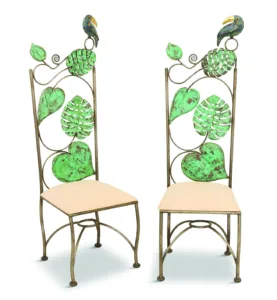
Figural birds are a favorite decoration, often appearing as a handle on a silver pitcher. They are used in other ways, too. For example, a parrot decorated with colorful inlaid stone perches on top of each of a pair of Emilia Castillo chairs that sold for $3,000 at New Orleans Auction. The chair backs maintain the nature motif with scrolling metal leaves and vines whose patina gives them a realistic green color. The depictions of birds and plants echo both the vibrant wildlife of Mexico and their long-standing significance to the country's art and culture.
------
Q: How can I tell if my Kelvin Fine China ashtrays are authentic? I have a set of four shaped like spades (like the card suit) that stack to fit in a holder. They are white with gold wheat sprigs.
I cannot find a set like them and think they may be very rare. The back is marked "Kelvin Fine China" underneath a crown, and there is a peeling black sticker that reads "Kelvin China Japan."
A: Kelvin Fine China was made in Japan for export during the mid-20th century and distributed in the United States by the Circle Import Export Co., which was based in California. At the time, there were many Japanese companies that made porcelain giftware for the American market. Hand-painted dishes, figurines, and inexpensive replicas of fine porcelain pieces were popular. Kelvin's products included painted porcelain dishes and bisque figurines of birds, animals, and children. Some of their most popular pieces among collectors today are their "birthday dolls," bisque figurines of children that came with a tag with a short celebratory poem.
The Kelvin brand name was apparently active into the 1980s, although production had moved to Taiwan. We haven't found the same pattern or item you describe, but we believe your ashtrays are authentic Kelvin Fine China based on the mark. Similar mid-20th-century ashtray sets made in Japan usually sell for about $30 to $50.
------
Q: My old Regulator schoolhouse clock used to belong to my parents, but I am not sure exactly how old it is or where it may have come from. Do you know how I can find out more about it?
A: The earliest regulator clocks were made in Europe in the 18th century. They were wall-mounted and had weight-driven movements and long pendulums to make them more accurate than the tall case (grandfather) clocks that were popular at the time. Because they were built for accuracy, they usually had plain designs and no chimes; they only struck the hour. They were often used for professional or scientific purposes, such as in clockmaker's shops and observatories.
Some of the most famous regulator clocks were made in Vienna, Austria, throughout the 19th century. By the late 1800s, many American clockmakers like E. Howard & Co., Gilbert, and Seth Thomas were producing regulator clocks. The style that collectors call "schoolhouse," usually made with a wood case, an octagonal frame around the dial, and a drop front with a pendulum behind a glass door, was often seen in public buildings like schoolhouses, train stations, and post offices because of their precise timekeeping and the large dials and simple designs that made them easy to read.
Starting in the 1920s, some companies stenciled "Regulator" on the glass door of pendulum wall clocks as a sign of quality and accuracy. Check your clock for a maker's mark. That may help you find out additional information about it, such as its age. There are plenty of resources available about historic American clockmakers. Look for books like "American Shelf and Wall Clocks" by Robert W.D. Ball or "The Warner Collector's Guide to American Clocks" by Anita Schorsch at your library, or contact a collector's club like the National Association of Watch & Clock Collectors, Inc. (nawcc.org). Remember that your clock might be more recent than you expect. Many antique clock designs have been reproduced.
------
TIP: If you live in an apartment and are a collector, be sure to get renter's insurance and check your coverage. You may not be covered for water damage if it's caused by broken plumbing in a suite above yours or water backup in your own apartment.