
Trending
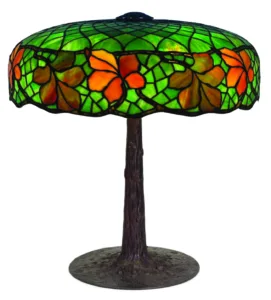
For many of us, we're not quite far enough into fall for the ground to be covered in golden leaves. If you love the look, though, you can find plenty of fall foliage in antique decorative arts. Take a look at the Autumn Leaf table lamp made by the Suess Ornamental Glass Co. about 1910. Leaves in fall colors stand out against an emerald green background on the leaded glass shade, and the bronze base has the texture of a tree trunk. At first glance, the stained glass shade, figural bronze base, and nature theme may have collectors thinking of Tiffany, but they weren't the only studio making stunning glass lamps.
The Suess Ornamental Glass Co. was founded in Chicago in 1886 by German immigrant Max Suess. Initially the Chicago Stained Glass Works, the company made stained glass windows and street signs. Suess was an innovator in many ways; in addition to creating beautiful designs, he patented methods and machines for decorating glass. Apparently, the innovative spirit ran in the family. After his death in 1904, his son Walter took over the company. It was Walter's idea to make stained glass lampshades, taking advantage of the newly popular electric lamps.
Unfortunately, the company's success did not last long; it went bankrupt in 1907, and its workshops burned down in a disastrous fire in 1908. However, that wasn't the end of the Suess name in lamps; a relative, John Baptist Suess, traveled to Seattle, Washington, where he co-created the company Suess & Smith. Suess lamps are fairly rare today, which means they sell for high prices. This Autumn Leaf lamp sold for $6,250 at Fontaine's Auction Gallery.
------
Q: I am requesting an appraisal of a Shomei Yoh print, numbered 12 of 800, found at a local estate sale recently for $5. The glass-covered frame measures 13 3/4 inches square from edge to edge; the mat measures 11 inches square; and the print measures 7 7/8 inches square. It appears to be in perfect condition. There is a Japanese label and two Certificates of Authenticity on the back.
A: Shomei Yoh (or Yoh Shomei) is a Japanese author, illustrator, artist, and poet born in 1946. He started his career illustrating postcards and stationery, then found success painting landscapes and creating picture books. Five dollars for an original print of his is definitely a bargain, and finding one at an estate sale is a stroke of luck; his prints appear to be difficult to find for purchase outside Japan, and, based on prices from the Yoh Shomei Museum, sell for over $200.
If you need a more specific value, check to see if a local library or art museum subscribes to online art databases like Artnet or Artbnk where you can look up prices. You could also consult a local art gallery for assistance.
------
Q: I am writing to share details regarding a collection of three earthenware liquor jugs. The measurements for the jugs are as follows: One jug measuring 14 inches high by 9 inches in diameter; one measuring 11 inches high by 7 inches in diameter, and one measuring 4 1/2 inches high by 3 inches in diameter. All three pieces are marked with "J. J. Stump" or "John J. Stump Liquor Dealers Cumberland, MD."
I bought the large jug about 50 years ago at a flea market. The other two were purchased through eBay over the years. The only information I have is what is printed on the jugs. Would you provide me with any additional information you may find?
A: Based on the information we found, John J. Stump (or J.J. Stump) was in business as a liquor dealer by about 1895. Your stoneware jugs are typical of liquor dealers' packaging from the late 19th to early 20th century. We haven't identified a maker, but since Maryland and the surrounding states had plenty of stoneware potters, it's likely that they were supplied by a local pottery.
The 4 1/2-inch-high jug was probably an advertising premium or gift that Stump gave to his customers. We have read that he also gave liquor glasses and possibly bottles etched with the name of his business to saloons that bought his products. For more about J.J. Stump and his liquor jugs, you may want to reach out to a historical society, library, or museum in Maryland. Stump liquor jugs are sometimes discovered during bottle digs, so a bottle collector's club like the Federation of Historical Bottle Collectors (fohbc.org), especially one in Maryland or the surrounding area, like the Tri-State Bottle Collectors & Diggers Club or the Delmarva Antique Bottle Club, may have additional information.
------
TIP: If you find an old lamp with part of a lightbulb still in the socket, try this: Push a fresh potato or a wine cork down into the old socket. Turn it and it will probably unscrew the old light bulb base.