
Trending
The origins of trick-or-treating are not entirely certain. Countries throughout Europe have had traditions of costumed revelers traveling from house to house and receiving treats since at least the Middle Ages. Ancient Roman Saturnalia festivals, medieval European mummers' plays, cakes given out on All Souls' Day, Christmas and New Year's traditions like wassailing, and New York City's 19th-century ragamuffin parades have all been suggested as inspiration for today's Halloween tradition.
The earliest "treats" may have been offerings made to spirits, tributes to deceased loved ones, or rewards for clever costumes or entertaining tricks. No matter how it began, most of us can agree that celebrating with treats and costumes is a great way to liven up a cold, dark evening. Trick-or-treating had arrived in America and Canada by the early 20th century, with the phrase appearing in print by the 1920s. In the 1950s, postwar prosperity made Halloween bigger than ever, with candy manufacturers promoting their products for the holiday. Today, these advertisements are sought by collectors of both advertising and Halloween decorations.
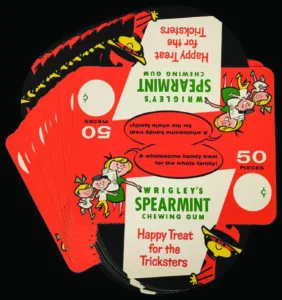
A group of unused Wrigley's Spearmint Gum labels from the 1960s, with a picture of a costumed child suggesting them as a "Happy Treat for the Tricksters," sold for $312 at Potter & Potter Auctions. Considering that Halloween candy has grown into a multibillion-dollar industry since then may put the price into perspective.
------
Q: I received an interesting vintage brooch as a gift. I'm not sure how old it is. It has a round silver frame filled with different colors of rhinestones. The back is marked "Lisner" with a copyright symbol. Can you tell me anything about this company? I hadn't heard of it before.
A: D. Lisner & Company was founded by David Lisner in New York City. It was in operation from 1904 to 1985. It sold domestic and imported jewelry by other manufacturers as well as making its own jewelry. The name "Lisner" was first used as a mark in the 1930s. The copyright symbol was added in 1955.
Lisner made and sold many styles of costume jewelry. In the 1950s and '60s, its jewelry was less expensive than pieces by other popular makers like Schreiner and Trifari, but still stylish, high quality, and innovative. Some of its best-known mid-century pieces are decorated with small molded plastic elements shaped like leaves or strawberries. Rhinestones were used more frequently a little later. Lisner also used enamel, faux pearls, filigree, and plated metal in its designs.
Lisner is still a popular brand among vintage jewelry collectors. Values for a single piece can vary widely. Pins with colorful rhinestones have sold recently for anywhere from about $10 to $40.
------
Q: I would like to know about some of my old Halloween toys. There are orange and black plastic jack-o'-lanterns, cats, and witches. They are made of hard plastic, have hollow areas, and are each about 5 inches tall. They are not marked, but I believe they were made by Tico Toys. Is there any collector interest or value to them?
A: Tico Toys is a brand name used by the E. Rosen Company, which was founded in Pawtucket, Rhode Island, in 1912 and closed in 1998. E. Rosen also owned Rosbro Plastics, which made similar toys. Both Tico Toys and Rosbro are known for the hard plastic blow-molded toys and novelties, including figural banks, party favors, and holiday decorations, that they made in the mid-20th century.
Three-dimensional toys with openings were made as candy containers; the E. Rosen Company was initially a wholesale candy seller and had its own candy making division, School House Candy, by the 1950s. Tico and Rosbro toys are often unmarked, although some vintage pieces still have their original paper tags or plastic packaging.
Their Halloween products are popular with collectors today and frequently sell for at least $50. Simple, predominantly orange designs tend to sell for lower prices, but more unusual pieces, like toys with moving parts (often with wheels or springs), witches riding things other than brooms, or designs with unusual colorways, can be worth over $100. A 2 1/2-inch-tall jack-o'-lantern cake topper sold at a recent auction for $60, while a 6-inch-tall candy container on wheels shaped like a witch riding a rocket, in black plastic with orange accents, sold for $550 online.
There are several online resources that can help you find out more information about your toys, such as Halloween Collector (halloweencollector.com), run by Mark B. Ledenbach, author of the book "Vintage Halloween Collectibles"; and Blow-Molded (blow-molded.com), an illustrated archive of molded plastic toys and the companies that made them.
------
TIP: If you store paper ephemera like trade cards or labels in notebooks or photo albums, be sure to open the albums several times a year to let the air circulate.