
Trending
Majolica collectors are familiar with many names, like George Jones, Sarreguemines, and, of course, famous ceramics factories like Copeland, Minton, and Wedgwood. Hugo Lonitz may be lesser known, but still important. While most of the best-known manufacturers of the richly glazed earthenware known as majolica come from France or England,
Lonitz had his factory in Neuhaldensleben, Germany. It was in operation from 1868 to 1904. His factory produced pieces that were both decorative and practical, such as vases, pitchers, punch bowls, candlesticks, and planters. Lonitz also made pieces like mirror frames and clock cases. Like most majolica, his was decorated with three-dimensional adornments and glazed in multiple colors. Renaissance-inspired motifs and human figures like winged putti or characters in historical costumes were frequently used.
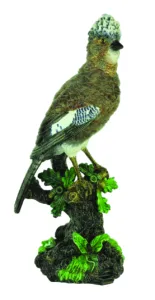
What truly sets Lonitz apart from his pottery-making peers is his renderings of animals, which have been compared to Black Forest carvings. Natural elements, including animals, are a common characteristic of majolica, but few manufacturers achieved the level of detail and realism that Lonitz did. His birds, deer, reptiles, fish, and more appear on candlestick bases, around bowls, and on wall pockets, which sell for high prices. His animal figures get the highest prices, however, when they stand alone.
Large animal figures, particularly birds, were some of the factory's best work, but rarely come to auction. These two factors give them extremely high value. A 17 1/2-inch jaybird perching on a detailed tree stump, one of only two known examples, passed its presale estimate to sell for an impressive $8,680 at Strawser Auction Group.
* * *
Q: I have a metal stool that was used in our family TV business way back in the 1950s. I have kept it since then. It has a round seat with a metal frame and four legs that are twisted near the foot. I recently removed old paint with steel wool and refinished the wooden seat. I was interested in learning the history of its maker, the Chicago Wire Chair Co. I contacted the museum in Chicago, but they had little information. Some advertisements supplied by the museum suggest that the company went out of business in 1930. Apparently, this style of twisted wire furniture was found in ice cream parlors. Any information would be appreciated. I am not looking to sell.
A: You're right, metal stools and chairs like yours were popular in ice cream parlors and soda fountains, to the point where they are often referred to as "ice cream parlor furniture" or "soda fountain furniture." Furniture like this emerged by 1875, after the Industrial Revolution made it possible to mass-produce the required metal wire.
What we have found out about the Chicago Wire Chair Co. indicates that it was founded about 1890 and, like you said, went out of business about 1930. It is considered a pioneer in twisted wire furniture. In addition to chairs, stools, and tables for ice cream parlors, they made furniture for other types of businesses, like barber chairs and shoe fitting stools. They also made wire furniture for home use and patented a type of folding sled. There were several other companies in Chicago making similar furniture at the time, especially for ice cream parlors, like the Royal Metal Manufacturing Company, Max Tonk, and A.H. Andrews & Co.
* * *
Q: I have a set of 10 Pizza Hut glasses that are at least 45 years old. They have the Pizza Hut logo with the red roof, and they are narrower at the bottom. Are they worth anything?
A: Your glasses are a style called a pilsner glass. Pizza Hut used glasses like these with the logo you described in the 1970s, so yours may be a bit older than 45 years. The red roof logo was introduced in 1974.
Individual glasses like these usually sell for about $10 to $15 online. These glasses, along with other Pizza Hut glassware, were made by Libbey, a company that was founded in 1888 and is still operating today. All kinds of Libbey glass, from its early cut glass to Victorian art glass to mid-century barware, are popular with collectors.
You may want to keep an eye on vintage Pizza Hut memorabilia on websites like eBay, Etsy, and Facebook collectors' groups. Vintage fast-food collectibles are increasing in popularity, and some companies are using it as a marketing strategy. Pizza Hut, with its "Pizza Hut Classic" dine-in locations, with decorations from the 1980s and 1990s, is one of the most notable examples.
* * *
TIP: Old majolica pitchers have a glazed interior. Many reproduction majolica pitchers have bisque interiors.
* * *
Kovels answers readers' questions sent to the column. Send a letter with one question describing the size, material (glass, pottery) and what you know about the item. Include only two pictures: the object and a close-up of any marks or damage. Be sure your name and return address are included. By sending a question, you give full permission for use in any Kovel product. Names, addresses or email addresses will not be published. We do not guarantee the return of photographs, but if a stamped envelope is included, we will try. Questions that are answered will appear in Kovels Publications. Write to Kovels, (Name of this newspaper), King Features Syndicate, 300 W. 57th Street, 41st Floor, New York, NY 10019, or email us at collectorsgallery@kovels.com.