
Trending
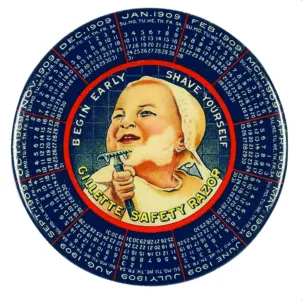
Baby New Year can grow up fast! The baby pictured here is already shaving. Well, it's probably not supposed to be Baby New Year, but being surrounded by a calendar, it's an easy association to make. This baby was the mascot for Gillette's safety razors, perhaps suggesting that they were both safe enough and easy enough for a baby to use, with the promise of baby-smooth skin, too.
Inventor King C. Gillette was not the first to create a safety razor, but he came up with the disposable blade, and his company popularized them in the early 1900s. Note that the calendar is for 1909 — a bit outdated for today's use, but very appealing to a collector of antique advertising. It sold for $295 at Morford's Antique Advertising Auctions.
Oh, and it's not just a calendar; it's a pocket mirror, too. They were a popular form of advertising in the early 20th century. These mirrors, like the Gillette one here, often had celluloid backs printed with the company's name, logo or slogan. But despite the product it advertises, a mirror like this one, at 2 1/2 inches in diameter, probably wouldn't be the best for shaving.
------
Q: My great-great grandfather William Begg sailed on Glenmorag (built in Glasgow in 1876), shipwrecked near Ocean Park, Washington, and salvaged the Ceres figurehead. In 1983, my grandmother sent Ceres to be restored in Portland, Oregon, but failed to pay, and it was sold to an unknown private collector. In 1991, West Sea sold Ceres at auction in New London, Connecticut. Several archivists have noted that she was in rough condition in 1991 and may not still be around, and I'm trying to see if she might exist somewhere.
A: Unfortunately, we have not found anything about the current whereabouts of the Ceres figurehead. Folk art or nautical collectors may be able to help you find information; you could try contacting collectors' clubs or museums, or advertising in specialist publications. Based on what you said about the figurehead's condition, its buyer may have had it restored. A maritime museum may be able to connect you with figurehead restorers.
------
Q: I have four pieces of capodimonte I would like to sell. Three are in excellent condition. The fourth has the end of a leaf and flower broken off but I have the pieces if someone would want to try and repair.
A: Capodimonte, also spelled capo-di-monte, is a type of porcelain first made in Naples, Italy, in the 1700s. It is usually marked with a crown over the letter "N." Many factories have made it since the 1700s. Today, it is made by the Richard Ginori firm. To sell your pieces, we recommend checking local shops to see if they sell on consignment. It is best to find a shop or dealer that sells items like yours. Another option is to sell them to a matching service. You may also want to look up porcelain restoration services; they may be able to repair your broken piece. Or a collector may want it to make their own repairs.
------
Q: I have an etched goblet made by Marion Glass. Can you help me find the name of the pattern?
A: The Marion Glass Manufacturing Company of Marion, Ohio, was active from 1917 to 1954. They started as an offshoot of a lamp chimney manufacturer, making the manufacturer's byproducts into water glasses. Later, they were known for purchasing glass "blanks" made by other companies and engraving them with intricate patterns. We have found little other information about the company, but a library or historical society in Marion, Ohio, may have more. We have not been able to find a pattern name, which is not unusual since some glass companies did not bother naming their patterns.
------
Q: I have an unusual cane that I want to sell. It is carved jujube wood with an animal horn handle, c. 1940. How can I find a buyer?
A: There are many ways to sell an antique or, in your case, vintage cane. They sell at antiques shops and auctions; you may want to look for one that specializes in vintage fashion or folk art. Be sure to check local laws about selling animal products like horns and ivory. Many regions have restrictions on what can be sold and may require proof of the item's age and authenticity. A club for cane collectors like the International Society of Cane Collectors may have more information and may connect you with potential buyers.
------
TIP: Celluloid should be stored in a dry, ventilated place. It will disintegrate if exposed to extreme temperatures, moisture or corroding metal.
------
Terry Kovel and Kim Kovel answer readers' questions sent to the column. Send a letter with one question describing the size, material (glass, pottery) and what you know about the item. Include only two pictures, the object and a closeup of any marks or damage. Be sure your name and return address are included. By sending a question, you give full permission for use in any Kovel product. Names, addresses or email addresses will not be published. We do not guarantee the return of photographs, but if a stamped envelope is included, we will try. Questions that are answered will appear in Kovels Publications. Write to Kovels, (Name of this newspaper), King Features Syndicate, 628 Virginia Dr., Orlando, FL 32803 or email us at collectorsgallery@kovels.com.