
Trending
Furniture can take unexpected forms, especially in contemporary design. From the late twentieth century onward, advances in technology created a wealth of new materials and construction techniques for designers to use, and social and cultural changes encouraged experimental approaches with new shapes and styles. Philippe Starck, born in Paris in 1949, is responsible for some of the most famous and creative furniture and industrial designs of the 1980s and 1990s, and he is still working today.
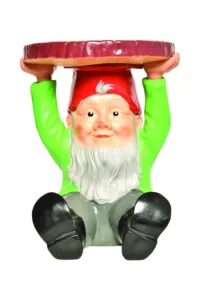
One of Starck's most famous designs, the "Louis Ghost" chair of 2002, is a fairly conventional-looking chair whose uniqueness comes from its material, clear plastic, and its construction method; it is injection-molded in one piece. Other designs are more unusual from first sight, such as his "Attila" side table designed for the Italian company Kartell, which takes the shape of a smiling, seated gnome with his arms raised over his head, holding up a faux tree trunk slice that makes the tabletop. Made of fiberglass and rubber, the table was originally made in the 1980s, but Kartell still carries it, albeit in different colors.
A vintage example, where the gnome wears a bright green shirt and truncated red hat, sold for $283 at Main Auction Galleries, a lower price than a new model would cost. Starck designed a similar gnome table he named "Napoleon," also made by Kartell. Perhaps he was making a statement about leaders famed for their ruthlessness, or maybe he just liked the idea of giving historical names to his whimsical tables.
------
Q: My family has a set of china that I believe dates to the time of World War II. It has a red mark with the letter "M" inside a laurel wreath and "Japan" underneath. Could you tell me when it was made and if it has any value?
A: You are right that the china set is from the World War II era. Items exported from Japan to the United States were marked "Japan" from about 1920 to 1940. Starting in 1890, imports to the United States had to be marked with their country of origin. Japanese imports were marked "Nippon," the country's Japanese name, until about 1921, when the United States started requiring the name in English. During the American occupation of Japan after World War II, from about 1945 to 1952, Japanese imports were marked "Occupied Japan." Unfortunately, we have not been able to narrow down the date or identify the maker.
There are several Japanese ceramics companies and exporters that used marks with a letter "M" in a wreath during the early to mid-20th century. The most famous is Noritake, which used several variants of the "M"-in-wreath mark from about 1911 to the 1950s. It is possible to date Noritake dishes by the colors, the style of the wreath, or the wording in the mark, but we haven't seen one that matches your description. Other Japanese companies that used similar marks include Moriyama and Seizan.
Sets of Japanese imported dishes from the mid-20th century generally sell for about $150 or less. However, a rare pattern or mark may increase their value, especially to a collector. There are collectors' clubs for Japanese imported porcelain, like the International Nippon Collectors Club (nipponcollectorsclub.com), which may be able to help you find more information.
------
Q: I bought an oil painting at a yard sale and would like to find out more about it. It is signed on the back, but I can't read the signature. I believe it dates to the early 20th century. Do you know how I could find out anything about the painting, the artist, or if it has any value?
A: It takes an expert to evaluate a painting, so we recommend contacting a museum or art gallery in your area. Some major art museums in big cities have days when they authenticate art for the general public, and some art and auction galleries offer free appraisal days. If you can identify the artist, you can try looking them up in databases like Artnet or Artbnk to find recent prices for their work. These databases require subscriptions, but you may be able to access them through a local library or museum. If the artist is American, you can also check online resources from the Smithsonian American Art Museum for more information.
Even if you cannot identify the artist, it is possible to estimate a value for the painting. Medium, style, subject matter, and even size are important factors. You already know that it is an oil painting and have an estimate of the date. You can get an idea of the value of your painting by looking up prices of oil paintings of similar subjects in similar styles from the same time period.