
Neglect, frustration mark neighborhood revitalization effort
Trending
PITTSBURGH --For Pittsburgh officials, the empty storefront on a once bustling street in Homewood was a building block in an effort to revitalize one of the poorest and most distressed city neighborhoods.
The city acquired the small building in 2013 for the cost of the back taxes: $1,769. But then the roof caved in and the rain poured inside.
The water damage spread to the attached, next-door building, leading the city -- seven years after taking ownership -- to pay nearly $100,000 in a negligence settlement with the owner.
The rotting structure on North Homewood Avenue has become a troubling reminder of what's gone wrong with the city's efforts to restore an area long plagued by blight and crime.
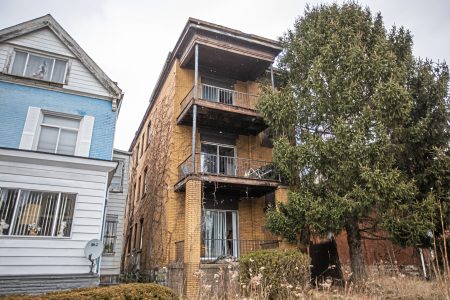
Year after year, the city acquired vacant properties in Homewood at treasurer's sales over unpaid taxes -- about $3.6 million -- but dozens of the homes remain eyesores and, in some cases, the target of code violations by the city's own inspectors.
The Pittsburgh Post-Gazette examined the records of 133 buildings owned by the city -- including houses and storefronts -- and found inspectors slapped violations on nearly 60% of them, including homes that were not only unfit for human habitation, but could place people in imminent danger.
In more than a dozen cases, inspectors imposed violations, only to return later and find the same problems.
While most property owners are threatened with fines as an incentive to fix violations, the city does not levy penalties on itself, avoiding charges that can run from $1 to $1,000 per day, depending on the infraction.
At one of the homes, the entire front porch collapsed into the front yard, a condemned sign attached to a pillar. On the same street where the city paid the settlement, a twisted security grate covers a shattered glass door of a building that has been abandoned for nearly a decade.
The troubling inspections come as community groups push one of the most ambitious plans in the neighborhood's history to promote green space, affordable housing and a business corridor to help an area that has undergone dramatic changes.
The once stable neighborhood of factory and steel workers went through a period of civil strife in the late 1960s following the assassination of Martin Luther King Jr., and while many businesses and residents stayed, the crack cocaine epidemic and gangs took a toll on the area, say community leaders. By the 2000s, the area was hit especially hard by blight.
For the past several years, 10 groups have pushed for a "cluster" approach to resuscitate the neighborhood -- parcel by parcel -- as money becomes available. The goal is to combat crime and stem the loss of businesses and people.
But the rows of empty, decaying homes and weedy, barren lots, including those owned by the city -- the largest landowner -- represent a major roadblock.
"Where is the oversight?" said Ayo Young, 43, a longtime resident and coach who works with students in after-school programs. "If you own the lots, own the properties, they're dilapidated, depleted, falling apart and you give yourself code violations, it's just one big mess. How do you untangle that?"
City officials say that taking care of hundreds of properties is a costly, complex process that takes time and must be carried out in phases because of the number of homes.
While the Post-Gazette found 833 properties that were taken over by the city in treasurer's sales -- including 700 vacant lots -- the city says it owns 1,124 properties in the neighborhood.
The goal is to turn over some of the houses and storefronts to a land bank now planned to be run by the Urban Redevelopment Authority, which is expected to be a key player in the new plan.
Ultimately, the objective is to pave the way for development and the potential for new homes, parks and stores.
But so far, most of the properties have not been turned over to public agencies or private investors since the city ramped up acquisitions a decade ago.
In fact, the city launched its own land bank in 2014 as a way to better manage the homes, but only one property has been moved into the program, the mayor's office said.
Mayor Bill Peduto said the city's settlement last year over the decrepit storefront -- $95,000 -- was an investment on North Homewood Avenue, one of the city's newly named "Avenues of Hope,'' in the mostly Black neighborhoods that community leaders have designated for redevelopment.
"The reason we invested that $95,000 was to be able to secure it to see if we can have success in delivering that for Homewood," Mr. Peduto said.
But that investment took place only after city code inspectors visited the structure three times since the city purchased it -- and ordered the city three times to fix the building, records show.
Then came the 2018 lawsuit from the next-door neighbor, who claimed the collapsed roof of the storefront had inflicted severe damage and income loss to her family's property.
Several residents and business owners interviewed by the Post-Gazette say the city should have taken better care of the buildings if it wanted to improve the area. Rats, squatters and rusted-out city vehicles have turned up on the properties, they said.
"They need to do something, and do something quick," said longtime resident Doris Keith-Clark, 65, who lives next to a city home condemned by its own inspectors.
Several urban planning experts interviewed by the Post-Gazette admitted the problem is overwhelming for cities, but they agreed that it does the city no good to acquire parcels and sit on them, letting them decay and rack up code violations.
"In this case, I would argue that the city is a slumlord that is consciously participating in the underdevelopment of the community," said Henry Louis Taylor Jr., a professor in the Department of Urban and Regional Planning and associate director of the Community Health Equity Research Institute at the University of Buffalo.
Mr. Taylor said the city should have reached out years ago to nonprofits that specialize in urban land trusts -- a way to prioritize the community's ideas and needs -- to help find ways to sell, raze and clean up blocks of neglected and dangerous homes as the city acquired them.
"They are responsible (for the properties) and have partial responsibility for all of the health and issues that flow out of those kinds of situations," he said.
For years, community groups have tried to slow the blight in Homewood, where shootings and drug dealing still occur in certain pockets.
In 1999, community leaders fanned out, conducting a door-to-door campaign to survey residents and create an ambitious plan to stem the bleeding and bring in new residents.
But since then, Homewood has shrunk even more, from 9,300 people to about 6,000, while business corridors such as North Homewood Avenue continued to empty out.
Ricky Burgess, a veteran city councilman from the district and the pastor of a church in the neighborhood, said the plan two decades ago fell short because of a lack of money to pay for the proposals.
"I was there. Our city was distressed," he recalled, referring to the city's financial crisis at the time.
In 2012, the city razed abandoned row houses known as the "Killing Fields" along Formosa Way, a haven for crime in the '90s. City officials even went to the trouble of serving an absentee landlord in Israel. Today, the city still owns the land -- vacant stretches unused.
In fact, much of the landscape in Homewood is lined with long stretches of forlorn lots.
Records show that of the 700 vacant lots owned by the city, about one in eight has been cited for code violations ranging from broken-down vehicles to properties overgrown with weeds and piled with trash.
Salik Farouk, owner of Salik Hardware, said that for the past five years, he's called Mr. Burgess' office and his state representative about the overgrown open space next to his shop that's littered with junked city dump trucks and piles of debris.
"This summer, the weeds were so bad that they covered the sidewalk. I went out and cut them myself," said Mr. Farouk, who's been running the family business on North Homewood Avenue since the 1980s, when he moved here from the Bronx.