
‘Particularly bad’: Rural Pennsylvanians talk opioids
Attorney General Josh Shapiro attends round table with local officials
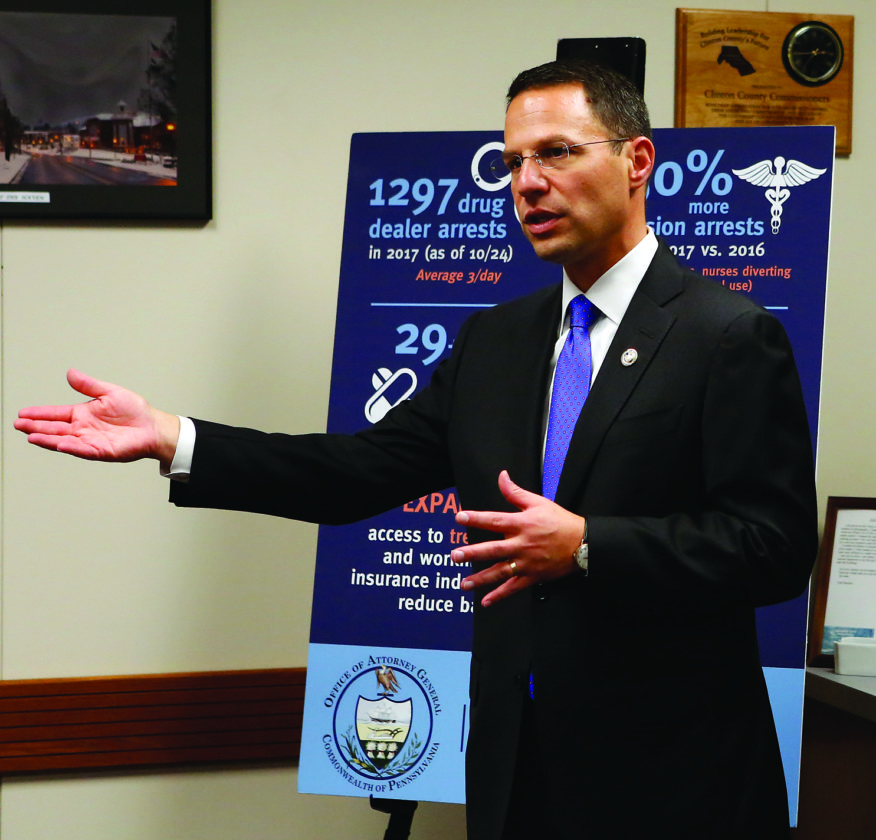
State Attorney General Josh Shapiro addresses a group of local officials about the opioid abuse crisis. SPENCER MCCOY/ THE EXPRESS
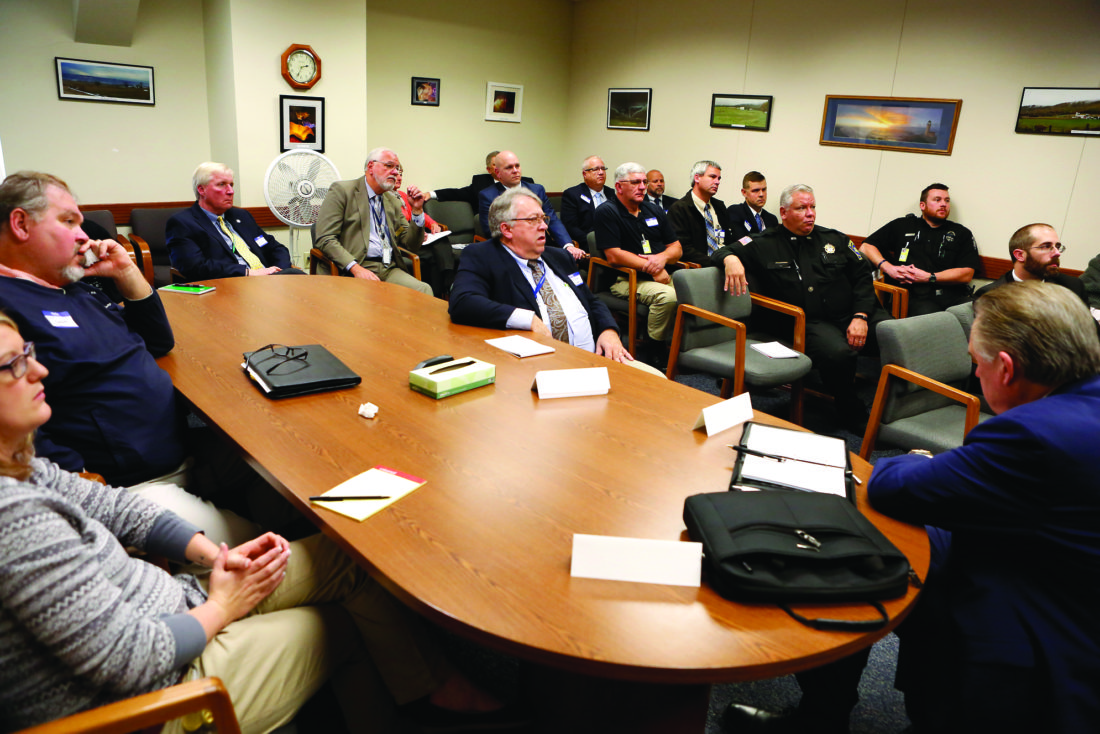
SPENCER McCOY/THE EXPRESS Local officials gather yesterday at the Clinton County Roundtable to address the opioid epidemic.
State Attorney General Josh Shapiro addresses a group of local officials about the opioid abuse crisis. SPENCER MCCOY/ THE EXPRESS
SPENCER McCOY/THE EXPRESS Local officials gather yesterday at the Clinton County Roundtable to address the opioid epidemic.
Trending
LOCK HAVEN -- "The issue is particularly bad in rural Pennsylvania," said Attorney General Josh Shapiro of the opioid crisis at a roundtable with local county officials Thursday.
Community members, county officials and law enforcement shared their concerns with Shapiro, ranging from analysis of drugs to treatment and prevention.
District Attorney David Strouse said the turnaround on laboratory tests of drugs collected by law enforcement can be an issue for small departments like the ones in Clinton County.
"It's hoped that the attorney general's office is going to help with the analysis of drugs," he said.
Agent in Charge Chief Bill Kelly said the office would be getting the word out "very shortly" about how they will be helping.
Commissioner Jeff Snyder brought up concerns about pharmaceutical companies profiting off the opioid crisis, citing a Washington Post and 60 Minutes report that demonstrated how legislation sponsored by Rep. Tom Marino, R-Pa., impeded the Drug Enforcement Agency in its fight against the opioid crisis.
"We're gonna hold them accountable," said Shapiro. "We are arresting doctors who are diverting this stuff."
He added that the office's goals were to change the drug behavior of people going forward and to "recover for the Commonwealth."
Shapiro said prescription drugs play a large role in drug abusers switching to heroin.
One of his top priorities, he said, is "getting rid of these drugs."
Last year, the state attorney general's office collected 26 tons of prescription drugs from deposit stations. So far this year, it has collected 33 tons.
"In rural, I mean really rural, parts of Pennsylvania, folks can't access these drop off boxes," Shapiro said.
To allow rural residents to dispose of their prescription drugs, the office distributed 300,000 drug deactivation bags. Shapiro said the bags neutralize the drugs safely and effectively, making them environmentally sound to throw away.
Professor Beth McMahon of Lock Haven University said that university students will be the future of how the opioid crisis is handled. She mentioned that the rates of people who abuse opioids will plateau in 10 years.
"Universities are critical in this," Shapiro said. "But I don't see signs in the next few years" that the rates will plateau.
A report issued by national healthcare and medical publication STAT in June predicted, in a middle-of-the-road scenario, that the death toll from the opioid crisis would rise 35 percent between now and 2027. Some predictions show the death toll reaching a plateau with adequate prevention measures.
Shapiro said there will be second generation opioid abusers resulting from the crisis, meaning college students "will be key" in education around and prevention of abuse.
"If we can get prescription drugs under control…we can turn this around," he said.
Dave Goodwin, a probation officer for the county treatment court, said he appreciated that treatment for opioid abuse was increasing, but that most of his clients can never afford a stay longer than 30 days. He asked if the attorney general's office could provide more funds for patients to be able to stay longer.
Shapiro said it was "extremely important" for the office to support treatment courts.
He added that his office was "working to get rid of the IMD exclusion," a 1960s federal law that states Medicaid can't reimburse people for treatment in facilities with more than 16 beds.
Getting rid of the exclusion "will open up a ton of beds, and Medicaid to pay for it," he said.
He already has the backing of the National Association of Attorney Generals and hopes President Trump's executive order that created a commission to combat the opioid crisis will help with the funding issue.
In addition to his lawsuit against pharmaceutical companies for their role in the opioid abuse crisis, Shapiro wants to support the work local drug task forces are doing.
"I think…doing away with the stigma of addiction, doing more when it comes to education and prevention" will change the culture surrounding opioid abuse, he said.
"It's not one thing," he said of the most effective tactic to end the crisis. "It's a combination of many."
His office has been making three and a half drug dealer arrests a day, has shut down "massive" pipelines of heroin and increased diversion arrests by 50 percent.
But, "you can't arrest your way out of this crisis," he said.
Treatment, education and prevention must be combined with harsh penalties for those distributing drugs, he said.
In Clinton County, Shapiro remarked that the many law enforcement officials who showed up to the roundtable had a more holistic view of how to combat the opioid crisis.
"They talked to me about treatment, they talked to me about health care, about mental health care," he said, admitting that it surprised him.
Also in the county, "I felt that people worked together," he said. "I didn't get the sense that people were divided (about the crisis)."
Shapiro visited Lycoming, Tioga and Clinton Counties Thursday before traveling to his last stop in Greene County.
Shapiro emphasized that he valued county input on combating the opioid crisis.
"It's less about me standing up and telling them stuff, and more about me listening," he said.