
‘You’re in the Footsteps’: Local resident reflects on trip to Normandy
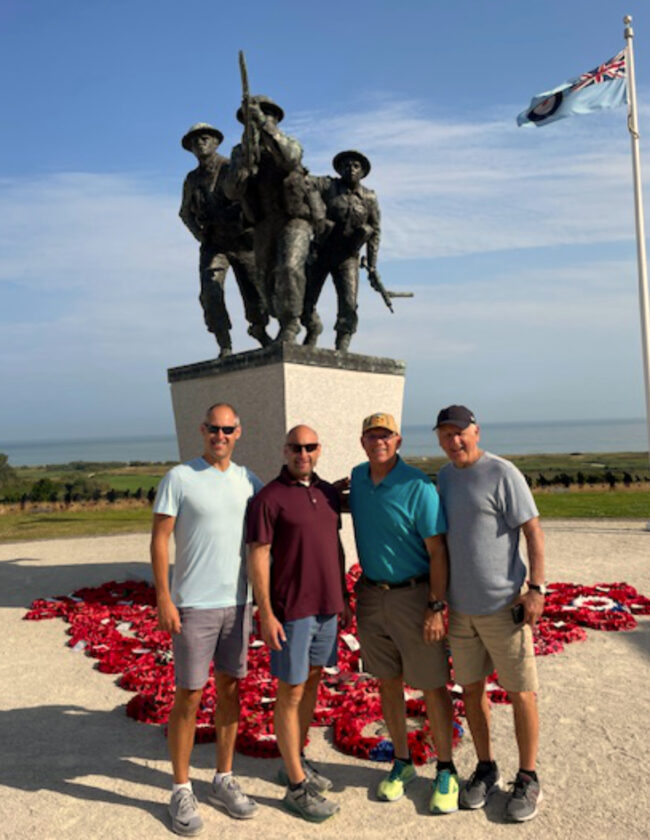
Pictured, from left, are Matt Rendos, Mike Rendos, George Elliot and Michael Rendos at the British Memorial at Gold Beach. PHOTO PROVIDED
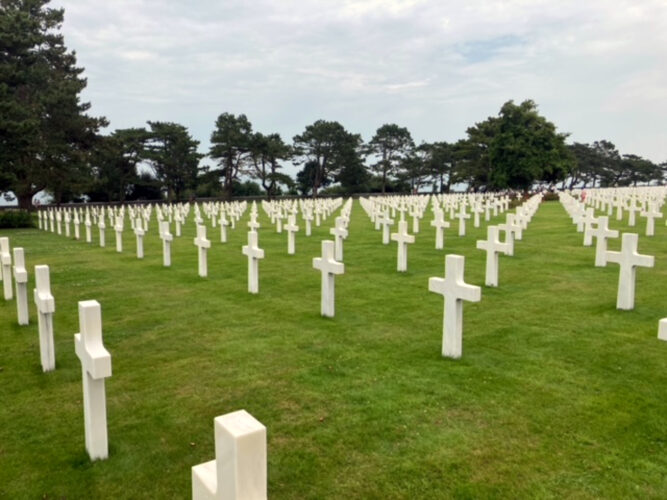
PHOTO PROVIDED
Pictured is the Normandy American Cemetery in France. The photo was taken during local resident, Michael Rendos’s, visit to the area.
(Editor’s Note: This is part two in a two-part series regarding a local columnist’s experience while visiting Normandy during a recent trip.)
NORMANDY — As a student of military history, especially World War II, I had longed to perhaps someday visit Normandy, the site of the D-Day invasion into Nazi-controlled Europe, the most detailed amphibious military operation in history.
That day finally came this past July when my sons Mike, Matt, brother-in-law George Elliot and I boarded an airplane at NYC’s Kennedy Airport bound for London, England, and then onto a ferry across the English Channel to France.
I would like to share some thoughts and reflections on my Normandy experience and the place it holds in American military history.
Normandy
Normandy is one of France’s 13 administrative districts, located in northwest France, hard on the English Channel. The name comes from the settlement of the area back in the 9th century by the Vikings (Northmen), hence the name Normandy.
Historically, Normandy has been noted for a varied coastline, melding into lush farmlands above white chalk cliffs. The farmlands above the cliffs are very similar to the ones seen in central Pennsylvania. For four years prior to the invasion, German troops had occupied France, and there was widespread French collaboration with the German occupiers.
In Normandy, however, there was stiff resistance to the German occupation, and the locals yearned for the day the German garrison would be driven out by the Allies.
The D-Day Beaches
Our tour guide for the Normandy invasion beaches was a retired British Colonel who served in the post-WWII British army, a fountain of knowledge on the history of the invasion.
In his military career he often taught young British officers about the strategies and logistics utilized by the Allies during the Normandy invasion. The code name for the Normandy invasion was Operation Overlord, with American General Dwight Eisenhower as the Supreme Allied commander and British General Bernard Montgomery as the commander of all land forces in the operation.
The Allied plan was to strike at five separate beaches along the Normandy coast. Interestingly, the actual code names assigned to each beach landing zone were randomly chosen from a military code book used in British military operations.
The five beach landing zones were Utah and Omaha (American troops), Sword and Gold (British troops) and Juno (Canadian troops). These five beaches were the drop off points for the largest seaborne invasion in history, and the beginning of the liberation of Western Europe from the clutches of Nazi tyranny.
D-Day
Taking weather and water conditions into account, General Eisenhower gave the order to invade at daybreak on June 6, 1944. Eisenhower and his staff expected stiff resistance at all five beach landing zones and realized the outcome would very well hang in the balance between each side. In fact, at the Normandy Museum there are copies of two letters that Eisenhower had written, pending the outcome of the operation. The first letter commended and gave all the credit to the men for securing such a victory. The second letter regretted that he had underestimated the strength of the enemy and he took all the responsibility for the failure of the invasion. Eisenhower’s leadership and decision making was critical on D-Day.
Omaha Beach
While we visited all five beaches, Omaha was the most striking.
Omaha was heavily defended by German troops and casualties were higher there than any other beach. No less than 26 waves of American troops, spaced at intervals, arrived at Omaha.
Our British guide reported that the initial waves of troops experienced a 90% casualty rate, meaning that if the boat carrying the troops held 40 men, 38 went down before they reached the beach.
Army sergeant Ted Lombarski noted that, “Omaha Beach was a wall of unimaginable enemy fire, with bullets and shrapnel making the ocean appear to be boiling.”
Being in the first wave was entering the confines of hell with all accompanying noise, violence and sheer terror. At Omaha, there is a monument at the water’s edge where the Army medics set up the first station to treat the massive amount of casualties.
Army medics and Navy corpsmen worked side by side at water’s edge courageously dealing with the carnage, while chaplains and Rabbis aided the dying.
Aftermath
Whether by parachute, glider or water assault craft, 160,000 Allied troops landed in Normandy on D-Day. Factually, two out of every three soldiers who landed on D-Day would be either British or Canadian.
However, in the days following D-Day the balance would begin to shift to the Americans, since almost 2 million American troops were stationed in southern England, and American forces would soon outnumber the British and Canadians as the invasion moved inland.
By nightfall, 10,300 Allied soldiers were killed, wounded or missing, 2,400 of whom landed at Omaha. The Normandy Museum has a gallery of individuals who rose to the challenge and exhibited incredible courage under fire that day.
Some examples are Waverly Woodson, a 21-year old African American medic from America’s Deep South, who was hit by shrapnel before he was even off the landing craft. Struggling to the Omaha seawall under intense enemy fire, Woodson spent the next 30 hours treating over 200 wounded men, all while enemy small arms and artillery fire pummeled the beach. Eventually, he collapsed from his own injury and blood loss and was evacuated back to England.
General Theodore Roosevelt Jr., son of former president Theodore Roosevelt, at age 56 was the oldest person and one of the highest ranking officers to come ashore on D-Day. He was also the only father to serve with his son on D-Day. His son, Captain Quentin Roosevelt went ashore at Omaha. General Roosevelt had been stationed in North Africa, but desperately wanted to be part of the Normandy campaign and petitioned the Army for reassignment.
Roosevelt landed at Utah Beach and found troops a mile away from the intended landing position. Using seasoned leadership principles, he was able to rally the men from the beach, over the seawall and move inland.
A month later, Roosevelt died of a heart attack during the inland push across France. He posthumously received the Medal of Honor for his leadership on Utah and was buried in Normandy next to his brother who had been killed in World War I.
Major General Norman “Dutch” Cota, one of the highest ranking officers on the beach that day, was part of the second wave to arrive on Omaha and personally rallied shell-shocked, pinned down soldiers. With a cigar clenched in his mouth, a .38 revolver in one hand and a walking stick in the other, Cota went up and down the line urging the men forward to the seawall, at one time shouting, “Men, we are being killed on this damn beach, if we have to die let it be inland.”
On Juno, a unit of Canadian troops came off of the landing craft, bagpipes playing “My Bonnie Lassie (I Hear the Bagpipes Coming).” The officer in charge of the Canadians went to the beach master and announced, “Sir, my men are hungry for a fight. Can you direct us to one? Told to move inland, where he will find the enemy, the Canadian officer turned to his men and said, “Follow me, lads, we have work to do.” Off they went, playing the bagpipes inland.
These are a few examples of thousands of Allied soldiers who stepped up at Normandy and moved forward on very difficult circumstances on D-Day. Most survived, but many good young men spent their final day on earth on a Normandy beach. And so it was that the 24-hour span of D-Day, while at a great cost of lives, gave the Allies a foothold on the European continent.
Even so, it took another eleven months of Allied advance toward the heart of Germany before the War in Europe ended on May 8, 1945.
WWII Cemeteries
at Normandy
Including D-Day and the ensuing march inland, almost 130,000 soldiers, both Allied and German, lost their lives during the 3-month long Normandy campaign. The remains of many fallen soldiers were claimed by their families and returned to their native lands.
Others were buried in Normandy, the land where they fell, in one of military cemeteries, each designated by a specific nationality or country. My sons and I visited three of those cemeteries:
The American Cemetery, which overlooks Omaha Beach at Colville sur Mer is one of the world’s best known cemeteries.
The hallowed grounds preserve the remains of nearly 9,400 Americans who died during the Normandy campaign, including three Medal of Honor recipients and 45 sets of brothers who lie side by side. The perfectly aligned rows of snow-white crosses and Stars of David, the perfectly manicured green lawns and the blue sea below invite visitors to contemplation and reflection on the sacrifice made by those resting here.
If I could describe the American Cemetery in one word, the word would be solemn.
The British Military Cemetery of Bayeux is located on the bluff above Omaha Beach and contains 4,848 graves of British soldiers killed during the Second World War.
A stark figure of this resting place is an area which holds 338 unidentified Brits whose remains were never found or identified. Each marker on these unidentified graves has the name of the missing soldier along with an inscription from his family. I read one that simply said, “The song has ended, but the memory lingers on.”
The German Cemetery at La Cambe is situated inland from the beaches. In all, 80,000 German soldiers are buried in Normandy, 22,000 of them at La Cambe, the largest German military cemetery in France. The names of the interred German soldiers buried at La Cambe are engraved on dark stones laid flat on the ground. At the head of the cemetery is a large mound, the mass grave site of 207 unknown German soldiers who died on D-Day. The cemetery is surrounded by 1,200 maple trees symbolizing reconciliation between countries and peoples.
Closing thoughts
Visiting the Normandy area with my sons was truly an overwhelming and unforgettable experience. Making the trip even more memorable was a personal connection that surprisingly occurred.
While driving inland off Omaha Beach, the guide pointed out a small stone memorial that recognized the crash site of an Army airplane that had been carrying 28 American paratroopers behind enemy lines on Utah Beach during the early morning hours of D-Day. Downed by enemy flack, only two paratroopers survived the crash.
As my son, Mike, was reading the list of the deceased on the memorial, he said, “Dad, you need to see one of the names.” One of the pilots killed in the crash was Lt. Joseph Kowalski, hometown Johnsonburg, Pa. My wife’s hometown is also Johnsonburg, and Lt. Kowalski was brought back home and his funeral was in the same Elk County church where my wife and I were married.
After checking with some friends in Johnsonburg, I was able to connect with Lt. Kowalski’s nephew who lives in Montreal, Canada. The nephew related that Lt. Kowalski had a brother who was also at Normandy, landing at Utah Beach. The brother survived and moved inland as the Allies advanced. The nephew also told me that, per capita, Johnsonburg had the highest percentage of young men serving in World War II than any other community in Pennsylvania. Quite a tribute to that small, paper mill town located along the headwaters of the Clarion River.
Conclusion
Flying home, high above the north Atlantic, I thought about the incredible destruction and loss of life back on June 6, 1944. Young men, many of them only a year or so out of high school, willingly walked into a gauntlet of fury and fire in an effort to rid Europe of the fanatical Nazi regime which was murdering thousands and thousands of civilians in Hitler’s quest to Germanize all of Europe. Allied troops were stepping up to help people they didn’t even know. In the end, evil was defeated, but at a very heavy cost. The young men who stormed the beaches of Normandy must never be forgotten, never!
Local news

A judge rules against a PA man’s deportation whose ‘80s murder conviction was dismissed
DEP provides update on oily sheen report on West Branch near Clearfield

Redmon hired as super in Wisconsin
Trump uses Iran war address to ask electorate for more time
WASHINGTON (AP) — President Donald Trump used his first major address since launching his war in Iran to assure ...
Lock Haven native serves in leadership role during West Point parent weekend
Game Commission: Pa. hunters harvested more deer in latest season
Pennsylvania hunters harvested about six percent more deer in the 2025-26 hunting seasons than they did the year ...