Friends become foes at Gettysburg
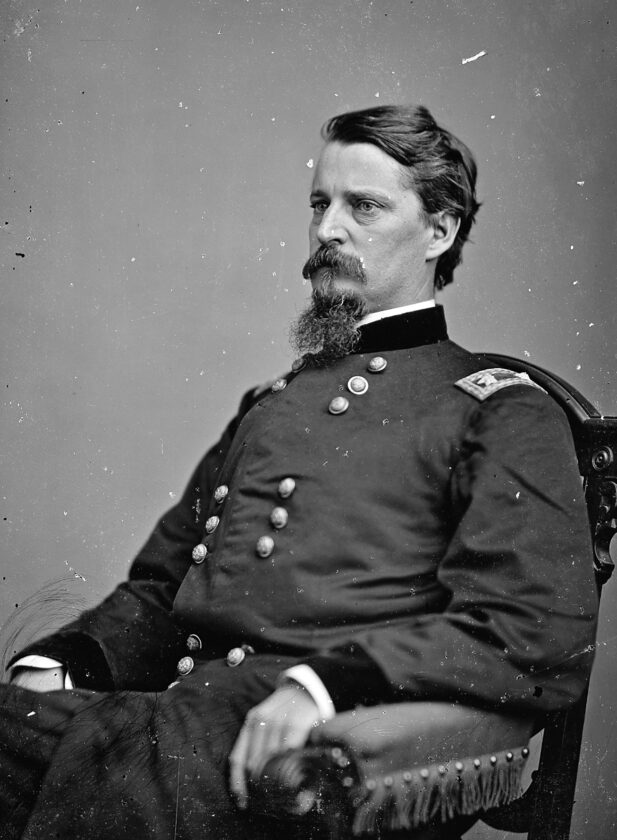
PUBLIC DOMAIN IMAGE Winfield Scott Hancock is pictured.
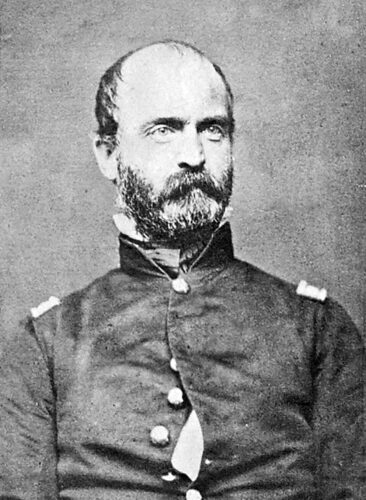
PUBLIC DOMAIN IMAGE
Lewis Armistead is pictured.
Memorial Day is a time set aside to honor and remember the long line of Americans who served in the country’s armed services, defending the freedoms we so richly cherish. As one might expect, American military history abounds with heart-grabbing stories relative to those who engaged on the fields of battle. One particular stirring Civil War tale was chronicled both by author Michael Shaara in his top-selling novel, “The Killer Angels,” and in an essay, “These Generals Were the Closest of Enemies,” penned by Peggy Noonan, former presidential speechwriter and Pulitzer Prize winner. It is a story worth repeating and remembering.
The principals of the story are Virginia-born Lewis “Lo” Armistead and Pennsylvanian Winfield Scott Hancock. They had a lot in common, both had attended West Point, became very close friends when they were based together in California and served together in the Mexican War, both cited for gallantry under fire and promoted to higher ranks. In the eyes of others, Armistead and Hancock were courageous, honest and highly respected. The 17-year friendship between the two bonded them closer than brothers, and there is nothing one wouldn’t do for the other. In the early 1850s Armistead tragically lost both his wife and young daughter, and he leaned heavily on Hancock to persevere through a very difficult and trying period of his life.
When the storm clouds of secession broke out into the Civil War in 1861, officers of the Army had to decide where they stood on the conflict. Hancock stood firm with the Union, while Armistead could not turn his back on his love and loyalty to the Confederacy’s Virginia. Shaara suggests in his novel that, “The war had come as a nightmare to the relationship between Hancock and Armistead, and each had to choose their nightmare side.” In their farewell, both Hancock and Armistead shed tears, Armistead saying, “Goodbye, Win, you can never know what this has cost me.” It was the last time they would see each other. Soon after the final meeting between the two, Armistead sent Hancock’s wife a package to be opened in the event of Armistead’s death in the war.
At the outset of the war, Hancock was appointed brigadier general of the Union’s II Corps of the Army of the Potomac. Armistead was selected brigadier general in the Confederate Army of Northern Virginia.
During the first two years of the war Hancock and Armistead were miles apart in the various skirmishes and battles that occurred. In fact, Armistead, a very religious man, prayed daily that he would never have to face Hancock on a battlefield.
That all changed at Gettysburg in early July, 1863, as General Robert E. Lee’s 70,000-man Army of Northern Virginia quietly slipped across the Potomac River and invaded the North, General Armistead in command of one of the southern brigades. Meanwhile, at Gettysburg, newly appointed northern Army of the Potomac commander, General George Meade, selected General Hancock to be a Corps commander at Cemetery Hill, a pivotal point of the Union’s defense of Gettysburg.
July 3 was the day of reckoning at Gettysburg, the stakes high for both sides. Should the Union Army repel the expected Confederate attack at Cemetery Hill, the will of the South to continue the war would be severely weakened. Should the Confederate Army break the Union line atop the hill and drive the Federals out of Gettysburg, there would likely be sentiment in the North for peace terms to end the war.
Lee’s strategy that day was to have General George Pickett’s 15,000-man Division charge up the mile long hill into the middle of the Union defense and rout the Federals. Interestingly, Lee’s top advisor, General James Longstreet, opposed such a maneuver. Longstreet was a brilliant strategist and firmly held to the centuries-old military axiom that, “He who holds the high ground controls the battle.”
Longstreet believed that a frontal assault, uphill, over open ground, with incoming artillery would be a disaster for the Confederate army. Lee replied to Longstreet, “I believe the Federals will break under pressure. In any case, we have no alternative.”
In what has gone in history as “Pickett’s Charge,” Pickett’s division, with Armistead leading the Virginia brigade, stepped out of the tree line at the bottom of the hill at 2 p.m. on a sweltering hot afternoon.
Armistead knew that Hancock’s Second Corps was waiting behind a stone wall at the top of the hill. In perfect marching order, the gray clad Confederates started the assault, walking over streams, hay fields and fence rows. Armistead was at the head of his Virginia brigade and shouted encouragement, “Virginians, keep a tight formation, look straight ahead, hold your weapons tightly.” Union infantrymen waited behind the wall, readying for the Confederate approach. Hancock was along that wall and knew that Armistead was on the way up the hill.
When Armistead and his men reached the 700 yard mark from the wall, the Union artillery was unleashed. Cannon balls and red-hot steel shrapnel rained upon the approaching Confederates, causing confusion and fear, and disrupting the Virginia line. Armistead saw unrelenting explosions, fire and terror in the faces of his men. As the Division neared the wall they faced massive Union rifle fire. Realizing the charge was rapidly losing traction and in disarray, he took off his field hat, stuck it on his battle sword and raised it high, urging the Virginians to follow him to the stone wall.
Armistead was the first to reach the wall and as he climbed over he was hit three times by Union fire and slumped to the ground. A Union officer came over to Armistead saying, “Sir, you are seriously injured, allow me to get you medical help.” Armistead replied, “No, I must remain with my men, but can you tell me anything about General Hancock?” The officer replied, “Sir, I am sorry to tell you that General Hancock was hit and fell about an hour ago and I have no news on his condition.” Armistead replied, “Oh no, not both of us, dear God. Will you please tell General Hancock that General Armistead sends his regrets and how very sorry I am.”
Armistead died two days later in a Union field hospital tent. Hancock survived his wounds and the war, but carried pain from the wounds for the rest of his life. The Confederate Army would never recover after losing nearly 7,000 men during Pickett’s Charge.
A month or so later, Hancock’s wife received the package that Armistead had sent, to be opened should he not survive the war. Upon opening the package, Mrs. Hancock found Armistead’s well-worn personal Bible. A note inside simply read, “Win, This Bible is very close to my heart, as you have been in my life. There is no one in the world I would rather have it than you. This conflict has cost me so much.” Your friend, Lo.
Stories such as this help to form the fabric of American life, and we should never forget the sacrifices made by those before us. America has a long and vast history, and part of that history is that in the Civil War Americans were fighting each other, even good friends.
Memorial Day is a time to remember them all.
Michael Rendos is a retired public school educator, sports enthusiast and historian whose columns appear in The Express.
Local news
The ever-constant evolution of Pennsylvania’s Right-to-Know law
Divided local lawmakers speak up as university funding hangs in the balance
US deploys thousands more troops to Middle East
TSA workers quitting instead of working without pay
Clinton County Camp Cadet now accepting applications for 2026