Divided local lawmakers speak up as university funding hangs in the balance
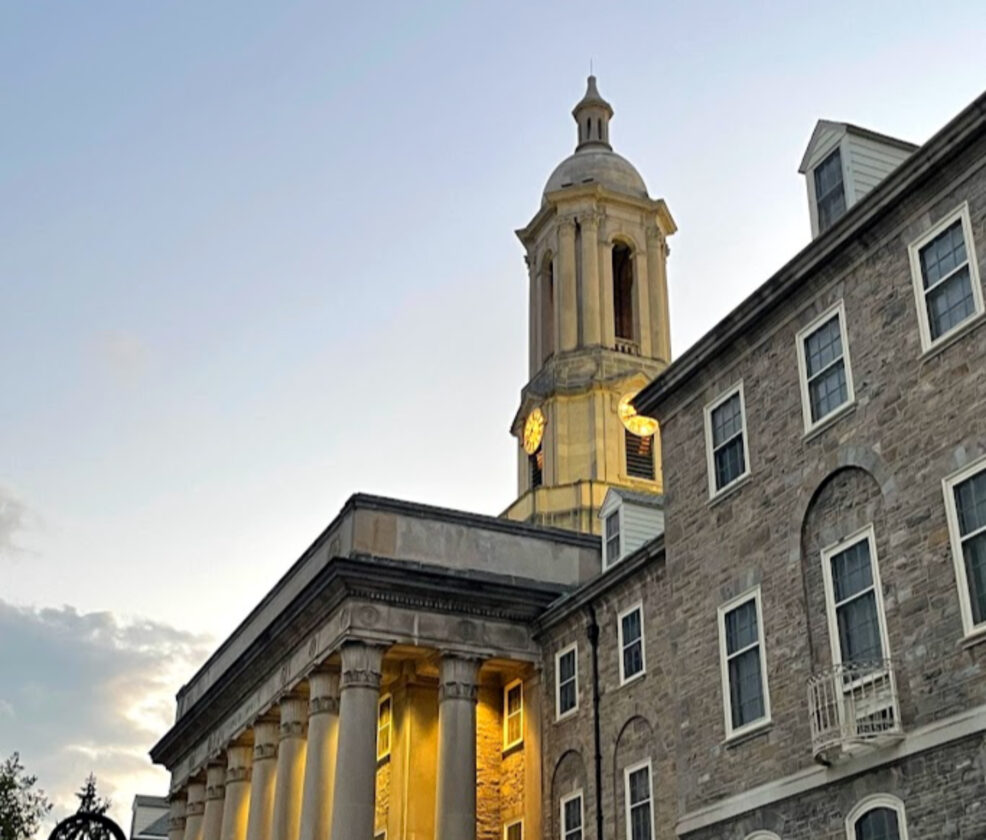
HUNTER SMITH/THE EXPRESS Old Main is pictured on the Penn State Campus.
STATE COLLEGE — When Penn State President Neeli Bendapudi testified before state legislators in Harrisburg earlier this month, she called for increased investment in public universities and their in-state students.
But despite the university’s more than $15.8 billion annual contribution to Pennsylvania’s economy, lawmakers remain divided over funding for it and other higher education institutions.
To understand why, The Express spoke with local legislators. Supporters pointed to the school’s economic and scientific impact, while opponents cited transparency concerns.
Framing that debate is the university’s argument that state support directly affects affordability for Pennsylvania students.
According to Jimi Werner, an advocacy specialist for Penn State’s office of Government and Community Relations, the state’s investment in Penn State and other state-related universities helps save residents thousands of dollars a year.
At Penn State, the state government’s investment amounts to an average of $5,700 per-student, which Werner said “Penn State more than doubles to save over 41,000 Pennsylvania residents an average of $16,000 annually in tuition.”
“While Penn State is grateful for the state’s support, we also must point out that Penn State is last in state funding on a per-student basis compared to our peers,” Werner added.
By comparison, schools in the Pennsylvania State System of Higher Education (PASSHE) received $9,526 per in-state student, while Temple University and University of Pittsburgh received $10,505 and $9,538, respectively.
In raw dollars, Penn State’s general support appropriation was larger in 2000, at $242.9 million, than it is today, at $242.1 million. Had funding kept pace with inflation over the past quarter century, Penn State’s general support appropriation would exceed $450 million.
Some legislators, including Centre County Rep. Paul Takac (D-82), said their goal is to reverse decades of stagnant education funding so more Pennsylvanians can access the state’s world-class institutions.
“Across the board, from PASSHE schools to non-preferred universities, to community colleges and career and technical education programs, state funding still falls short of what is needed, but we are now moving in the right direction,” Takac said. “My priority is expanding access to affordable, high-quality education while ensuring taxpayer dollars are used to deliver results.”
He pointed to the state’s new performance-based funding model, which evaluates state-related universities on benchmarks tied to student outcomes, access and workforce development. Both he and Bendapudi have expressed support for the approach as a way to align funding with results.
“I have long supported Pennsylvania’s implementation of a performance-based funding model for public higher education… This forward momentum is encouraging, but additional legislative action is needed to bring the model to life,” President Bendapudi said earlier this month. “If approved, performance-based funding would tie future funding increases to outcomes we have long prioritized and delivered on — strong student outcomes, expanded access, workforce preparation and meaningful community impact.”
Takac, who voted in favor of funding Penn State in the 2025-26 state budget, said he will continue working with Governor Josh Shapiro and colleagues from both parties to secure funding that reflects higher education’s role in economic development.
Other lawmakers supported funding but framed it around the university’s broader value.
Rep. Kerry Benninghoff (R-171), pointed to Penn State’s economic footprint and scientific contributions as key reasons for continued investment, while also arguing institutions must be allowed to adapt to changing market conditions without political backlash.
“They are obviously an economic driver here in our community as well as the Commonwealth,” Benninghoff said, noting many of his constituents both work at and attend the university. “We also rely on them to help us take care of some significant scientific issues.”
He pointed to research at Penn State on agricultural challenges such as honeybee population decline and crop resilience, as well as energy development and medical innovation in cancer research through Penn State Health’s Milton S. Hershey Medical Center.
At the same time, Benninghoff said universities face conflicting pressures from lawmakers.
“I think over the years, the legislature has tried to push these institutions to be more frugal, but then when they make efforts to downsize and try to cut their costs, they get criticized,” he said. “We can’t ask institutions to reduce their costs and make fiduciary decisions and then penalize them or threaten their funding when they do that.”
He added that higher education is undergoing a broader shift, as declining enrollment, online learning and trade alternatives reshape the demand, and that hard decisions, like closing campuses, is key to their long-term success.
“The market is completely different than it was 20 years ago,” Benninghoff said, arguing institutions must be allowed to “retool” themselves to remain viable.
“Our members need to look at the totality,” Benninghoff said. “It’s easy to find one thing you don’t like about them or don’t agree with, but where would our Commonwealth be without these institutions?”
That tension — between investment and cost control — was echoed more sharply by Sen. Cris Dush (R-25).
Dush said he supports recent changes at Penn State under President Bendapudi, particularly efforts to scale back programs and address long-term financial pressures.
“President Bendapudi has done a remarkable job since she arrived there in right-sizing programs,” Dush said, acknowledging the pushback her decisions, including closing seven of Penn State’s branch campuses, have drawn.
“Trust me, it’s been painful,” he said.
He argued the certain programs were not aligned with workforce needs and said low-enrollment majors with large faculty commitments were unsustainable.
“Fiscally, with the declining demographics that we have as far as students coming in, it’s not just affecting Penn State, it’s affecting all of our state-related universities,” Dush said. “Decisions have to be made that probably should have been made 15-20 years ago, but she’s made those hard decisions, and as a result, she’s been able to do pretty well.”
Dush said those changes reflect broader budget realities, adding that institutions must be allowed to control costs as the state faces financial constraints.
He expressed similar concerns about the Pennsylvania State System of Higher Education, citing high personnel costs and the need for further cost-cutting.
“They’ve got some tough decision to make,” Dush said, adding the system must look at offloading unprofitable properties like the president’s house at Commonwealth University-Lock Haven and the theatre at CU-Mansfield.
“Those things are costing money to the system and not benefiting it,” he said.
Clinton County Rep. Stepahanie Borowicz (R-76), was among 52 House members who opposed funding Penn State in November. She and Lycoming County Rep. Joe Hamm (R-84), were the only representatives in The Express’s coverage area to oppose funding the university.
“I believe, like many of my colleagues, that more transparency is needed regarding Penn State’s use of taxpayer dollars,” Borowicz said.
When asked to elaborate further, The Express received no reply. Likewise, Rep. Hamm did not respond to requests for comment as of press time Friday.
Local news
The ever-constant evolution of Pennsylvania’s Right-to-Know law
Divided local lawmakers speak up as university funding hangs in the balance
US deploys thousands more troops to Middle East
TSA workers quitting instead of working without pay

Clinton County Camp Cadet now accepting applications for 2026