
Commissioners to consider update to hotel tax ordinance
Solicitor: Update corrects ‘typo’ made in previous ordinance and designates CCEP as recipient instead of TPA
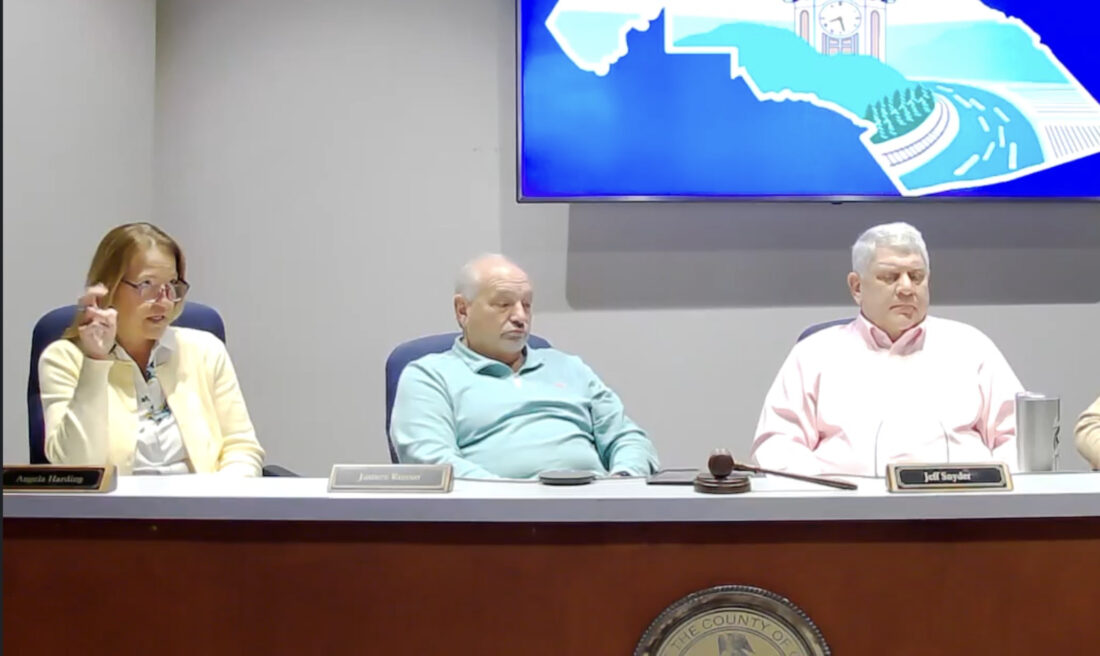
PHOTO PROVIDED Clinton County Commissioner Angela Harding, far left, gestures as she asks for clarification regarding the reason behind a proposed update to the county's ordinance regarding the Hotel Tax Funding distribution while Chair Jim Russo, center, and Commissioner Jeff Snyder, right, listen. The board will consider an update for the ordinance which would designate the Clinton County Economic Partnership as recipient of Hotel Tax Funding.
LOCK HAVEN — The Clinton County Commissioners will consider an update to its ordinance regarding the distribution of Hotel Tax Funding, which its solicitor said corrects a “typo” made in the previous ordinance in 2022.
During its work session this week, the board heard from Solicitor Justin Houser regarding the changes being proposed to this ordinance.
Houser said three changes were made, particularly designating the Clinton County Economic Partnership as the recipient of Hotel Tax Funding. The county’s ordinance updates in 2022 and in 2016 designated the Tourism Promotion Agency as the recipient of these funds.
During both instances, the ordinance was updated due to a change in either the percentage collected for the tax or enforcement of the tax.
A 2016 article that ran in The Express regarding the ordinance change stated the commissioners at the time held “several discussions with members of the Tourist Promotion Agency and Clinton County Tourism/Chamber Director.”
It further noted “the approval arrived after the TPA offered concrete and positive long-term plans on how the money will be used to draw people to this region” and that the “tourism/chamber director works under the umbrella” of the CCEP.
The 2022 ordinance was updated to ensure Hotel Tax revenue was collected in a timely manner.
According to Houser, the partnership was designated as the county’s tourism promotion agency in 1995, prior to the creation of the Hotel Tax, Act 18.
At the time, this was to align with the Tourist Promotion Law of 1961.
He said in 1978, a Tourist Promotion Agency was created to collect funds from that law and later in 1995, the partnership was designated as the TPA under the law.
“Then the Hotel Tax Law was first placed in the early 2000s and it sort of grandfathered in and said if you have a recognized Tourist Promotion Agency that agency continues,” he said.
Houser said the ordinance was restating the CCEP as the recipient due to recent confusion around who is considered the Tourism Promotion Agency.
This comes after an audit conducted this year by the Clinton County Auditors flagged the distribution of Hotel Tax funds to the partnership as going against policy it followed in previous years.
Houser contends, based on his research, the partnership has been the TPA since 1995 and that to change it, another ordinance would need to be passed with a majority approval from municipalities within the county.
Commissioner Angela Harding asked for clarification on Houser’s statement.
“In 2022, not under the purview of you being our solicitor, the county passed an ordinance and within it the Tourism Promotion Agency was the rightful recipient of the Hotel Tax. It’s my understanding that one of the reasons we are putting this ordinance in place is because, at the time, that was a ‘typo’ and therefore the TPA should not have been listed,” she said.
Houser, who was not the county solicitor in 2022 or 2016 when ordinances were passed, said that was his understanding.
“For it to be the official TPA for the county, it would have to have been — because the economic partnership was approved in 1995 — disestablished through an ordinance by this county, as well as by ordinances by a number of municipalities representing 65 percent of the population,” Houser said. “That never happened.”
Other updates to the ordinance included allowing the county to designate days for hotels and rentals to submit their tax monthly and reiterating what the Hotel Tax may be used for.
Houser said the previous ordinance designated the 15th of each month as the collection date for the tax, but noted that doesn’t work for every business.
“They still have to pay their tax and report it, but we can be a little flexible as to the date in the month when they pay so it matches with their fiscal schedule,” he said.
As for the Hotel Tax funding designation, Houser said it more closely follows and clarifies what the funding may be used for based on Act 18.
Act 18, established by the Commonwealth, lays out guidelines which tourism agencies must follow to receive Hotel Tax funding.
According to Act 18, revenues from the special fund — which is collected by the county and distributed to the TPA — must be used by the county’s recognized promotion agency and can only be used for the following purposes:
— Marketing the area served by the agency as a leisure travel destination.
— Marketing the area served by the agency as a business, convention or meeting travel destination.
— Using all appropriate marketing tools to accomplish these purposes, including, but not limited to, advertising, publicity, publications, direct marketing, sales, technology and participation in industry trade shows that attract tourists or travelers to the area served by the agency.
— Programs, expenditures or grants that are directly and substantially related to tourism or a business, convention or meeting travel destination within the county, augment and do not compete with private sector tourism or travel efforts and improve and expand the county as a destination market as deemed necessary by the recognized tourist promotion agency. The following shall apply to grants awarded under this paragraph: Grants require a cash or in-kind local match of at least 25 percent; Grants may not be used for signage that promotes a specific private entity on the situs of that entity, except where the signage also carries the logo of a recognized tourist promotion agency.
— Any other tourism or travel marketing or promotion program, expenditure or project that does not compete with private sector tourism or travel efforts as deemed necessary by the recognized tourist promotion agency.
The board will consider updates to this ordinance at its voting session Thursday, Dec. 18 at 10 a.m. The meeting is held on the second floor meeting room of the Piper Government Building and is streamed live on the county’s Facebook page.
Local news

Former skill game executive pleads guilty to money laundering and tax fraud

Vote on Bucktail’s Hynerpeton delayed
KC board postpones interviews for Region 9 candidates to Feb. 12

Who owns Pa.’s digitized history? We’re a step closer to an answer
Bellefonte Boro to hold e-bike training sessions
BELLEFONTE — The rules governing e-bikes and similar devices in Pennsylvania can be hard to untangle. To help ...
Keystone board accepting applications for Region 8 opening; due Feb. 20
MILL HALL — Filling vacancies continued to be a topic of discussion at the Keystone Central School District Board ...