Right-to-Know in PA during the age of AI
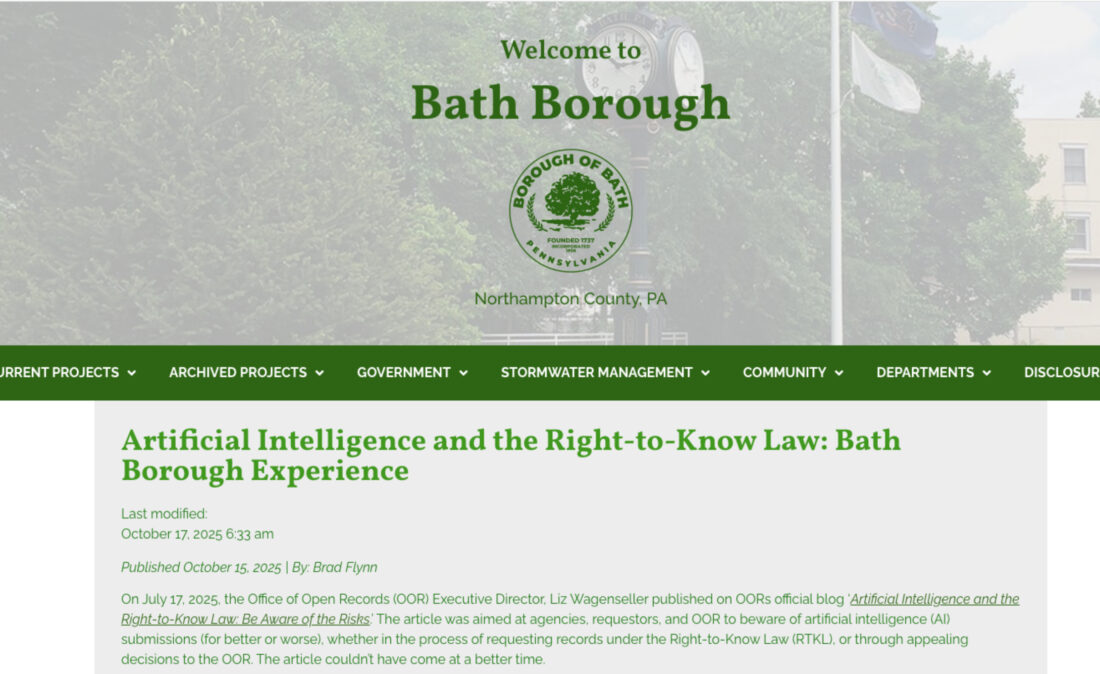
Screenshot of Bath’s website The borough of Bath, north of Allentown in Northampton County, has chronicled its unique experience with one resident’s use of AI in the Right-to-Know process.
The proliferation of generative artificial intelligence has upended the state’s public access process, either burdening governments with voluminous filings or increasing transparency for individuals with no legal training.
In the coming weeks, state Senate Bill 431 could become a vehicle for reforming the commonwealth’s Right-to-Know law, tamping down on AI’s “malicious use.”
Sponsoring Sen. Tracy Pennycuick (R-Montgomery) said inspiration came from local reports of Right-to-Know requests for basic information that could be found elsewhere, such as building addresses and hours of operation.
“The intent, I think, is to bog down the municipalities,” said Pennycuick. “They’re obviously AI generated, and they are more of a malicious nuisance versus an actual Right-to-Know request.”
Processing them, even if they don’t appear to be genuine, takes time and effort from municipalities. But the widespread use of AI appears to be more anecdotal than systematic, according to Kyle Kopko, the executive director of the County Commissioners Association of Pennsylvania.
“This is something that counties are at least concerned about … County commissioners want to be transparent; they want to have good government,” said Kopko. “At the same time, they don’t have time to deal with multiple or frivolous Right-to-Know requests.”
But the state agency tasked with handling appeals had a different story.
“We have a huge spike in the number of appeals and we have an increase in people submitting pages and pages of defense, which is often full of hallucinations and other inaccuracies,” said Liz Wagenseller, the executive director of the Pennsylvania Office of Open Records.
“Our concern is that this is just the beginning of this phenomenon and this could continue to increase at the rate exponentially,” she continued. “At some point, it’s just unsustainable. Our attorneys have to eat and sleep.”
Pennycuick’s bill currently focuses on records requests and not appeals, allowing entities to reject if they have “reasonable suspicion that the request was automatically generated by a computer program, script, artificial intelligence or generative artificial intelligence.”
But Wagenseller, whose agency is collaborating on the proposal, said a future amendment could include the appeals process as well. The bill advanced out of committee in October, but hasn’t yet been considered by the full Senate.
Borough of Bath case study
But one filer in Northampton County says the technology has reduced barriers and is “the only realistic option available.”
Local media have covered Michael Long’s records dispute with the borough of Bath and its now-resolved court appeals. But his use of AI to submit numerous legal filings has gotten less attention.
“(In 2022,) I had no legal training. I had no legal budget. What I had was a phone, the Right-to-Know law and a growing suspicion that something was seriously wrong with how the borough was managing public money,” Long told the Capital-Star, who estimated he spent $300 a month on AI subscriptions.
Bath Borough Manager Brad Flynn has repeatedly documented the municipality’s experience with AI in the Right-to-Know process with Long, calling it “a wake-up call.”
Upwards of $200,000 has been spent on the borough’s legal costs battling Long over three-plus years, Flynn estimates, in an entity with an annual budget of $1.5 million.
Flynn told the Capital-Star that he uses generative AI regularly, but drew the line when it came to legal filings — calling Long’s use “for the wrong reasons.”
“To use it for ill will and get into court challenges … that’s a problem,” Flynn said.
Following Long’s prolific filing period in late 2024 against the borough, Common Pleas Judge Abraham P. Kassis imposed a $1,000 sanction on Long at the borough’s request. The ruling was based on “frivolous, vexatious and bad faith filing” of motions, “which were unsupported by legal authority, irrelevant and exceeded the scope of the sole issue still pending in the unnecessarily protracted litigation between the parties.”
Long didn’t immediately respond to a follow-up question about the sanction on Friday.
Pennsylvania’s public access process
In Pennsylvania, agencies or local governments must respond within five days of a request under the presumption that government records are public — unless proven otherwise. The 2008 law establishing this premise also created the Office of Open Records, which processes appeals at no cost.
OOR has 30 calendar days to respond (unless the requester agrees to an extension), dismissing or granting hundreds of requests each month.
Wagenseller said appeals have increased with AI’s adoption, growing from 3,227 appeals in 2024 to 3,970 in 2025 — a 23% increase, overall. But December 2025 had the highest number of appeals ever filed in one month at 448, an 88% increase from the previous year, and January of this year had 422.
The escalating number would demand more attorney time without any additional documentation, which Wagenseller said wasn’t required to initiate the appeals process. But the agency reported an increasing number of appeals submitted with lengthy paperwork that needs to be reviewed.
“Previously, the requester didn’t say much often in an appeal, so the burden is on the agency … to defend their decision to deny access,” said Wagenseller. “But now, when they’re submitting the appeal, they often include very voluminous statements.”
“They’re copying and pasting what AI says to them, which is fine, but we’re getting the sense that they’re not reviewing what the content is,” she added. “(AI) gives inaccurate legal advice. AI just doesn’t often understand context; it doesn’t understand nuance.”
As an example, Wagenseller said filings will “cherry pick” a quote from case law “that sounds like it’s a slam dunk,” but “then you look at the case as a whole that they’re quoting from and it’s really not actually relevant to the issue at hand.”
That’s if it exists, since AI is known to “hallucinate” and invent new cases that don’t exist.
But if the agency doesn’t review the record, it moves to the courts — a more expensive process for the requester and agency.
‘A space for AI’
Both Sen. Pennycuick and Wagenseller emphasized the need for careful language, not wanting to write out AI from the Right-to-Know process entirely through the proposed legislation.
“It’s really important to ensure that an individual that’s truly trying to find something out is not blocked from the system,” said Pennycuick.
But Wagenseller warned that the escalating workload could cost the commonwealth if the agency needs to bring in more attorneys, which she said could be roughly $200,000 per hire when accounting for salaries and benefits.
“We’ve estimated we would need two to three more attorneys every year if it continues at this rate. That’s not ideal for anyone,” she said.
Long, the serial requester from Bath, suggested the process itself could be reformed by forcing specificity and incorporating an AI review of inputs that the system “flags” to “effectively (filter) out bad requests before they ever reach an agency.”
“While the Senate seems to view AI as a threat that will flood agencies with nonspecific requests, my experience suggests the opposite is true. The biggest drain on taxpayer dollars and the Office of Open Records (OOR) isn’t the number of requests, but the quality of them,” Long said. “We see agencies bogged down by vague inquiries and the OOR overwhelmed by appeals that ultimately get denied because the requester didn’t understand the legal standards.”
Wagenseller said that there weren’t many internal avenues for reform, noting that processes were streamlined after a spike in Right-to-Know requests in the early years of the COVID-19 pandemic.
“There is a space for AI to be used. And having people know more about the Right-to-Know process is great … but if you use it in a way that is slowing things down for your appeal or for others because of how you use AI, then perhaps it could be something that could be denied,” she continued, speaking about the in-progress amendment. “This is still an emerging issue, so we’re gathering data and assessing the most appropriate path forward.”
——
Pennsylvania Capital-Star is part of States Newsroom, a network of news bureaus supported by grants and a coalition of donors as a 501c(3) public charity. Pennsylvania Capital-Star maintains editorial independence. Contact Editor Tim Lambert for questions: info@penncapital-star.com. Follow Pennsylvania Capital-Star on Facebook and Twitter.
Local news

Centre kicks off its local America250PA celebrations
Rape crisis centers say Shapiro’s budget will worsen staffing, service challenges
HARRISBURG — Rape crisis centers in Pennsylvania have been flat-funded for 6 of the past 10 budget cycles, a ...

House rejects bill requiring aircraft locator systems
Right-to-Know in PA during the age of AI
FedEx joins in seeking a refund after tariffs are ruled illegal
FedEx is suing the U.S. government, the latest company to request a refund on what it paid for tariffs set by ...