Senators grill Pa. DEP head on efforts to speed new power plant permitting
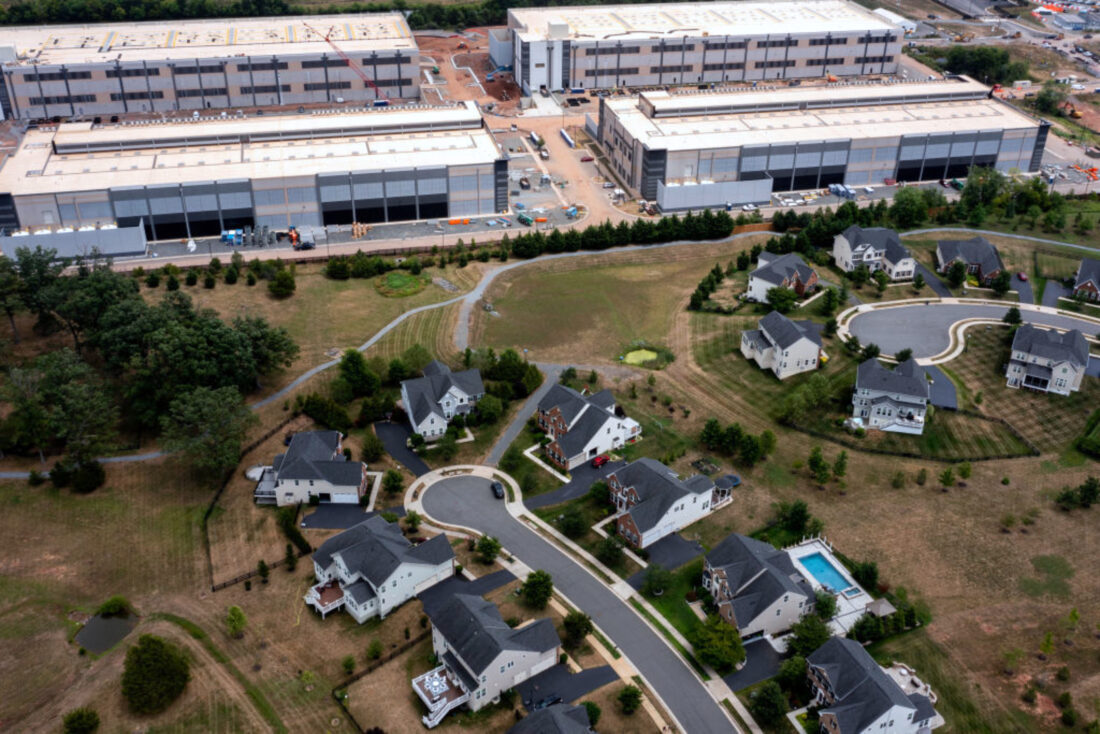
Photo by Nathan Howard/Getty Images via Penn Capital-Star An Amazon Web Services data center is shown situated near single-family homes in Stone Ridge, Va., in 2024. As Americans grow increasingly frustrated over their electricity bills, states are trying to keep the nation’s growing number of data centers from causing higher energy costs for consumers.
With energy affordability and reliability dominating headlines, state lawmakers peppered Pennsylvania Environmental Protection Secretary Jessica Shirley about the administration’s strategy to speed the addition of new power sources to the electric grid.
Members of the Senate Appropriations Committee asked Thursday about the administration’s plans to ensure Pennsylvanians’ lights stay on as the commonwealth courts tech companies to build their energy-intensive artificial intelligence infrastructure here.
“It’s one of the things that keeps me up at night,” Shirley said during a hearing on the Department of Environmental Protection’s proposed $4.1 billion budget. “I know that there are people all over Pennsylvania that are making choices every day because of their electricity bill, and those choices might not be the best choices for them … rationing medication or finding unsafe ways to heat their homes.”
Rising energy costs have compounded in the last two years as older power plants retire. This is happening at the same time that energy use is forecast to surge across the electricity grid Pennsylvania shares with 12 other states and Washington, D.C.
Grid operator PJM Interconnection has also been slow to add new capacity. The result was a runaway auction in 2024 that set a record price for future electricity generation and prompted PJM and federal regulators to cap prices.
Committee Chairman Scott Martin (R-Lancaster) said Gov. Josh Shapiro’s agreement as part of a budget deal late last year to remove the commonwealth from a multi-state greenhouse gas reduction program was “a major step toward protecting energy affordability.”
Former Gov. Tom Wolf announced Pennsylvania’s entry into the Regional Greenhouse Gas Initiative in 2018. It encourages the retirement of fossil fuel-fired power plants by requiring owners to pay for their carbon emissions.
But the program never took effect in the commonwealth, as GOP lawmakers objected and asked the state Supreme Court to determine whether it constituted an unlawful tax on energy.
Shirley refuted Martin’s assertion that RGGI was a cause of higher energy prices, noting that because the regulations were never implemented, the cost of carbon credits had little or no impact on electricity bills.
Increases since Pennsylvania joined RGGI are attributable to the rising cost of natural gas, which is the source of 60% of the commonwealth’s electricity, and continued demand growth in neighboring states, she said.
Shapiro has taken a leading role in demanding reform to stabilize prices and increase supply on the PJM Interconnection grid, calling for faster approval of state-backed projects and market reforms to ensure large electricity users pay their own way.
In January, Shapiro was among a bipartisan group of governors who joined the Trump administration in a statement of principles to guide PJM’s reform. He’s also proposing an overhaul of the commonwealth’s energy laws, Shirley said.
Shapiro introduced the Lightning Plan in 2025. The proposal would replace RGGI with a Pennsylvania-only carbon credit program and modernize energy standards to incentivize nuclear and renewable energy.
Part of that initiative, which would require the General Assembly to pass multiple pieces of enabling legislation, is to increase the use of battery storage.
“We’re forced to pay higher prices when everybody else wants the same resource that we have, instead of being smart about it and storing it when it’s cheap,” Shirley said, noting that the technology is available and the commonwealth has major battery manufacturers.
Shirley said the DEP is waiting for permission from the federal government to begin distributing $260 million from the Department of Energy for the state’s Home Electrification and Appliance Rebate and Home Efficiency Rebate programs, which would be distributed to low- and moderate-income families for energy efficiency improvements.
The Solar for All program would have had federal funding under the Biden-era Inflation Reduction Act available for community solar power projects, aimed at reducing electricity bills for low-income families. In August, the U.S. Environmental Protection Agency clawed back $156 million from Pennsylvania as part of a $7 billion budget realignment. Pennsylvania is one of 23 states suing to reverse the move.
“We need to get the federal government to release those funds,” Shirley said.
Senate Environmental Resources and Energy Committee Chairman Gene Yaw (R-Lycoming) said whether RGGI deterred investment in new generating facilities in Pennsylvania is moot, but added the commonwealth is facing a shortage it should have confronted a decade ago.
“We’ve now gotten ourselves into a self-made crisis, in effect, where it’s five to seven years before they can even get the equipment to start generating electricity,” Yaw said
Japan’s SoftBank announced plans last month to build the world’s largest gas-fired power plant in Ohio, he noted. At 9.2 gigawatts, it would be more than twice as large as the gas power plant now under construction at the site of the former Homer City Generating Station, a coal-fired behemoth that was retired in 2023 and demolished.
“It’s a $33 billion investment, and they’re already looking at sites,” Yaw said.
Yaw and Martin each pressed Shirley on the administration’s progress in streamlining permitting processes for new power plants. Reducing the time needed to obtain licenses, permits and other regulatory approvals across state government has been a top goal of Shapiro.
DEP Executive Deputy Secretary Ramez Ziadeh listed a number of agency permits with reduced average wait times. As an example, stormwater permits for construction formerly took an average of 148 days and are now processed in 119 days.
Shirley said the department’s Streamlining Permits for Economic Expansion and Development (SPEED) program, which began in August, has received about 13 applications. The program allows eligible applicants to have a private engineer or other qualified professionals review permit applications.
“One of the really nerdy, exciting things that we’ve had recently is we’ve actually had a repeat customer, someone who got one of those air permits, came back and said, ‘We want to use speed again.’ So that was telling for us that it was a great experience,” Shirley said.
New power plants have been slow to come on line because PJM has a backlog of projects awaiting approval to connect to the grid, although the organization notes it has made significant progress in reducing the number from about 200,000 megawatts to 63,000, as of last summer.
Shirley said DEP is aware of two natural gas power plants that are in the PJM queue and the agency hasn’t received permit applications. The Homer City project will primarily supply electricity to data centers planned on site. Shirley said despite that, it is a good example of DEPs success in to speeding its permitting process, Shirley said.
“We worked really closely with the folks that are redeveloping that site … but we were able to permit that air source in seven months, which is really record time,” she said.
——
Pennsylvania Capital-Star is part of States Newsroom, a network of news bureaus supported by grants and a coalition of donors as a 501c(3) public charity. Pennsylvania Capital-Star maintains editorial independence. Contact Editor Tim Lambert for questions: info@penncapital-star.com. Follow Pennsylvania Capital-Star on Facebook and Twitter.
Local news

Iran vows revenge after the killing of its top leader

Trump’s Medicaid work mandates are meant to save money, but first states will have to spend millions
Trump was once wary of ordering regime change in Iran
WEST PALM BEACH, Fla. (AP) — With Saturday’s military operation against Iran, President Donald Trump ...

Freezin’ for a Reason: Third annual event raises funds to help area animals in need
Senators grill Pa. DEP head on efforts to speed new power plant permitting