US deploys thousands more troops to Middle East
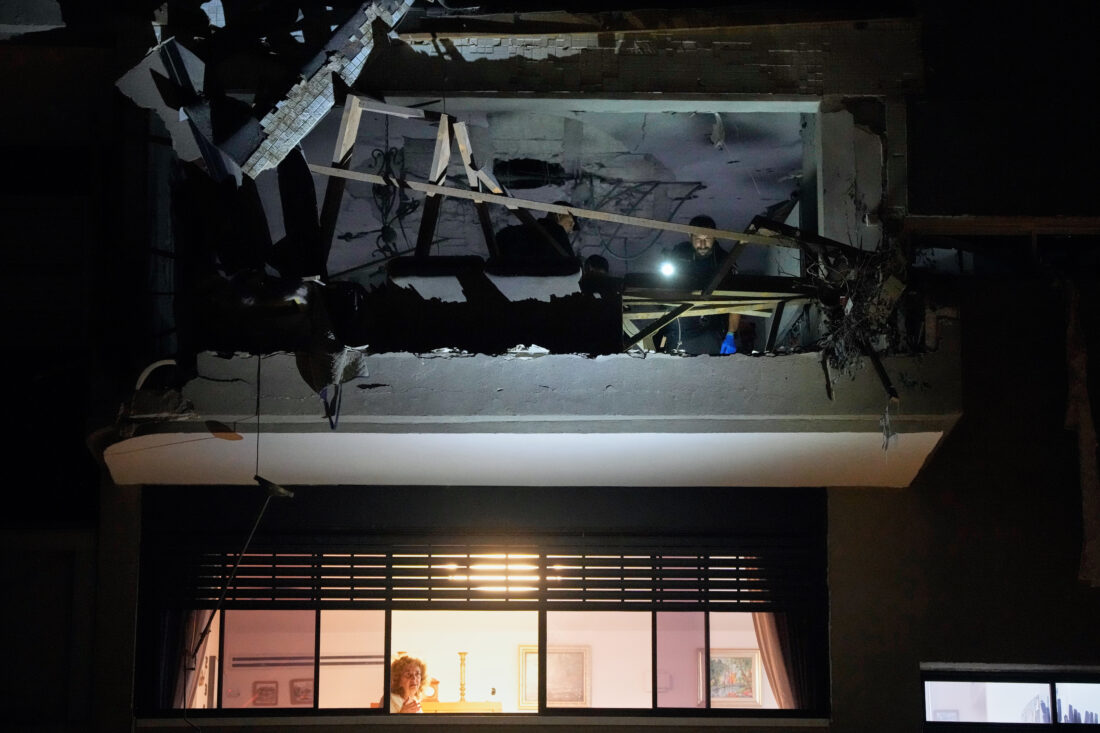
Israeli security forces inspect an apartment struck by an Iranian missile that killed two people in Ramat Gan, Israel, Wednesday, March 18, 2026. (AP Photo/Ohad Zwigenberg)
The U.S. military is deploying three more warships and roughly 2,500 more marines to the Middle East, where there’s no end to the war in sight despite three weeks of U.S. and Israeli air strikes that have decimated Iran’s military and leadership. The Pentagon’s request for another $200 billion to fund the war would need congressional approval as the U.S. national debt hits a record $39 trillion.
Prime Minister Benjamin Netanyahu said Israel will stop attacking the gas field that Iranians depend on for most of their electricity at the request of U.S. President Donald Trump. Iran responded to Israel’s attack on the field by intensifying targeting of energy infrastructure in other Middle East countries, sending oil and gas prices soaring.
The death toll has risen to more than 1,300 people in Iran, more than 1,000 people in Lebanon, 15 in Israel and 13 U.S. military members in the region. Millions of people in Lebanon and Iran have been displaced.
— The Iran war poses risks and benefits for Argentina, now an energy exporter
The Iran war has Argentines worrying inflation will spike, threatening the fiscal surplus President Javier Milei won at the cost of widespread anger over his economic austerity policies.
“Every week there’s an increase” in gasoline prices, complained German Toledo, 38, a traffic safety officer. “You can’t make it to the end of the month.”
“Argentina has weathered this shock relatively well so far” by becoming a net energy exporter, of $8 billion in oil and gas last year, International Monetary Fund spokesperson Julie Kozack said Thursday.
But higher export revenues will lag behind the bills Argentines must pay for importing costlier liquefied natural gas, said Mariano Machado, a principal analyst for the Americas at the global risk intelligence firm Verisk Maplecroft.
“The Iran shock has arrived at the worst possible moment for Milei’s counter-inflation program,” Machado said. The higher gas prices have pushed Milei’s target of 1% monthly inflation “mathematically out of reach” until mid-year.
— Trump says of the Strait that ‘at a certain point, it will open itself’
The president said as he prepared to leave the White House that Iran “from a military standpoint, they’re finished” but they’re “clogging up” the Strait of Hormuz.
Trump said it would be a “simple military maneuver” to keep the vital shipping lane open but it requires help, which he described as “ships” and “volume.”
He said “it would be nice” if the countries that rely on the strait would get involved in helping to keep it open.
— Trump condemns Iran’s execution of three protesters
Asked by a reporter about the execution of three men accused of violence during Iran’s anti-government protests last year, Trump said it was “terrible.”
“These are thugs and animals and horrible people,” Trump said as he departed the White House. “Can’t hit anybody harder than we’ve hit them. But I’m not surprised, they executed three young people for protesting.”
— Trump says ‘I may have a plan, I may not’ to attack Kharg Island
Trump was asked while leaving the White House on Friday afternoon about plans to have U.S. forces further target Kharg Island in Persian Gulf, which is vital to Iran’s oil network.
He responded, “I may have a plan I may not” but said he wouldn’t tell reporters one way or the other.
“It’s certainly a place that people are talking about. But I can’t tell you that,” Trump added.
— US imposes new Sanctions on Hezbollah
The Department of the Treasury sanctioned Friday a network of 16 individuals and entities led by what it called is Hezbollah financier and former public investment official Alaa Hassan Hamieh for diverting funds to benefit Lebanon’s Hezbollah group.
The treasury said these individuals and companies — located in Lebanon, Syria, Poland, Slovenia, Qatar, and Canada — have been involved in numerous economic projects and are estimated to have enabled the diversion of over $100 million since 2020.
This network represents a critical source of funding for Hezbollah, it said.
The U.S. Department of State designated Hezbollah as a Specially Designated Global Terrorist in 2001, and three years earlier as a Foreign Terrorist Organization.
— Schumer says $200 billion funding request for Iran war ‘will never happen’
Senate Democratic Leader Chuck Schumer says that a potential $200 billion price tag for the Iran war “will never happen” if it is sent to Congress and it is a “preposterous and dangerous risk.”
Schumer said in a Senate floor speech Friday that “even a fraction of $200 billion is unacceptable for a war without a plan, without an endgame, and without the support of the American people.” He called on President Donald Trump to end the war.
The Pentagon has sent a $200 billion request to the White House, but the White House has not yet sent an official request to Congress. Once there is an official request, Republicans would need some Democratic support to pass it in the Senate.
“So much could be done with that money instead of a war that Donald Trump has chosen to wage without even a vote in Congress,” Schumer said.
— UK to allow US to use bases against Iran attacks in Strait of Hormuz
British ministers have agreed to allow the U.S. military to use the U.K.’s bases in operations to prevent Iran attacking ships in the Strait of Hormuz.
In a statement, No. 10 Downing Street said ministers met Friday afternoon and “confirmed that the agreement for the U.S. to use U.K. bases in the collective self-defence of the region includes U.S. defensive operations to degrade the missile sites and capabilities being used to attack ships in the Strait of Hormuz.”
The statement follows President Donald Trump’s labelling of NATO partners as “cowards” for not directly joining operations to secure the Strait of Hormuz.
British Prime Minister Keir Starmer allowed the U.S. to use U.K. bases in the region for defensive operations a few days after the start of the war on Feb. 28, when Iran started launching missiles and drones around the Middle East, notably those on the other side of the Persian Gulf.
Under that agreement, U.S. armed forces could use the bases to target Iran’s missiles and missile facilities.
232 service members injured in Iran war so far, U.S. military says
Capt. Tim Hawkins, the spokesman for U.S. Central Command, told The Associated Press that 232 service members have been injured in the Middle East.
That’s 30 more than a previous military tally of roughly 200 from Monday.
Hawkins said 207 of the 232 injured have already returned to duty. The number of service members that are considered seriously wounded has remained at 10.
Since the war in Iran began, 13 U.S. service members have been killed.
Lebanon death toll reaches 1,021 and millions in Iran seek refuge
Lebanon’s Health Ministry said Friday that 20 deaths were reported over the past 24 hours, and that 57 more people were wounded raising the total injured to 2,641.
Israel renewed its offensive in Lebanon after Iran-backed Hezbollah fired rockets into northern Israel, two days after the U.S. and Israeli attacks on Iran triggered the widening war. Israel has since ordered evacuations from large parts of Lebanon, displacing more than 1 million people.
The U.N. refugee agency said last week that more than 3.2 million people inside Iran have been displaced as U.S. and Israeli airstrikes target Tehran and other major cities. And on Thursday, the U.N. migration agency said more than 80,000 people had fled to neighboring countries, mostly Afghanistan.
— Israel strikes Iran’s feared Basij from commanders down to street level, but its grip remains strong
Iran threatened recreational and tourist sites worldwide, insisted it was still building missiles and its supreme leader issued another defiant statement on Friday. The United States was deploying more warships and another 2,500 Marines three weeks into the war it launched alongside Israel.
Iran fired on Israel and energy sites in neighboring Gulf Arab states as many in the region marked one of the holiest days on the Muslim calendar. Iranians were also celebrating the Persian New Year, known as Nowruz, a normally festive holiday that is more subdued this year.
With little information coming out of Iran, it was not clear how much damage its arms, nuclear or energy facilities have sustained in the punishing U.S. and Israeli strikes that began Feb. 28 — or even who was truly in charge of the country. But Iran’s attacks are still choking off oil supplies and denting the global economy, raising food and fuel prices far beyond the Middle East.
Local news
The ever-constant evolution of Pennsylvania’s Right-to-Know law

Divided local lawmakers speak up as university funding hangs in the balance
US deploys thousands more troops to Middle East
TSA workers quitting instead of working without pay

Clinton County Camp Cadet now accepting applications for 2026