Deadline looms for PA home care workers to get budgeted raises
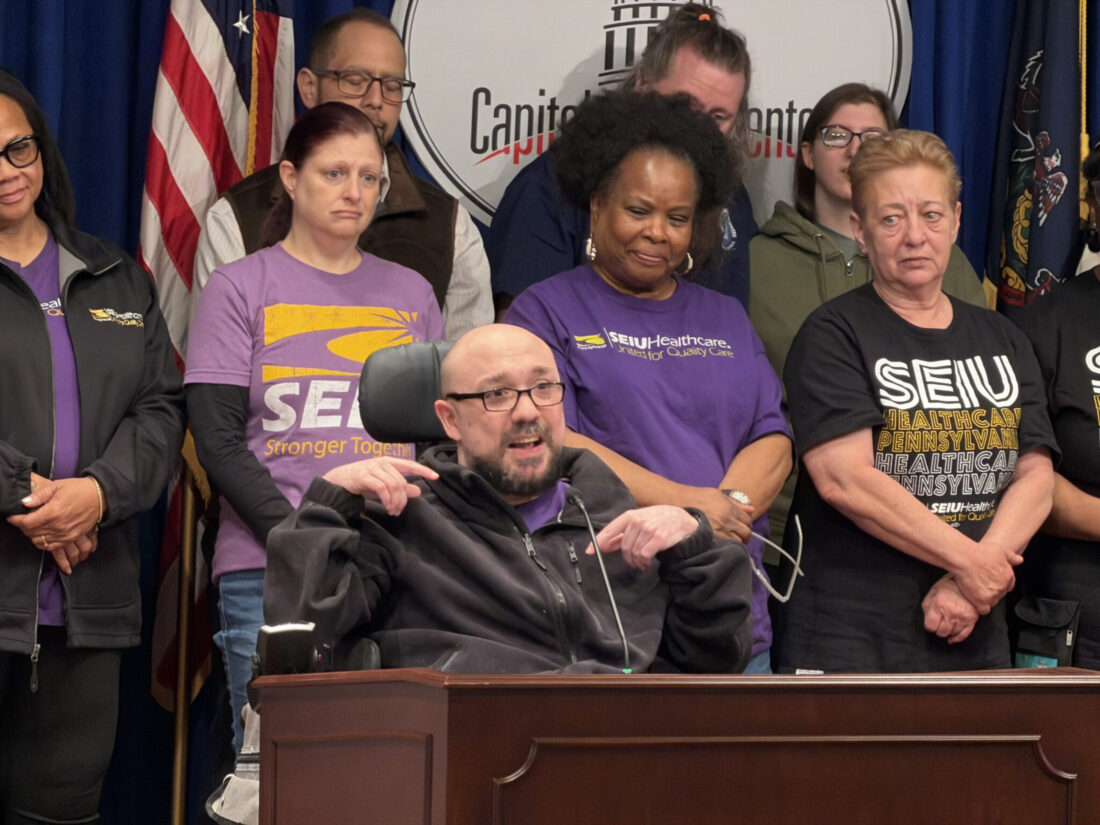
Photo by Whitney Downard/Pennsylvania Capital-Star Brandon Kingsmore, of Allentown, pushes for better pay for his direct care worker at a Capitol press conference on April 21. Kingsmore has cerebral palsy and needs assistance with daily living activities.
A typical day for Suzanne Ott starts by getting her children ready for school, like many parents. But then she becomes a caregiver in the greater Erie area, cooking, bathing and dressing someone with a disability that prevents them from living independently.
“It is not a part-time commitment, and for a long time, I was doing it all for $12.24 an hour,” Ott said at a Tuesday press conference at the state Capitol in Harrisburg. “Everything for me was a struggle. My groceries, my utilities, my mortgage, my bills were going up … No matter what I did, I felt like I just could not get ahead.”
Starting on Jan. 1, workers like Ott got an increase to $17.50 an hour after the state dedicated $21 million to boost wages in the last budget cycle.
“This month, for the very first time, I was able to pay my mortgage on time. No late fees. I paid my bills and I still had a little bit of money left over,” said Ott. “I’m actually saving for a car … that’s what this raise means. It’s not extra; it’s stability.”
Ott doesn’t work for an agency, meaning the person she cares for is her boss and the number of hours she works are determined by their Medicaid managed care organization. Roughly 6% of direct care workers in Pennsylvania operate outside of an agency in a participant-directed model, which comes without guaranteed benefits like paid time off and health insurance.
“Almost all” participant-directed workers should now be at $15 per hour or more, according to state Department of Human Services Secretary Val Arkoosh.
The increase isn’t automatic, however.
Arkoosh said that the employers must submit paperwork by May 8 to access the extra funds for caregivers. Once completed, the worker will qualify for backpay from the beginning of the year, though the payments filter through the managed care organization.
Cheryl Harp lives in Harrisburg and works as a direct care worker for her mother with dementia, and previously couldn’t afford to get the very service she provides: health care.
“I’ve never had health insurance. So this raise is a blessing every morning,” Harp shared, struggling to speak through her emotions. “To go years without health care, and now I’m able to have health care? Because at the end of the day, we have to take care of ourselves to be able to take care of our loved ones.”
She urged workers to get their paperwork submitted through their employer.
“That is your money going all the way back to January the first. Don’t leave it sitting there,” said Harp. “We’re going to fight, and we’re going to continue winning.”
The road ahead
Like many people who directly hire caregivers, Allentown’s Brandon Kingsmore lives with his full time and their salary funds household costs. Getting a boost to $16.26 will improve every day life for the roommates.
“That wage could possibly keep us ahead,” said Kingsmore, who has cerebral palsy. “With gas prices going up and everything going up, we need everything we can get.”
Kingsmore said he doesn’t want another caregiver, but couldn’t secure a back-up person last year when his primary caregiver was hospitalized. Previously offering $13.86, Kingsmore said applicants would “ghost” him after just one interview.
“We fought like hell and we finally won,” said Kingsmore about the increase. “But it’s not enough.”
Caregivers aren’t guaranteed to have paid time off or dental insurance. Following the expiration of federal subsidies, insurance policies under the Affordable Care Act Marketplace ballooned in costs. Kingsmore pointed to all three as “needs” for direct care workers.
But funding for all direct care workers — agency or not — is flat in the latest version of the budget, which passed the state House on a bipartisan vote last week. The Pennsylvania Homecare Association, which represents agencies, previously told the Capital-Star that reimbursement rates haven’t kept up, even as economic pressures push wages higher.
The association warned that providers may pull out of Medicaid entirely and rely on private payers or pivot to other state programs. But direct care workers are already in short supply, even as demand is slated to grow in the country’s fifth-oldest state.
Arkoosh said that group is “going to be so critical to enabling older adults who choose to age” at home or in their communities, the preference of most seniors.
“We want to make sure that these workers are treated with the dignity and fairness that they deserve, and paid a professional wage to acknowledge the work that they are doing,” said Arkoosh. “I think when we do that, we will have the workers that we need.”
But Arkoosh put the responsibility for funding squarely on the General Assembly, tying it to the Shapiro administration’s priority to increase the state’s minimum wage to $15 an hour for all professions, up from its current $7.25. House lawmakers have passed legislation doing that three times in the last four years, but the Republican-controlled Senate has rejected such measures.
“We’re waiting on the Senate to act next,” said Arkoosh.
Whether wages for direct care workers will stay flat — or get another increase — will also be determined by the Senate, which is crafting its own budget counterproposal.
——
Pennsylvania Capital-Star is part of States Newsroom, a network of news bureaus supported by grants and a coalition of donors as a 501c(3) public charity. Pennsylvania Capital-Star maintains editorial independence. Contact Editor Tim Lambert for questions: info@penncapital-star.com. Follow Pennsylvania Capital-Star on Facebook and Twitter.
Local news
Centre backs grant for sensor tech initiative
BELLEFONTE — The Centre County Commissioners are backing an Appalachian Regional Commission (ARC) grant ...

Lucas re-elected to PSATS exec committee
Trout Unlimited picks up litter for 32nd year for Adopt a Highway Program
Council tables police building bids; Requests to look at City Hall feasibility again

Bellefonte hires interim manager permanently