
With $4.5B on the line, Pennsylvania businesses seek tariff refunds
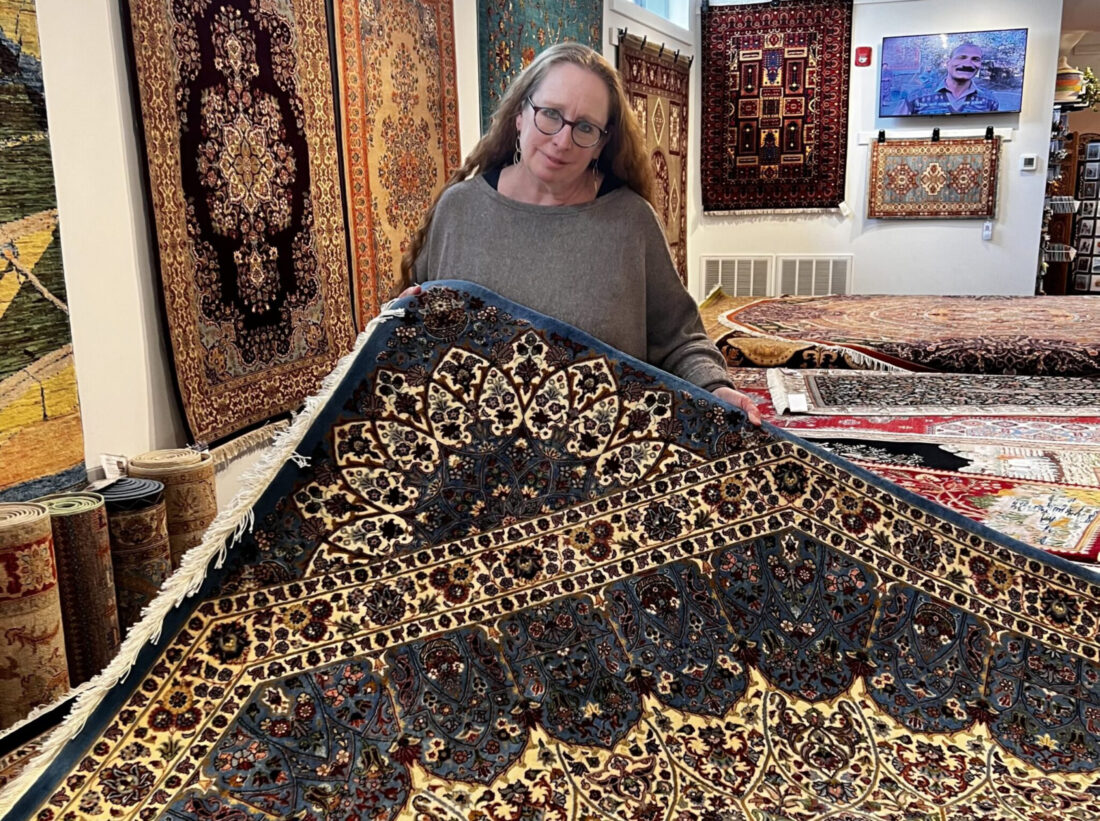
Photo courtesey of Jenni Leister Jenni Leister, co-owner and Director of Operations at Bunyaad Marketplace in Lancaster County, said the company has resisted raising prices on its hand-knotted Pakistani carpets following tariff expenses.
The Bunyaad Marketplace in Lititz, where colorful, hand-knotted carpets from Pakistan are stacked nearly to the hip and hang on the walls, has an explicit fair trade mission to sell its inventory at a price that pays its artisans a living wage for their craftsmanship.
Co-owner and Director of Operations Jenni Leister proudly shares that over half of their rugs are made by women living in the villages of her husband’s homeland, even if it comes at a higher cost. But combining that expense with tariffs has forced the Lancaster County company to be “scrappy.”
“We find ways here in North America to minimize our overhead, to do things as economically as possible,” said Leister. “When the tariffs came in for a lot of the fair traders that we work with, we certainly did see costs go up and we knew how hard that was hitting them.”
The dollars needed to get a $12,000 rug shipment across the ocean “was hard to stomach” knowing “what amazing good that could do in Pakistan.”
“Our customers are feeling the rising costs everywhere — everything from when they go into their local department store or their local grocery store,” said Leister. “This is not a way to make the world a more just and equitable place for all.”
Products from Pakistan and textile furnishings, in particular, were both taxed at a higher rate under a now-defunct class of tariffs imposed by President Donald Trump during his second term. After the U.S. Supreme Court struck down a category of fees in February, they were quickly replaced, but some small businesses are calling for refunds.
We Pay the Tariffs — a coalition of more than 1,100 small businesses, including Bunyaad Marketplace and 42 others in Pennsylvania — reported that companies in the commonwealth had paid $4.5 billion in “illegal” tariffs nearly one year after their announcement on “Liberation Day.”
Leister couldn’t put a price tag on the amount of tariffs paid through Bunyaad, but said the store staffing is at “the barest of bones” and they’ve pulled back advertising dollars. Americans feeling a financial pinch may already hesitate to buy a high-quality rug, so Leister said they’ve tried to avoid a price increase.
“We are constantly juggling, ‘How much of the increased cost of things can we take before we must pass it on to our customers?’ Because we also want to stay in business. Because if we’re not in business, we’re not supporting the artisans that we work with,” said Leister. “But on the other hand, we also realize that we are a choice business. It’s not food.”
Outside of
Pennsylvania
Matthew Cagle, of North Carolina-based Rig’Em Right, produces outdoor gear like camping chairs and backpacks, many of which are manufactured in the Philippines. As a seasonal business, missing just a few weeks because of shifting tariffs can have an outsized impact on his bottom line, he said.
“This is the first year since I started my company in 2006 that we didn’t grow. We were on a really sharp growth trajectory … growing like crazy and then all of a sudden we hit a year where we’re flat,” said Cagle. “And it’s literally only because of the tariffs.”
Cagle said that consumers and retailers might turn to purchasing “knockoff products” directly from foreign competitors due to the tariffs, weakening American companies like his. Cagle and others with We Pay the Tariffs agreed that domestic production didn’t meet the demand.
At Ohio-based Down Decor, co-owned by Andy Payne, most of the components for their down bedding are imported from China and then assembled at a Cincinnati facility. Payne said that American companies don’t weave the feathering down they use, noting that Chinese customers are some of the biggest consumers of geese and duck.
“If somebody wove down-proof fabric in the U.S., we would certainly consider buying from them if the USA had even remotely close to the supply of feather and down that we need. But the USA consumer just does not eat goose or duck meat in the quantities that other places do to produce the raw material,” said Payne.
Purchasing a loom to create the fabric would cost $500,000, Payne estimated, and “an operation of scale” would need at least 50 or 85 looms — a barrier for anyone considering a factory in America.
“Who’s going to make that kind of capital investment?” Payne asked. “If the administration changes, and the new administration says, ‘Alright, we’re getting rid of the tariffs.’ You’ve just sunk a ton of capital into something that’s going to be obsolete.”
Payne’s company laid off half of its workers due to the cost of tariffs, according to We Pay the Tariffs. If an estimated $2 million in tariffs were repaid to his company, Payne said retailers and others want a portion of those dollars.
“Even if we get a refund, we’re not going to see very much of it because our customers expect to get it back,” said Payne, though he added that he hoped it would be automated.
Tariff
background
Trump claimed he had the authority to impose those tariffs under the International Emergency Economic Powers Act, but justices on the nation’s highest court disagreed. Their ruling, however, didn’t address how, or if, any of the collected money would be returned.
Refunds are a top priority for We Pay the Tariffs, with Executive Director Dan Anthony saying that the money was “taken illegally in the first place.”
“There is a lot of holding the feet to the fire here and saying, ‘This money should be refunded. It should be refunded quickly,'” said Anthony.
Shortly after courts took away the first option, Trump advanced tariffs under the Trade Act of 1974, further adding to market chaos. We Pay the Tariffs reported that Pennsylvania importers have paid $7.8 billion across all tariffs between March 2025 and January 2026.
Pennsylvania Gov. Josh Shapiro has joined 23 other state attorneys general and governors in a lawsuit filed at the Court of International Trade challenging the Section 122 tariffs as unconstitutional and in violation of federal law. These fees are limited to 150 days.
Anthony maintained that the federal government knows who paid what in terms of tariffs through its customs oversight, and a refund process should be simple enough not to require small businesses to contract with attorneys to recoup their losses.
“Requiring the government to tap into the knowledge that it already has to expedite these processes, rather than shifting the burden to the small business employers … that’s what we’re trying to avoid,” said Anthony. “This has been, for a lot of them, an all-consuming issue to deal with. We shouldn’t now have an all-consuming process to get that money back that was taken illegally in the first place.”
Additionally, he noted it’s not clear if businesses will have to pay taxes on tariff refunds.
——
Pennsylvania Capital-Star is part of States Newsroom, a network of news bureaus supported by grants and a coalition of donors as a 501c(3) public charity. Pennsylvania Capital-Star maintains editorial independence. Contact Editor Tim Lambert for questions: info@penncapital-star.com. Follow Pennsylvania Capital-Star on Facebook and Twitter.
Local news
Area history buffs share passion through the lens of social media
Public comments on recreation at Centre jail
BELLEFONTE — Centre County commissioners on Tuesday heard public concerns about conditions at the county jail and ...
Centre makes donation to local shelter
BELLEFONTE — After Centre County PAWS took in 43 dogs from an apparent animal hoarding situation last month, the ...
Regatta Foundation serves over 300 seniors at Easter dinner
With $4.5B on the line, Pennsylvania businesses seek tariff refunds
PUC holds hearings regarding proposed UGI increase
LOCK HAVEN — As UGI looks to increase its annual operating revenues for natural gas distribution service by about ...