
The evolution of Fisherman’s Paradise
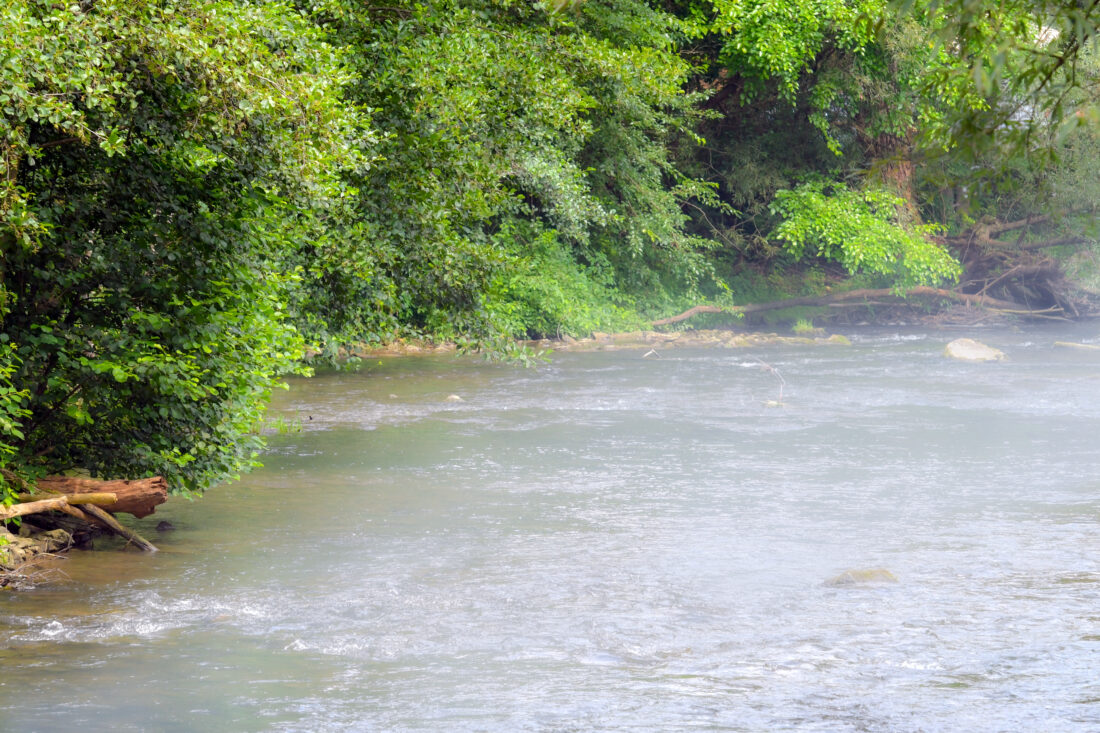
TIM WEIGHT/FOR THE EXPRESS Spring Creek at Fisherman’s Paradise is pictured in this photo from 2021.
If you are a fly angler, there is little doubt you have heard of Fisherman’s Paradise of Spring Creek, located between Bellefonte and State College. Anglers from all around are familiar with what is considered a premier fly fishing area.
But why is this section of stream so popular? How did it rise from an isolated area accessible only by trail become somewhere anglers and nature lovers travel from across the map to visit?
It’s all by design.
Sure, Spring Creek is spring-fed, making it perfect for trout. It is also located in a relatively remote canyon but within easy reach of those visiting State College. But it is also one of dozens of similar streams crossing Centre and nearby counties. What makes it stand out, and allowed it to gain the reputation of a primer trout stream, is that it was designed to be better.
The Spring Creek visitors encounter today is not the Spring Creek that greeted early settlers, or even the Penn State Class of 1930.
In 1930, the Fish Commission, as it was known at the time, acquired 90 acres of property in the canyon, most of which lined a little over a mile of Spring Creek. Originally known as the Spring Creek Project, this property was intended to be used to provide water for fish culture operation and demonstrate new stream improvement methods.
By 1934, a hatchery had been built along the far shore, the stream was heavily stocked and now included numerous stream improvement devices such as deflectors, riparian buffers and log covers. The result was a hit with local anglers and thousands of people were visiting the site annually.
Word quickly spread and the Spring Creek Project had become a Fisherman’s Paradise, with people lining up to fish the stream and a side channel that had been added as a female-only area. The nickname stuck and Fisherman’s Paradise would eventually be adopted as the project’s official name.
The project would also morph into an area so popular with anglers that special regulations were put in place to manage access.
Anglers were required to check in and obtain an identification badge prior to fishing. All anglers were required to check out and report their catch at the end of the day. Fishing was restricted to May through July. The minimum size for harvest was ten inches, or seven inches on the females-only section. Anglers were limited to five trips per year.
Despite the increased restriction, which were almost unheard of at the time, the popularity of Fisherman’s Paradise continued to grow. Records indicate approximately 3,000 anglers visited in 1934. By 1941, this number had increased to over 20,000. In 1952, attendance was a staggering 44,000 anglers, the same year a second hatchery was built upstream at Benner Spring.
By the 1960s, attendance had dropped significantly, due in part to an expanding network of smaller projects throughout the Commonwealth. Then, in 1961, the project was closed to fishing due to heavy amounts of untreated wastewater entering the stream upstream, most likely from the Rockview Correctional Facility which bordered the project’s upper reaches. When fishing reopened in 1962, it would be under a different management program that focused on providing anglers with a more natural experience, while maintaining the area’s ecosystem and diversity.
The new management program abandoned the check in station, visitation limits and focus on big trout. Now anglers could fish the area as often as desired year round but were limited to fly fishing only with no harvest permitted. With a few minor changes, this is the management plan that remains in place today.
The regulations and name are not the only changes the Spring Creek Project has encountered over the years. Shortly after the site was purchased the Fish Commission constructed a small, stone two-story building near what is now the main parking lot of Fisherman’s Paradise.
This building would first be used to train new fish wardens in the fall of 1934. Since then every waterways patrolman, waterways conservation officer and deputy officer would be trained at the H.R. Stackhouse School of Fisheries Conservation and Watercraft Safety.
Over the years the original 90-acre area has grown to over 195 acres, stretching from Bellefonte Hatchery to Benner Spring Hatchery and including both the H.R. Stackhouse facility and a firearms range at the upper reaches of the original 1.2-mile project area.
The area surrounding the project was also transferred from the Department of Corrections to Benner Township, the Game Commission and the Fish and Boat Commission. This change of ownership not only ensured the future protection of the Spring Creek Canyon, but also opened hundreds of additional acres to the public.
Fisherman’s Paradise remains a destination fishery with anglers from far and wide traveling to test their skills against weary, hard to hook trout. But it also attracts a host of other outdoor enthusiasts including hikers, bikers, dog walkers, hunters on the adjacent game lands and anyone else who wishes to enjoy paradise in our backyard.
Outdoors
In the Parks
Various local parks will offer programs that folks may be interested in attending. All children must be accompanied ...
Hanover Bald Eagles lay first egg in nesting season
In the parks
Various local parks will offer programs that folks may be interested in attending. All children must be accompanied ...

Shrinking North American bird population is getting worse faster. Experts blame agriculture, warming
Game commission monitors avian influenza in wild birds
Oregon jury orders PacifiCorp to pay $305M to wildfire victims in latest class-action verdict
PORTLAND, Ore. (AP) — An Oregon jury has ordered PacifiCorp to pay $305 million to 16 victims of the state’s ...