River trip helped bring awareness to West Branch of Susquehanna
-
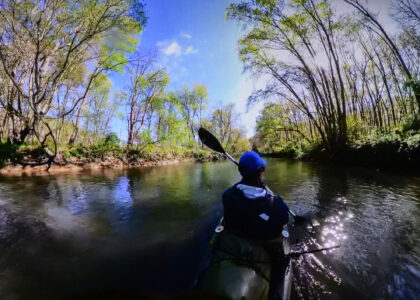
- RALPH WILSON/Sun-Gazette Correspondent Photographer and story-teller Michael Kinney shows a selfie taken during a trip along the West Branch of the Susquehanna River during a talk at Trout Unlimited meeting in January.
-

- RALPH WILSON/Sun-Gazette Correspondent Photographer and story-teller Michael Kinney explains his use of a Go-Pro camera for underwater photography while recording fish populations along the West Branch of the Susquehanna River during a Trout Unlimited meeting in January.
-
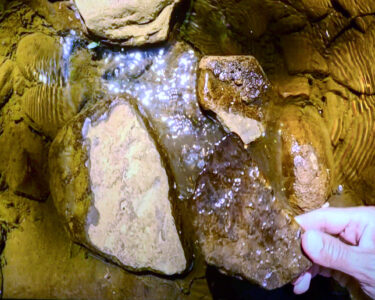
- RALPH WILSON/Sun-Gazette Correspondent Photographer and story-teller Michael Kinney shows an image of the effects of acid mine drainage along the West Branch of the Susquehanna River during a Trout Unlimited meeting in January.
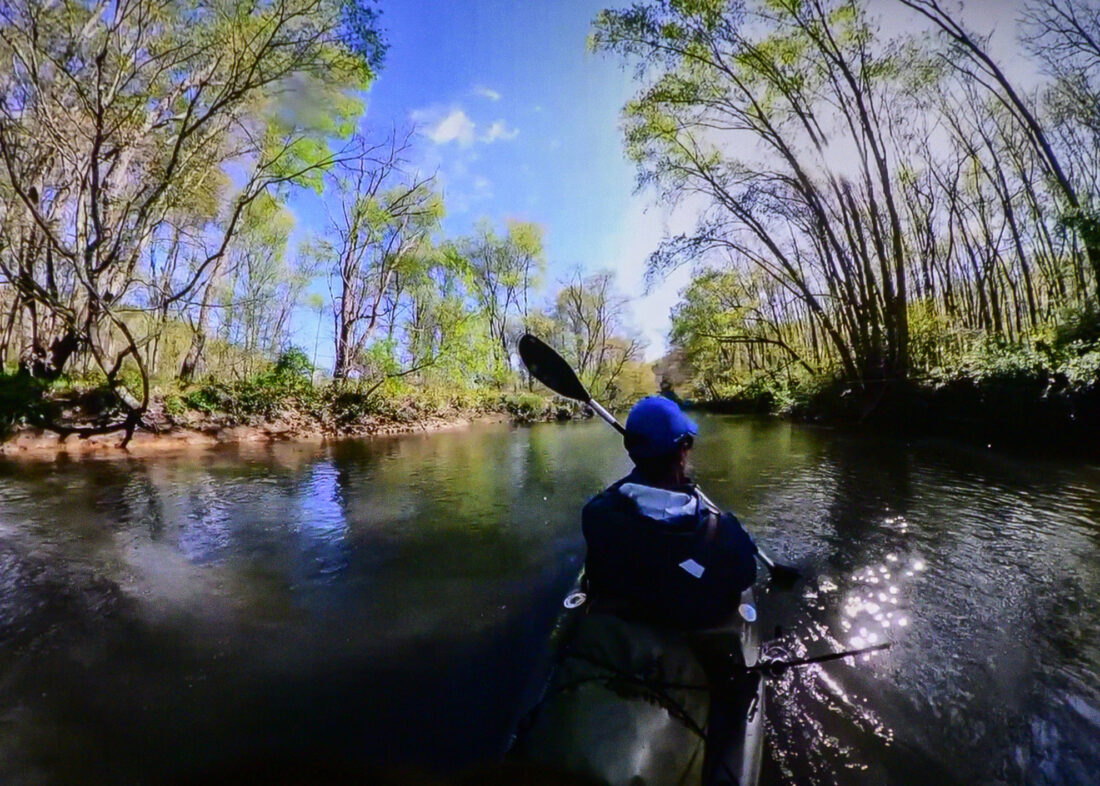
RALPH WILSON/Sun-Gazette Correspondent Photographer and story-teller Michael Kinney shows a selfie taken during a trip along the West Branch of the Susquehanna River during a talk at Trout Unlimited meeting in January.
You may never see the West Branch of the Susquehanna River the same way after viewing the spectacular photography of Michael Kinney from his journey down this great waterway.
Kinney captured breathtaking shots of various fish species idling underwater, birds roosting in woodlands and along shorelines, as well as breathtaking scenery.
He recently shared part of the documentary he filmed with the Susquehanna Chapter of Trout Unlimited, a local organization involved in stream protection and conservation.
The environment is Kinney’s concern as well, and by recounting and sharing his 24-day trip he hopes to bring awareness to a fragile ecosystem that supports various fish and wildlife.
The West Branch is important to him.

RALPH WILSON/Sun-Gazette Correspondent Photographer and story-teller Michael Kinney explains his use of a Go-Pro camera for underwater photography while recording fish populations along the West Branch of the Susquehanna River during a Trout Unlimited meeting in January.
Growing up, he enjoyed fishing, camping and boating with his family along the West Branch and its tributaries, Loyalsock and Lycoming creeks, near his hometown of Williamsport.
He continued fishing as an adult and began photographing some of his catches.
“That led to pointing a camera underwater without the need of a fishing pole,” he stated.
He uncovered, he said, a fascinating underwater world that most people otherwise never see.
He was inspired to make the 228-mile-long journey paddling a kayak and canoe in the spring of 2024 after photographing an Eastern Hellbender seven years earlier.
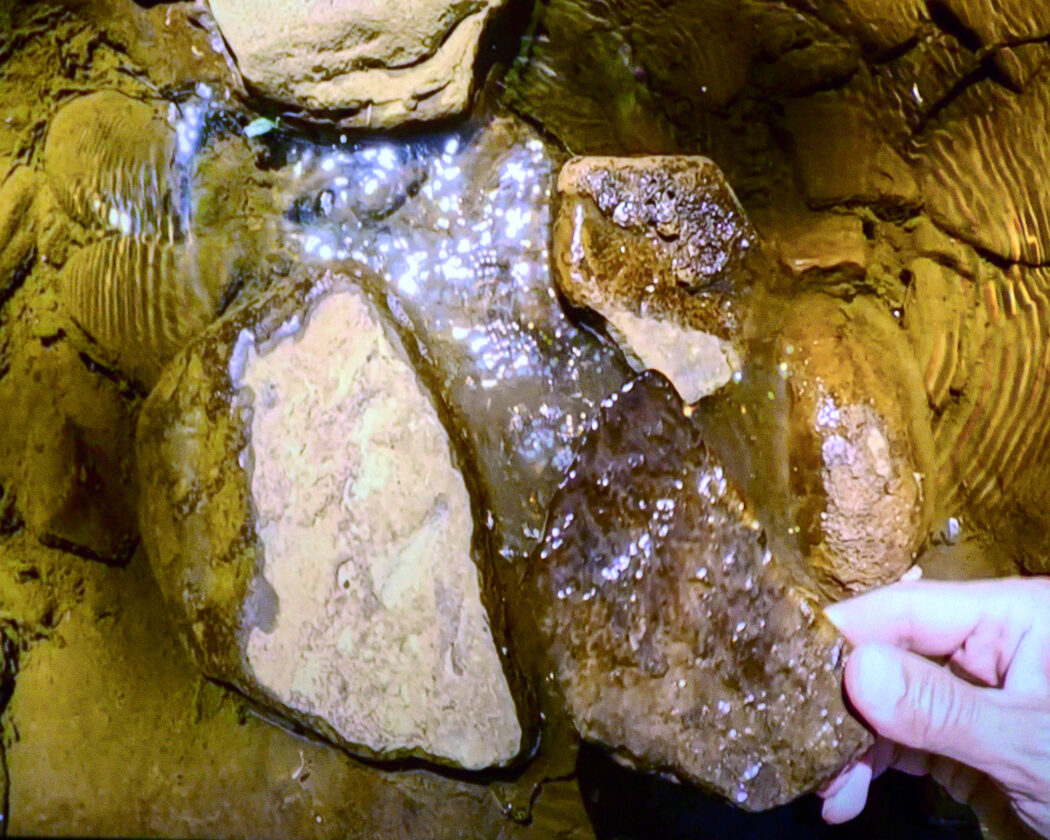
RALPH WILSON/Sun-Gazette Correspondent Photographer and story-teller Michael Kinney shows an image of the effects of acid mine drainage along the West Branch of the Susquehanna River during a Trout Unlimited meeting in January.
Prior to the trip, he painstakingly mapped out the journey to mark stops he would make along the river route, readied gear and equipment, and planned out supply drops along the way.
Kinney launched his trip in the very headwaters of the West Branch at the small town of Cherry Tree (Cambria County) where the Susquehanna begins as a narrow and shallow body of water about the size of a small creek.
As with many trips, things did not go as planned.
As he stated in the documentary: “The plan was to travel 20 miles on the first day, but I quickly fell behind schedule and spent over three hours walking around trees and debris.”
Other setbacks or challenges along the way, including rain, chilly weather and occasional treacherous waters, did not stop Kenny from finishing this river odyssey.
Early on, he captured shots of wild trout gathered in spots underwater, a sign of good water quality.
Save for its headwaters, the Susquehanna is not otherwise known as a trout fishery.
“Basically, there is trout water to Curwensville,” he said.
Kinney fished various spots of the river using a lightweight spincast rod and the same lure throughout the trip.
Eighteen miles into the trip he came upon a covered bridge, the only such structure on the river. Early on, his girlfriend, Missy, joined him for much of the rest of the downstream journey.
They spotted log booms on the stream from the logging days of more than 100 years ago on the Susquehanna.
Bird species either spotted or photographed along the trip included eagles, wild turkeys, house sparrows, barn swallows, mergansers, mallards, blue herons and many others.
Around Hyner, Kinney uncovered signs of acid mine drainage in the upper West Branch often around small tributaries showing rust-colored water.
“It was like we suddenly landed on Mars with the bright red tint and no signs of life,” he recalled of one spot on the river.
He noticed a decline in bird noises, macro invertebrate and all other river life.
On day 19 of the journey Kinney and Missy passed through Williamsport where Kinney caught and released a hefty smallmouth bass and photographed a bald eagle flapping on the water surface.
They stopped at the Hepburn Street Dam where in 2017 Kinney had caught an Eastern Hellbender. At the time, he didn’t know what it was, nor did many other people.
It has since been his mission to raise awareness of the Hellbender, officially declared in 2019 as the state amphibian.
The Hellbender is an ancient water creature and indicative of clean water.
Unfortunately, he would see no Hellbenders on his river journey.
He did find some disturbing sights along the river around the city in the way of litter and what he termed “plastic-choked banks.”
“Our actions, the choices we make about what we discard, have direct consequences for the creatures without a voice,” he lamented.
At Muncy, they passed the railroad bridge spanning the river where in March 1938 the historic “Last Raft” crashed, spilling everyone overboard, killing seven people.
And then it was southward on the river to Montgomery, Watsontown and finally to Sunbury where the West Branch connects to the North Branch and the journey ended.
Kinney said his hope from the journey is to raise awareness of the need to conserve, protect and be stewards of the river and the whole ecosystem.
“Sometimes the river speaks to you in a way a rod and reel never could,” he said.
Outdoors
In the parks
Various local parks will offer programs that folks may be interested in attending. All children must be accompanied ...
River trip helped bring awareness to West Branch of Susquehanna
In the Parks
Various local parks will offer programs that folks may be interested in attending. All children must be accompanied ...
An ancient forest in Ecuador is the last stand for a tiny hummingbird facing extinction
In the Parks
Various local parks will offer programs that folks may be interested in attending. All children must be accompanied ...