
Trending
The Saint Louis glass factory, or Compagnie des Cristalleries de Saint Louis, is one of the oldest glass manufacturers in Europe, tracing its history to the Muntzthal glassworks in Lorraine, France, established in 1586. The factory started making lead crystal in 1781 and was renamed Cristallerie Royale de Saint-Louis in 1829. The rest of the 19th century brought further innovation, as the factory started producing colored glass; introduced paperweights, including millefiori, about 1840; and, like many other glassmakers at the time, made cameo glass when it came into fashion in the late 19th to early 20th century. Today, its antique cameo glass is among its most desirable products.
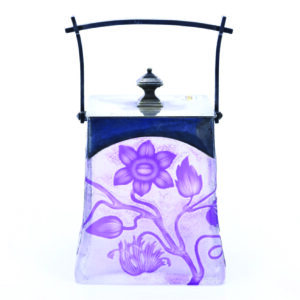
Saint Louis cameo glass is characterized by a thin transparent layer of colored glass with an acid cut design, usually flowers, over a clear base. A glass biscuit jar that sold for $300 at Woody Auction was unmarked but listed as "Saint Louis style." Decorated with acid cut flowers in transparent amethyst glass over a colorless frosted ground, it resembles the cameo glass that the Saint Louis factory was known to produce. Today, Saint Louis is owned by Hermes and focuses on cut crystal. The factory, still located in Lorraine, has a museum dedicated to the company's long history.
------
Q: How should I sell my collection of Hummel figurines? I have more than 100, and they are originals from the 1950s. What would they be worth?
A: The best way to sell a large collection like yours is to contact an antiques shop or dealer in your area, or an auction house, preferably one that specializes in porcelain figures or similar collectibles. Most Hummel figurines have relatively low value today after the collecting craze of the mid- to late 20th century saturated the market, but very early Hummels, like yours, can be exceptions.
The first Hummel figurines were released in 1935. Figurines from the 1950s are usually marked with what collectors call the "Full Bee" or TMK-2, a mark that was used from about 1940 to 1959. Some of them can be worth over $100. You may want to look for additional information to get an idea of the value of your figurines before you sell them.
Check your library for collectors' guides to Hummels, like "The Official M.I. Hummel Price Guide: Figurines & Plates" by Heidi Ann Von Recklinghausen or "Luckey's Hummel Figurines and Plates: Identification and Value Guide" by Carl F. Luckey. Their prices may be outdated, but they may have some useful information. A collectors' club like the M.I. Hummel Club (mihummel.org) may also be helpful. However you sell your collection, be sure to get a signed contract that covers all terms of the sale, including fees and insurance.
------
Q: I have a teak wood statue that I have read is called a Sawasdee Lady. It is a standing woman, over 5 feet tall, with carved details. I am considering selling it, but I have not been able to find a value for it. Can you help?
A: The Sawasdee Lady or Sawasdee figure is a traditional Thai statue that is usually placed at the entrance of a home or business. "Sawasdee" is a Thai greeting. The statues, usually figures of women or boys, have their hands in the Wai position, held to the chest with the palms together, which is a gesture of welcoming and respect. They are commonly made of teak wood, like yours.
Most of the Sawasdee figures collected today date to the mid-20th century, when trade with Europeans opened up a market for tourism in Southeast Asia, where teak has been carved into practical, decorative, and religious figures for thousands of years. Five-foot-tall statues like yours are generally worth about $200 to $300. Smaller statues usually have lower values. Prices can vary depending on the condition, quality of the carving, and whether the statue has additional decoration, like painting. For more information and a more specific value, you may want to contact a dealer or auction house that specializes in
------
TIP: Tired of scrubbing and scrubbing glass to remove marks from masking tape and labels? Get commercial hand cleaner, pat some on the stain, and let it stand for 30 minutes. Then rub it off with a cloth and wash the glass.