
QUOTES, NOTES AND ANECDOTES: The Eagles’ Italian-American heritage on display
Historically and culturally speaking, the greater Philadelphia region was a beacon for Italian immigrants seeking employment in the area’s factories and manufacturing sites. In fact, Hammonton, N.J., across Philadelphia’s Walt Whitman Bridge, is home to the densest population of Italians in the world, outside of Italy.
NFL data reveals that no team has requested more Italian flags for the league’s cultural heritage initiative than the Eagles. Considering that no less than six members of the Eagles’ coaching staff are of Italian-American descent, it is small wonder that a famiglia bond exists, both in the locker room and on the Eagle sideline each game.
Coach Nick Sirianni’s grandfather was an Italian immigrant who managed a clothing store in Kane. Defensive coordinator Vic Fangio’s father came to America from Tuscany, Italy, in 1919 and ran a clothing store in Scranton. Passing coordinator Kevin Petullo and Special Teams assistant Joe Pannunzio both hold their Italian-American heritage closely. Head of game day operations Dom DiSandro grew up in a south Philadelphia family with Italian as his first language.
Petullo believes that the coaching staff’s sense of family has resulted in the rest of the staff members wanting to convert to the Italian bond. The Eagles’ locker room postgame buffet table overflows with cheesesteaks, ricotta cookies, cannolis and Fangio’s homemade meatballs, a recipe his grandfather brought to America from Tuscany and which Fangio zealously guards and is reluctant to share.
Blasting through the locker room sound system is Dean Martin’s Volare, the Italian word for fly. Sirianni is the most successful Italian-American coach since Vince Lombardi in the late 1960s, and there is no doubt that he and DiSandro set the Italian tone within the organization.
In fact, DiSandro is easy to spot, as he is always within elbow range of Sirianni, both sporting Eagles baseball caps with the Italian flag on the side. Last year, both Sirianni and DiSandro were awarded the National Italian American Foundation Colangelo Sports Excellence Award, an honor given out to those who have a positive effect in the community, but also people who wear their heritage on their sleeve.
In this case, Sirianni and DiSandro wear their heritage on their windbreakers and caps. Maybe Lew Santonico can arrange for Sirianni and DiSandro to come up north during the off season and play a few games of bocce at the local SOI club.
Ancient Form
of Soccer
There is no doubt that the game of soccer is a physical sport, with its jarring body checks and slide tackles, but a yearly event in England gives new meaning to physical play. Each year on Shrove Tuesday and Ash Wednesday, in the small village of Ashbourne, England, thousands of people gather to watch a two-day game of mass soccer, in what could best be described as a riot.
Called Royal Shrovetide, the event has its roots from England’s medieval 1600s. The game pits two town teams of 100 players each, the Up’ards vs the Down’ards, with the object to score a goal at either end of a three-mile section of town that winds through streets, streams, rivers, hedgerows and anywhere else, except churches and cemeteries.
Locals describe the event as a “tug of war without a rope, simply a mad spectacle.”
Rules are limited: shoving, pushing, punching, tripping and gouging are all allowed, but records from the game’s origination back in the 1600s indicate that “murder was prohibited.” Play begins in the town square with the playing of the British national anthem and players and spectators singing Auld Lang Syne in unison.
After that a huge leather ball, the size of a pumpkin, is thrown into the hug of the opposing teams and they are off as a giant herd. In the recent game two weeks ago, it took 45 minutes for the scrum to get out of the starting spot. Play lasts from 2 p.m. until 10 p.m. each of the two days.
Once the sun sets, there are periods of time when the ball is out of sight, yet the game goes on. Long time veterans of the game say that good players need to be hard, aggressive and authoritative. Experience in boxing and wrestling are definite assets.
There are no team uniforms, as participants wear random soccer or rugby jerseys. The eventual goal is for a member of one of the teams to strike the ball three times against one of the millstones at either side of the village. Goal scorers liken the experience to winning an Olympic gold medal, as they are hoisted on shoulders and paraded through the town as heroes.
Seventy-five year old Ashbourne resident Janet Richardson has been going to Royal Shrovetide since she was 1 and says “I just live and breathe this lovely little game we have in our town.”
Soccer fans out there might want to consider a trip to Royal Shrovetide some spring.
Local sports

Homers, Fisher gem propel Bald Eagle softball to dominant, shutout win over Shore
Local roundup: Bellefonte softball defeats Tyrone 3-1
Bellefonte beat Tyrone, 3-1, in a close game in softball competition on Monday. The Red Raiders and Tyrone were ...

Red Raiders score 6 to secure home win vs. Tyrone in baseball
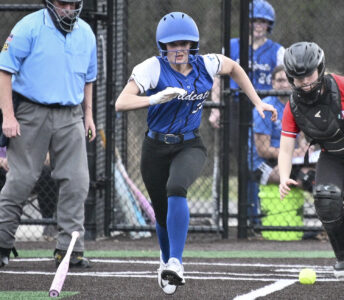
CM Week-In Review: Wildcats see positives, endure losses to open Spring
Local roundup: Jersey Shore baseball falls to Shikellamy 3-1
Jersey Shore tied the game with a run in the bottom of the third at 1-all, but two runs in the top of the fourth by ...
Jersey Shore track and field sees success at Molly Dry Invite
Jersey Shore's track and field team had a standout performance at the Molly Dry Invitational in both girls and boys ...