Cyclamen: A colorful winter houseplant
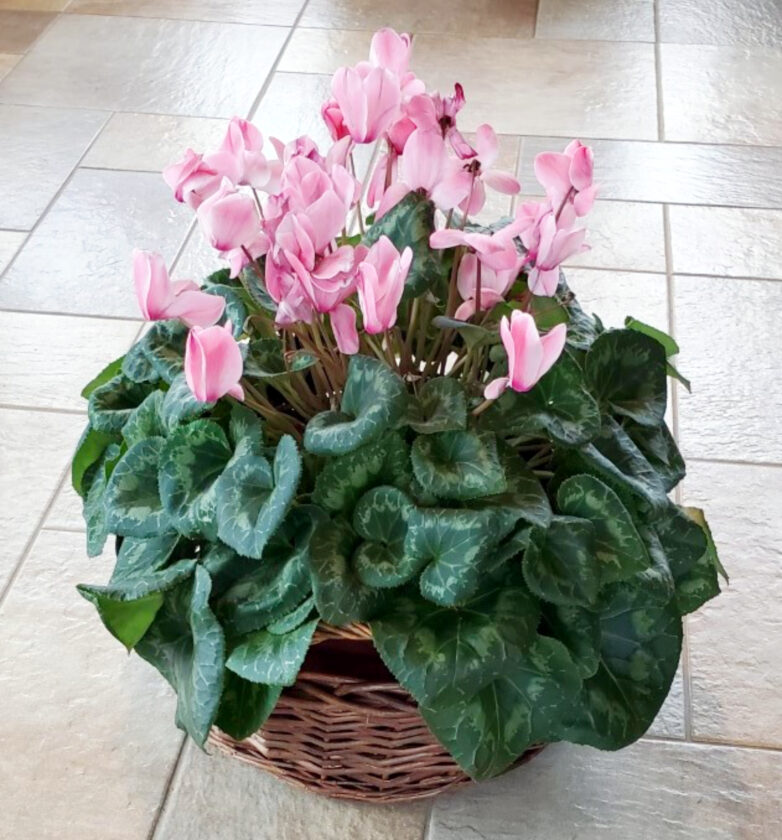
PHOTO BY DEBRA BURROWS A large florist’s cyclamen blooming in January at a home in Clinton County.
For many gardeners, myself included, January and February can be challenging. Although snow covered landscapes are beautiful sights in winter, all too often we see dreary, rainy and gray days. One way to brighten things up a bit is by adding blooming houseplants to our indoor environments.
One of my favorites is Cyclamen persicum, commonly called florist’s cyclamen. It is one of over 20 species of cyclamen and is an excellent houseplant choice for those in need of a little winter color. Although some species of cyclamen are hardy perennials, florist’s cyclamen cannot survive frost and is therefore grown as a houseplant in cold climates such as those here in central Pennsylvania.
Cyclamen persicum plants have mounding habits, attractive, heart-shaped leaves and bloom in a variety of colors including shades of pink, lavender, red and white. The flowers are uniquely shaped with reflexed (back-facing) petals which appear on single stalks standing straight above the foliage. Breeding has produced several different flower characteristics including single and double forms as well as ruffled and fringed petals and also petals with white margins. Healthy cyclamen leaves are strong and sturdy and can be solid in color or display very attractive patterns in shades of white and green.
Florist’s cyclamen plants are available in a variety of sizes, from miniatures less than six inches tall to large cultivars that can be more than a foot wide and reach heights of 16 inches. They grow from tubers, which are fleshy underground stems that store nutrients.
With proper conditions, florist’s cyclamen plants can bloom indoors for up to three months. They prefer cool daytime temperatures (60-65 degrees Fahrenheit) and even cooler nighttime temperatures. They should not be placed near heat sources such as vents and radiators. Because many homes have very low humidity levels during the winter months, it may be helpful to increase the humidity around cyclamen plants. This can be done by filling a plant saucer with a single layer of pea (small pieces) of gravel, adding water to reach almost to the top of the gravel, and then placing the pot on top of the gravel. As the water evaporates, it increases the humidity around the pot, and the pot is kept above the standing water because it is resting on the gravel. Water should be added as needed to maintain a level just below the top of the gravel.
Bright, indirect light is best, although a small amount of weak winter sunlight from an east or west-facing window may be suitable in some situations. Florist’s cyclamen should not be placed in strong, direct sunlight.
Cyclamen plants need plenty of moisture, but cannot tolerate soggy conditions. The soil in their pots should be allowed to dry slightly between waterings. The crown of the tuber will be susceptible to rot if it receives too much moisture, so bottom watering is often recommended. The pot can be placed in a saucer filled with water, allowing several minutes for the water to be soaked up into the pot. After about 15 minutes, any water remaining in the saucer should be emptied so that the pot does not sit in standing water.
The addition of fertilizer will support flowering, but too much fertilizer can be detrimental. A houseplant fertilizer applied according to package directions is recommended. Deadheading, or removing of spent flower stalks, will encourage more blooms. The flower stalk should be grasped as close to the crown as possible, then twisted and pulled out quickly.
The Cyclamen persicum species is native to Mediterranean climates, where rain and cooler temperatures in winter are followed by warm, dry summers. In their natural environment, they stop active growth during the dry season, shed their leaves and enter a state of dormancy. Growth resumes again in autumn when rain is more plentiful and temperatures cool. Replicating these conditions with houseplants can be challenging, which is why florist’s cyclamen are often treated as annuals and discarded once growth has stopped. Those interested in making the attempt can find step-by-step instructions in a factsheet posted by the Clemson University College of Agriculture at https://hgic.clemson.edu/factsheet/cyclamen/.
With Valentine’s Day approaching, garden centers, florist shops and even grocery stores will be offering selections of florist’s cyclamen. Chances are, I’ll be adding some to my collection.
— — — —
Debra C. Burrows, PhD, is a retired Penn State Extension Educator and a certified Master Gardener. She can be reached at dcb3@psu.edu.
Garden
Flower gardens endure hot, dry summers better if you choose these plants
How to mulch your garden beds without harming plants
When you look at your garden beds and borders, do you see any bare soil? If so, mulch is in order. Mulch is ...
Hard freezes and their consequences
Gardeners often hear about supposed hacks and quick fixes. Here are some common ones debunked
Microgardening means getting a surprisingly big harvest from a windowsill or balcony garden