
Surrounded by cicadas

Trending
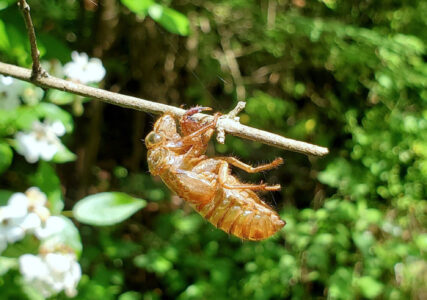
PHOTO BY DEBRA BURROWS
A cicada exoskeleton is left behind on a branch.
For the past several weeks, periodical cicadas have emerged in the wooded areas around my home. Their singing filled the air, so my husband and I ventured into the woods to get a closer look. There we saw thousands of cicadas climbing everything in sight--tree trunks, bushes, branches, stems of wildflowers and tall grasses, anything that grew upward. We also noticed thousands of discarded bronze exoskeletons. The sound was amazing. It was high pitched and vibrating and seemed to come in waves, reaching a crescendo, dying down and rising again. It surrounded us. We left the woods with a sense of awe and appreciation for the natural phenomenon we had just witnessed.
There are seven species of periodical cicadas which are native to eastern parts of North America. They are not found anywhere else in the world. Periodical cicadas spend most of their lives underground as nymphs and then emerge in very large numbers, called broods, after a period of either 13 or 17 years. Broods are identified by Roman numerals. This year in Clinton County, we are experiencing the emergence of Brood XIV which occurs every 17 years. It is one of three species of periodical cicadas found in Pennsylvania.
Cicada nymphs feed on the sap from tree roots and emerge from the ground when the soil temperature reaches 64 degrees in the 13 or 17 year. They begin climbing, shed their exoskeletons and develop into adults within a few hours. Males start to sing by vibrating a part of their bodies called a tymbal. As more males sing, the sound becomes a chorus, which serves as a mating call. Males and females mate within about 10 days. Females deposit their eggs into incisions in small branches. In six to 10 weeks, the eggs hatch into nymphs. The nymphs begin burrowing into the ground and the cycle begins anew. Brood XIV will emerge again in 2042.
Cicadas do not bite or sting humans and broods are active above ground for only about six weeks. While the noise from their singing is annoying to some, others may find it enjoyable. I certainly did. People sometimes incorrectly refer to cicadas as locusts, which is inaccurate. They are two very different insects. Whereas locusts are known for devouring crops, cicadas do most of their eating as underground nymphs, feeding on the sap from tree roots. They pose no threat to food crops.
Gardeners need not be concerned that periodical cicadas will harm their plants, with one exception, and that is very young trees and shrubs. Female cicadas use their ovipositors, which are saw-like appendages, to make incisions in the tips of branches where they place their eggs.
This is usually not a problem for mature trees and shrubs. The branch tips may die, which is called flagging, but the overall health of the mature plant is not affected. Very young trees and shrubs, however, can be harmed and even killed if cicada incisions bring about the loss of too many of their tender branches. Mesh netting can be placed around young trees and shrubs to prevent damage. The use of insecticides on cicadas is not recommended.
Periodic cicadas, like all living creatures, play a part in the web of life on earth. In the years when they emerge, cicadas are a bountiful source of protein-rich food for birds and other wildlife, including bats, racoons, opossums, coyotes, snakes and even fish. Chickens eat them, too. The tunneling of nymphs helps to aerate the soil around tree roots. Adult cicadas live for only about a month after their emergence from the ground, but as their bodies decay, they become a source of nitrogen fertilizer.
I'm glad I had the opportunity to spend time in the woods during this year's emergence of Brood XIV and I hope I'll be able to do it again in 2042.
Additional information on periodical cicadas is available from Penn State Extension at extension.psu.edu/periodical-cicada and from University of Arkansas Extension at www.uaex.uada.edu/environment-nature/anr-blog/posts/cicadas-2024.aspx .
-- -- -- --
Debra C. Burrows, PhD, is a retired Penn State Extension Educator and a certified Master Gardener. She can be reached at dcb3@psu.edu.