
Ferrara interviewed by KC board for Johnston’s open seat; KC board denies two late applicants
-
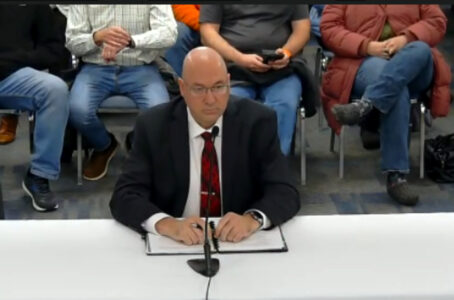
- PHOTO PROVIDED Region IV candidate Kevin Ferrara is pictured during his interview with the Keystone Central School District Board of Directors at a special meeting Thursday night.
-
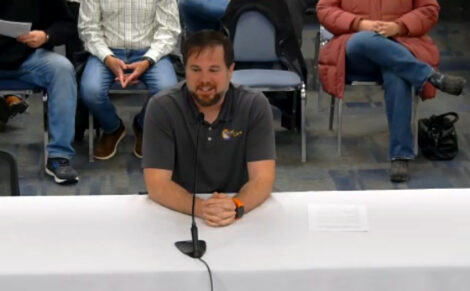
- PHOTO PROVIDED Jason Smith, a resident in Region IV, was one of two individuals who asked the board to consider accepting his letter of interest and application at its special meeting Thursday night.
-
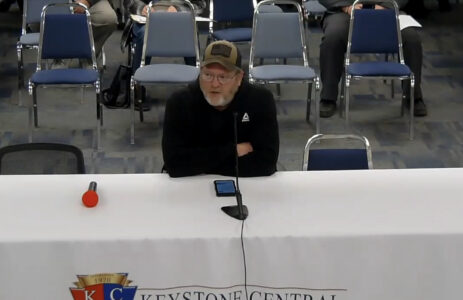
- PHOTO PROVIDED Former Keystone Central School District Board Member Roger Elling addresses the board during public comment at its work session on Thursday night.
PHOTO PROVIDED Region IV candidate Kevin Ferrara is pictured during his interview with the Keystone Central School District Board of Directors at a special meeting Thursday night.
MILL HALL — Though two new applicants spoke about their interest to fill a vacancy, the Keystone School District Board of Directors initially elected to not consider them during its special meeting this week by majority vote.
On Thursday night, the board held a meeting prior to its work session, looking to interview candidates to fill its Region IV seat — previously held by Jeff Johnston. Johnston submitted his resignation in December. Region IV includes Pine Creek II, Dunnstable and Wayne townships.
Only five members were present for the special meeting, President Elisabeth Lynch, Vice President John Miller, Chris Scaff, Manny Rodriguez and Dr. Bill Baldino.
Prior to its deadline, the board received only one application for the position from Kevin Ferrara, a resident of Pine Creek II.
During public comment, two residents of Region IV, Heather Yost and Jason Smith, said they submitted a letter of interest and application roughly a day or two past the deadline.
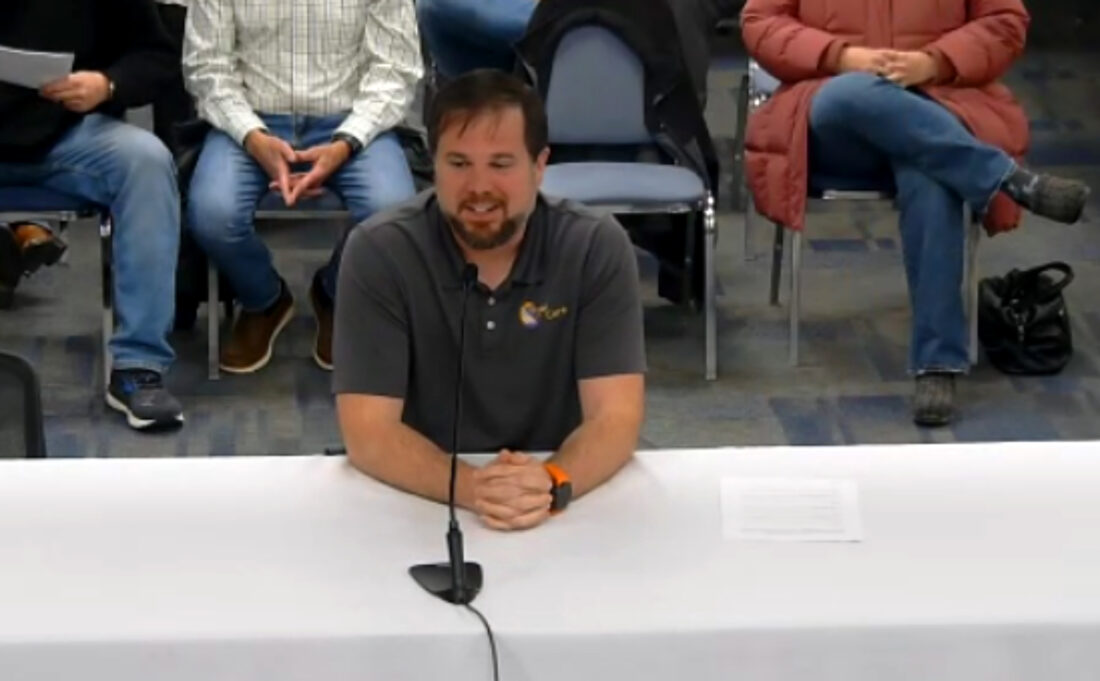
PHOTO PROVIDED Jason Smith, a resident in Region IV, was one of two individuals who asked the board to consider accepting his letter of interest and application at its special meeting Thursday night.
Yost, who attended virtually, told the board she was unaware of the opening but filled out an application once she’d learned. She submitted it two days past the deadline.
Later, the board heard from Smith, who said he was out of the country for the two weeks leading up to the deadline.
Following these requests, Superintendent Dr. Francis Redmon said there is no set law or procedure preventing the board from considering the applicants
“There is no strict requirement” beyond appointing someone within 30 days of a resignation, he said.
To meet this deadline, an appointment must be made before the end of January.
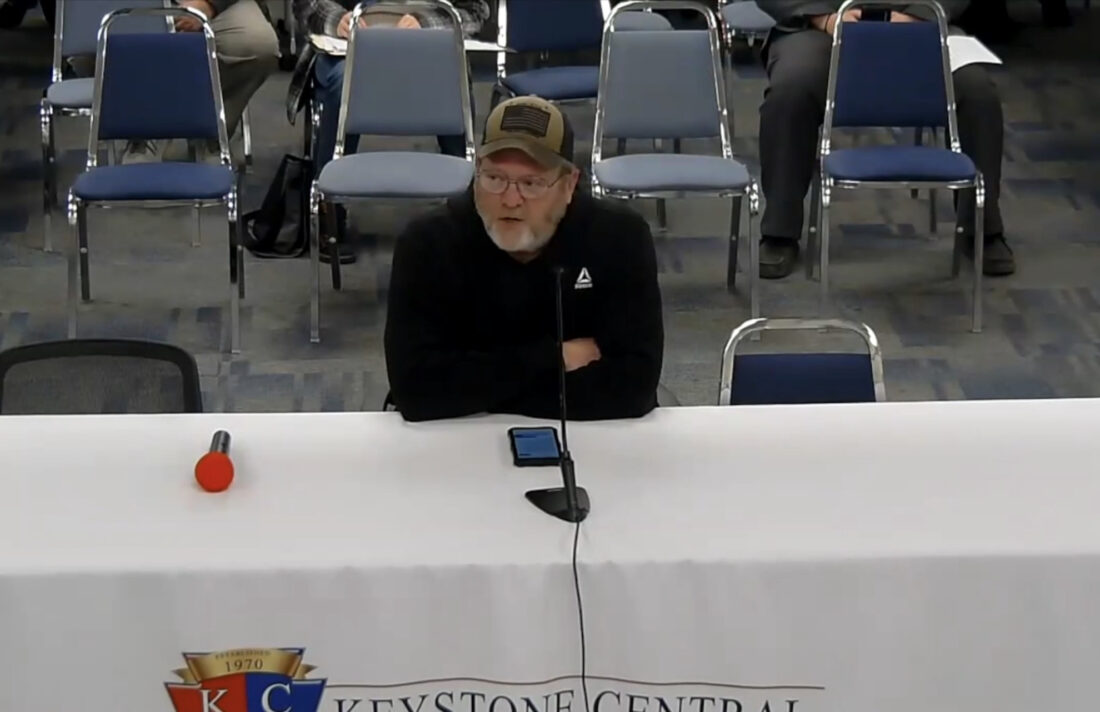
PHOTO PROVIDED Former Keystone Central School District Board Member Roger Elling addresses the board during public comment at its work session on Thursday night.
Redmon said in his own hiring practices, if he only receives a singular candidate, he would reopen the call of applicants to create a bigger pool if possible.
Baldino agreed with Redmon’s assessment.
“I think it would behoove us to accept these candidates. I don’t see the rush to fill this position,” he said.
Scaff also spoke in favor of allowing Yost and Smith to be considered.
“Since we have such a hard time getting candidates, I don’t see why we can’t listen to all of them,” he said.
Lynch asked the board if it would like to move ahead with accepting the candidates or continue with the practice it had utilized in the past.
Baldino requested a formal vote be made to see which direction the board would like to take.
Scaff motioned to interview all three candidates, which was seconded by Rodriguez.
However, the motion failed 3-2, with Lynch, Miller and Rodriguez voting no and Baldino and Scaff voting yes.
During public comment at its work session, former board member Roger Elling told the board it had accepted late applicants in previous instances.
“It’s only fair I let you know,” Elling said.
He went on to explain that when the Region III seat was vacated by then-member Billie Rupert in 2019, the board had two candidates to interview — past member Polly Donahay and Corey Watkins.
Elling said the night of the meeting, Katelyn Hendershot came to the meeting and noted she was unaware of the filing deadline.
“The board, in fairness to the region, interviewed her,” Elling said.
He went on to admonish the current board for choosing not to accept the two new candidates, emphasizing Scaff’s point that it’s difficult to find individuals interested in running for public office. He called their action “a disgrace.”
A decision surrounding the appointment of someone to the Region IV seat will not be made until the voting session on Thursday, Jan. 15.
According to Redmon, the board will either elect to appoint Ferrara to the position, or to table the appointment and reopen the search for further applicants to be considered.
Ferrara’s interview took roughly 45 minutes on Thursday, with each board member present reading a question for the candidate to answer.
The following questions were asked. Ferrara’s responses have been edited for length:
Q: Can you tell us about yourself and your background, including what led you to apply for this vacancy and describe your experience and skills you believe have prepared you to serve effectively as a board member?
Ferrara is a 1990 graduate of Jersey Shore High School. After taking a year off to decide what path to take in life, he elected to enlist in the Airforce in 1991.
He told the board he served four years, including deployment during Operation Desert Storm, and returned to the area in 1995 where he served as a deputy sheriff.
In 2001 he returned to the military and was deployed to undisclosed locations, traveling around the world. He retired from the military in 2017.
He also has a Master’s Degree in Community and Economic Development from Penn State University.
Following his retirement, he served at the Pentagon as a federal contractor for a short time, overseeing the Airforce’s Fire Protection Emergency Services.
He later chose to return to Clinton County in 2019 and started a consulting firm. He currently lives in Woolrich.
In his consulting work, Ferrara said he deals mostly with occupational exposure to military toxins, something he experienced during his time in the military.
He is currently part of the Pennsylvania Cancer Coalition and Penn State Cancer Institute.
His work has seen him speak before Congress about the Firefighter Protection Act and with the state for better regulations.
In terms of what his experience can bring to the board, Ferrara said his degree and his work with finances in the military are important.
“I was responsible for several multi-million dollar budgets that saved taxpayers millions annually,” he said of his time in the Airforce. “Some of those budgets are still in use, namely the personal protective equipment. We did a huge swap over with that.”
He told the board he was taught to overcome and adapt.
“Collectively I bring a lot of that to the board. How to streamline. How to do more with less and still be able to achieve the mission,” he said.
Q: What do you see as the greatest strength of KCSD and what challenges do you think we face?
Ferrara said the district’s greatest strength is its students and staff.
“Just like in the military, you can have the greatest equipment out there, finest facilities, but if you don’t have the personnel — and in this case in the district, the students and staffing — all of those visible luxuries, they’re just bricks,” Ferrara told the board. “You need great people to fill those facilities, to carry on all of that knowledge, whether they keep it here within the district or take it abroad like I did.”
In terms of its biggest challenge, Ferrara said moral and retention is the district’s major hurdle.
“There’s always going to be challenges. Let’s be honest, Keystone Central over the years has had its share of challenges,” he said. “But the students, the staff, the board, and the community have continuously rallied together and kept everybody united.”
He said morale is what keeps that going.
“If we keep the morale high here, we retain the student population, we retain great staff — especially our teachers. We know they don’t get enough thanks as they should. They have a hard task,” he said.
Retaining the great staff that exists, he said, is what will help make Keystone Central a superior school district.
Q: Describe a time when you had to make a difficult decision as part of a group. How did you handle differing opinions?
Ferrara said during reshaping — adjusting staffing — during his time in the Airforce involved some of the more difficult decisions in his career.
“At the end of the day, you’ve got to look somebody in the face and say ‘it’s great having you here, but the military says you have to go’ and we did that quite often unfortunately,” he said.
He explained the way to handle it was to sit the individual down to discuss why the change was happening and offer new avenues for them moving forward.
“That’s the hardest decision any leader, no matter if you’re in the district, in corporate america, in the military is saying ‘thanks for your service but your services are no longer needed,'” he said.
Q: What do you believe is the role of a school board member? How does that role differ from the superintendent or administration?
Ferrara compared the role of a school board member to his work in the Airforce at Air Combat Command.
He said during his time, the command — who was in charge of 14 installations — would make decisions regarding policy, procedures, funding and budgetary issues which would then trickle down to the installations.
“I see with the board here, the board establishes policy, procedures, financial issues and then they hand that off to the superintendent and administration who then enacts whatever the board has passed down or implemented,” he said.
The board, he said, acts as the overarching authority with the superintendent and administration working for the board.
He noted communication between the two is crucial.
“You have to have communication or otherwise there’s total chaos,” he said.
Q: Collaborative decision making is more effective when members actively listen to all sides of an issue and publicly deliberate before a decision is made. To reach an agreement viewpoints may not be in alignment with your beliefs. Provide an example of a situation in which you did not agree with the opposing group’s viewpoint. How did you respond? After the decision was made, and you still didn’t agree with the outcome, what follow up actions did you take? What did you learn?
Ferrara used his continued advocacy related to PFAs in drinking water as an example. PFAs are “forever chemicals” that can be found in water and other items consumed by the public.
He told the board he and others currently are looking to lower the levels of PFAs that are allowable in drinking water, after the Pennsylvania Department of Environmental Protection chose a hirer level.
Ferrara said before the decision was made, and during a public comment period, he submitted a lengthy comment featuring data and other information to show why it shouldn’t be at that level. DEP elected to keep that level, he said.
After this decision was made, he began speaking to cancer coalitions, environmental organizations, Congress, state legislators and media to try and make a change.
“What I learned is that you cannot give up the fight. If you’re passionate about something, you cannot just say ‘okay it’s the state, they’re powerful, they’re not going to win.’ You have to keep fighting the good fight,” he said.
Q: School board directors’ plans, actions and decisions are influenced by many factors, including input from community members and constituents. How will you engage with the community to obtain their viewpoint? What is your plan in ensuring their voices are heard? How would you handle an individual complaint brought to you by a citizen in your region?
Ferrara said communication and engagement was a large part of the program at Penn State where he received his Master’s. He told the board he was taught the importance of establishing lines of communication.
As an example, he spoke about the work the Penn State Cancer Institute does.
“We reach out to communities, get engaged with them,” he said. This can be through phone, email, in-person and virtual meetings.
Offering different options of communication, he said, was important. Particularly with how advanced technology has become.
“A lot of folks simply can’t get out and meet face to face. So if we can establish ways of communicating with them,” he said.
He said when receiving a complaint from an individual, there was a particular system he’d implement.
“When somebody does complain, accept it, document it and then tell that individual or individuals an initial plan,” he said.
From there, he said continuing that line of communication throughout the process is also important.
“Give them the opportunity to come up with solutions. Then you’ve retained that individual as an asset. They’re more receptive to show up to meetings, to be involved with the board or organization you’re with. Then you can rely on that individual as we’ve said,” he said.
Q: In what other school districts, community organizations or activities have you been involved in?
Ferrara said, due to his extensive time in the military, he wasn’t involved in any other districts.
In terms of organizations, he reiterated his work on the Community Action Advisory Board for Penn State Cancer Institute, the Pa. Cancer Coalition and is on two committees with the National Fire Protection Association. He also serves on a panel for a congressionally mandated program to review applications related to military exposures.
Q: Explain how you believe the school board can balance its responsibility to provide a quality education with the need to manage the financial burden on local tax payers?
Similar to how he dealt with foreshaping in the military, Ferrara said looking at the situation from a “30,000 foot view” can help keep that balance.
With that viewpoint, he said, you can look at different issues to evaluate whether its staffing, funding, etc.
In that process though, he noted transparency to students, staff and the taxpayers was important.
“When the board makes certain decisions, especially when it comes to funding, it has to be very transparent as to why it’s being done. And at the same time show the impact it has. Whether you reduce funding, you increase expenses, anything financially like that,” he said.
“The board has a huge responsibility to say ‘how do we maximize every penny?’ You have to maximize every penny to its fullest potential in order to reduce that financial burden on the community,” he said.
Q: Do you have any relatives that work at Keystone Central School District?
Ferrara said he does not believe he does.
Local news

Lock Haven Kiwanis Club set to celebrate 100 Years with event Jan. 24

Policing experts question tactics in Minnesota shooting as videos challenge narrative

Pennie enrollment drops as Congress wrestles with subsidies
Expanding horizons: New executive director shares vision for Clinton County Libraries
Kramer resigns from KC board
MILL HALL — Just a month after being sworn in, Keystone Central School District Director Mary Kramer has ...