Pennie enrollment drops as Congress wrestles with subsidies
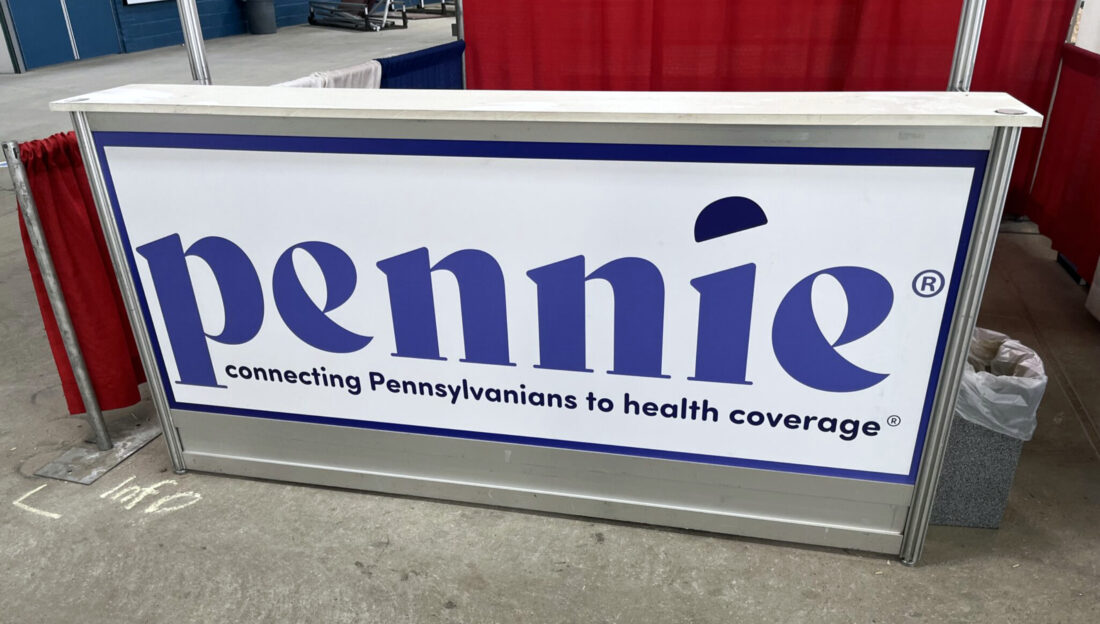
Photo by Whitney Downard/Pennsylvania Capital-Star A Pennie sign seen at the 2026 Pennsylvania Farm Show on Jan. 8.
Thousands of Pennsylvanians have left the state’s only Affordable Care Act marketplace, Pennie, following sharp increases in monthly premiums due to expiring enhanced federal subsidies.
Pennie numbers continue to fluctuate as the U.S. House voted Thursday to extend benefits for moderate-income enrollees for three more years. The measure moves to the Senate and, if approved, would need to be signed by President Donald Trump before the subsidies take effect. At least 70,000 Pennsylvania residents have left the exchange so far.
For those still enrolled, rising costs means cutting expenses elsewhere.
Andrew Gehman, who lives in Franklin County, told the Capital-Star that he’d ended a $12,000 contract with a salesperson after his premium jumped from $70 to $240. Gehman, 40, owns and operates a video production company, 2085 Productions, based in Waynesboro, pitching projects from Washington, D.C. to Philadelphia.
“It’s essential. I had to go to the emergency room six, seven years ago when I didn’t have health insurance … and I think the hospital bill was $6,000 or $7,000,” Gehman said. “I was out of work at the time, so it was 100% (covered by) financial assistance.”
“But the reality is, this is why you need health insurance,” he continued. “Because the whoopsies, the mistakes, the accidents happen.”
Gehman said he started his company in 2019, paying “basically nothing” at first for Pennie. Last year, his business made $75,000, which doesn’t include expenses.
While he has found a way to balance his checkbook, others aren’t so fortunate. Some have reported paying nearly $1,800 a month for their Pennie coverage.
“You should be able to work full time and afford health insurance,” Gehman said. “… It’s so high now for a lot of people and they have to choose between, ‘Well, do I want to make my mortgage payment or my health insurance?’ Obviously, they’re going to get rid of health insurance.”
Falling Pennie enrollment
In 2025, 497,000 Pennsylvanians were enrolled in Pennie — a record-breaking amount. During the enrollment period from Nov. 1, 2024 and Jan. 15, 2025, 90,000 people signed up.
But, more than halfway through this cycle’s enrollment period, overall enrollment numbers are down by 20,000 people and nearly 1,000 terminate their coverage each day, according to Pennie Director Devon Trolley. As of this week, between 465,000 and 472,000 Pennsylvanians are enrolled in Pennie. The open enrollment period for this year was extended to Feb. 1.
“We don’t have a lot of insight into where people ended up,” Trolley said. “Anecdotally, from our call center … we’ve been hearing pretty consistently that cost has been a major factor this year.”
The most significant premium increases hit those over the age of 55, Trolley said, especially those earning above the enhanced subsidy cutoff — roughly $62,600 for a single person or $84,600 for a family of two.
“Take a 60-year-old couple, for example. In 2025, they were paying about $500 or $600 a month and now, in 2026, their bill is $2,000 to $3,000 a month,” said Trolley. “In some cases, we’re seeing the monthly premiums for that population comprise upwards of 50% of their income.”
Preventative care for this age group can be critical to identifying chronic conditions and is a core part of the services covered by the Affordable Care Act, as detailed by health policy group KFF.
“Without health coverage, you’re not catching those early, you’re not managing chronic conditions,” said Trolley. “And by the time they do hit Medicare at age 65, the population is going to be sicker and more costly (to cover).”
To 61-year-old Scott Cannon, of Luzerne County, insurance is “a necessity” at his age.
“I can’t not have it, but I know some people younger than me who are gambling and not having it,” said Cannon. “I’m worried for them because if something were to happen, it’d be a tough situation.”
Cannon is a videographer whose wife works part time at the local library. Together, their monthly bill used to be $83 — which was “very affordable” — and now costs $283.
“It’s tough because the price of everything is going up … I do a lot of videos, television commercials and social media videos for businesses and AI is being used by those businesses instead,” said Cannon. “So business is getting harder and harder to find.”
After 30 years of using the same landline for his business, Cannon opted to cancel that contract to make up the cost difference.
While renewing the policy for him and his wife was fairly straightforward, getting coverage for their youngest daughter has been a challenge.
After turning 19 in November, she no longer qualifies for the Children’s Health Insurance Program, but might get her own policy through Medicaid. However, a paperwork mixup seems to have closed that pathway, so the Cannons are looking at adding her to the family plan.
“We’re already paying more than we did last year, so now we’re going to add my daughter’s insurance on top of that,” said Cannon. “In the meantime, I don’t think my daughter’s covered.”
Over in Congress
Though the credits are designed to make coverage more affordable, it comes with a $1 trillion price tag for the federal government, according to the Congressional Budget Office. Extending the subsidies for those making about the threshold makes up roughly $35 billion of that estimate.
The enhanced benefit is a recent development — part of a 2021 COVID-19 relief package that passed under former President Joe Biden and expired at the end of 2025. Extending the subsidies is popular across the country, according to KFF polling, but Republicans point to mounting costs for taxpayers.
In the House, votes fell largely along partisan lines, though three swing district Pennsylvanian representatives joined Democrats to advance the bill: Reps. Brian Fitzpatrick (1st District), Ryan Mackenzie (7th District) and Rob Bresnahan (8th District).
The commonwealth’s seven other Republican lawmakers voted against the measure.
The U.S. Senate has been working on its own health care package over the interim, and may not take up the House’s effort.
Not knowing where Congress will land complicates Pennie’s work, Trolley said. A “straight extension” would be the quickest to implement, she added, but “any changes beyond that would take more time to understand.”
“If congressional action does occur, we would make sure to provide some opportunity for people to come back in and change their mind,” said Trolley. “What that looks like really depends on when exactly an extension would occur and what that extension looks like.”
——
Pennsylvania Capital-Star is part of States Newsroom, a network of news bureaus supported by grants and a coalition of donors as a 501c(3) public charity. Pennsylvania Capital-Star maintains editorial independence. Contact Editor Tim Lambert for questions: info@penncapital-star.com. Follow Pennsylvania Capital-Star on Facebook and Twitter.
Local news

Lock Haven Kiwanis Club set to celebrate 100 Years with event Jan. 24

Policing experts question tactics in Minnesota shooting as videos challenge narrative

Pennie enrollment drops as Congress wrestles with subsidies

Expanding horizons: New executive director shares vision for Clinton County Libraries
Kramer resigns from KC board
MILL HALL — Just a month after being sworn in, Keystone Central School District Director Mary Kramer has ...