
University president talks goals, looks to future in Q and A with The Express
Trending
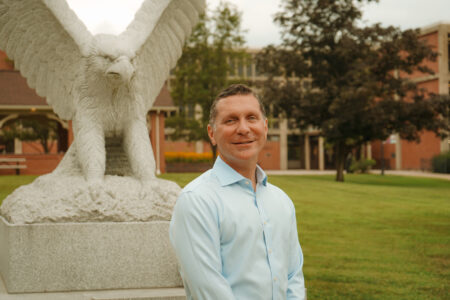
PHOTO COURTESY OF CU-LOCK HAVEN
Dr. Jeff Osgood, Jr., who was recently appointed as Commonwealth University's president following nearly a year in an interim capacity, is pictured on campus.
LOCK HAVEN -- When recently appointed Commonwealth University President Dr. Jeff Osgood, Jr. took on the presidency in an interim capacity in 2025, he'd initially expected to only lead the university's three campuses for a year.
Prior to his initial appointment, Osgood had spent 17 years at West Chester University, serving in a variety of roles. Becoming president of one of the Pennsylvania System of Higher Education's recently merged campuses wasn't in his plans.
However, during his time spent at all three campuses -- Lock Haven, Bloomsburg and Mansfield -- he developed a feeling of ownership of each and their unique identities. He also can see the potential to build on each's success and continue to improve the student experience over time.
"I hope that people see my desire and being part of this community is a clear commitment that we're going to be successful. Because I would not have come here if I didn't think success was a possibility," Osgood told The Express.
Osgood has previously spoken about his understanding of the trust that was broken between the campuses and their communities following the merger of all three into Commonwealth University. He's also been outspoken that he wants to work to mend that bond and continue to build on each campus's strengths.
He's also looking towards a five-year plan to balance the university's budget, improve face-to-face instruction on campuses and strives to build relationships and trust between faculty, staff and students.
Recently, Osgood sat down with The Express to dive into his plans, just a week after it was announced he'd be taking on the presidency in a permanent role.
The following questions and answers have been edited for length:
Q: How have you worked to rebuild trust between Commonwealth University and the community following the merger?
Osgood: The first part of that is visibility. I think that had been a missing component of the Commonwealth presidency. So I'm meeting with the county commissioners, showing up at events. One of the first events I did, Doug (Spatafor) and Albert (Jones) have a show at the Hangar, so we've done that.
I'm also going out with the faculty and staff to establishments in the community.
I'm just being a part of the community and making sure that my presence isn't just here on campus.
The other piece of this is testing out what's the best rotation to make sure I'm the president for all of the campuses.
For students, I prefer to eat at the dining facilities. I think, especially that first fall, people didn't have a familiarity with what I look like. I think that will decrease over time.
The other part is follow through. Previously leadership I think had good intentions and then let the urgency overtake following up on promises made. For me, the other kind of component is promises kept.
One of the things we're looking to do as the university continues to struggle with its financial situation... Commonwealth University doesn't need three presidential residences at each campus. We heard that the residency here has a great deal of meaning for our faculty and staff at Lock Haven, but also has a great deal of meaning for people in the community. So we're working right now to see if we can get that property transferred over to the county. I think we're making good progress on that.
Visibility and promises kept is also important. For the upcoming fall semester there (will be) significantly more face-to-face courses here at Lock Haven. We're really responding to that student feedback that they weren't getting the college experience they want.
Everything does take time, it's a cliche that time heals all wounds, but I think... that time, commitment and delivering actually heals those partnerships and I think that's what we're working towards.
Q: What are the biggest concerns you've heard from students/staff/community members? How have/will you address these?
Osgood: I think the first piece that's really important is the uncertainty that exists among the faculty and staff.
When I talk about uncertainty I mean that folks are wondering if their job will be here tomorrow. So my primary focus is communicating that the team and I are doing everything possible to right this budget situation so that I can continue my commitment to our faculty and staff and that is that we are not looking to lay off existing people.
We are absolutely eliminating vacant positions. That does impact the university because we become leaner and leaner and people have to pick up more and more work. But in my estimation that's a better trade off than eliminating a position which someone actually has.
Really, it's about addressing that uncertainty.
The second piece of this is communication. Communication was really an opportunity for us when I came into the presidency back in August of 2025. We did a lot of communication in the fall, you saw that moral shift happening.
I will tell you, I've never been a president before, but the spring semester really did take me by surprise. I really cannot believe we are about two weeks away from the first week of May.
There's been less communication in the spring, but I think we're going to be able to do a little post-game analysis of my first year to see how we can keep that level of communication consistent over the entire semester.
I think when you address those two things, you dial down the uncertainty, and people's morale starts to lift, and they finally envision a future in which everything isn't kind of falling apart.
Q: Are there any particular goals you have in mind during your time in office? Any you've completed or are nearly complete?
Osgood: My primary goals are three goals that are highly inter-related.
The first is to stabilize the institution's finances which then will lead to a restored trust and confidence in the longevity of the institution. Because right now what we're experiencing is there is some hesitation on the part of students who would want to attend Lock Haven but they are concerned if Lock Haven will be here tomorrow. So part of what we need to do as a team is shore up those finances.
Part of that work is already underway.
If I look back over this past year, two points of pride stand out for me: People will tell you that while it's not perfect, there is a palpable increase in morale on campus. The second is, as you know, there are two financial sides of a university's house. You've got one side where the tuition comes in and the other side which is like dining, student recreation center, housing and those kinds of things. We made the difficult decision with the trustees to align our fees for those to ensure we were in a stable environment.
Twenty-four months from this period we'll be able to say that one half of our financial house is stable. That's a huge milestone towards communicating that we are absolutely on the path to success.
We've got an increase in morale, we've got to stabilize (the financial) part to restore the confidence.
So that really is the primary goal: to balance the budget and restore confidence in the educational quality of this institution. It is there but there's been a lot of noise between the integration and the presidential transition. I think that's masked the true excellence that is here.
The third part, we have to address the facilities component.
Just this past week we were told we'll be able to tap into some additional funding through the Office of the Chancellor to help support a university-wide facilities master planning process. That will tell us where we need to start making investments. When I look around Lock Haven this is an amazing campus, but there are definitely aged facilities and those are investments we need to make.
We also have a couple of donors who are getting close to making what I'd call significant investments that will allow us to upgrade a number of facilities on campus. Because when students step on a campus the vast majority know in the first 30 minutes whether or not this is a place they want to be. The facilities play a huge role in that.
Q: During your time spent at CU-Lock Haven, what strengths have you identified on campus?
Osgood: It's easily the clear and unabiding commitment of our faculty and staff to our student population and their success.
Our students come from a variety of walks of life. Some of our students come from very modest means and need significant support. And our faculty and staff step up in amazing ways.
I will tell you that I was overwhelmed with The Haven Cupboard and what we are able to provide for our students.
The other thing that is surprising to me, in a positive way, more than a quarter of our students are student athletes here at Lock Haven. This is a place where athletics is a core part of educational experience for many of our students and how that helps develop them into the adults we're hoping they become.
With Lock Haven, what I have found is, at the end of the day with just a little bit more resources it can build on the amazing work that we're already doing.
It is very clear to me after a year that we are three amazing campuses under one roof and the future is not that somehow the Commonwealth identity will eclipse the Lock Haven identity.
The way I like to describe it is we are one university but we are three distinct students and faculty and staff and that is one of our core advantages.
Q: Are there any areas of improvement you've identified? How have you worked with students and staff to make them come to fruition?
Osgood: I don't want to overstate it but morale, I think that journey we're going to be on for quite some time.
I met with union leaders earlier and they said one of the biggest concerns right now is, now that I've gotten the job, if I'll do a complete 180.
One of my top priorities is, over the coming years, to show people that the person they met in year one is the person that they have for the next decade. What that means is somebody who thinks humanely, passionately about the decisions we're making about putting students first.
In terms of improvement we still have to work on aligning the number of face-to-face courses at Lock Haven. We owe it to our students that they have the classes they want. We made good progress in the fall, we continue that in the spring and we'll take a step back in the fall and talk to students and see what was enough and what changes need to be made. We plan to survey our students in fall and we work really closely with our student government association presidents. Also we've been really cognizant of meeting with student organizations and making ourselves available. That's the key way of getting that information.
The facilities piece is also critically important.
I have been here less than a year but the immense pride I have in this place -- there's no artifice in that. I had no anticipation of being this committed to Commonwealth at all. I told people I was going to be here a year.
But I want to find a way to communicate my commitment to Commonwealth, to the broader community, so parents and students and community partners can feel good that we're here and here for the future.
Q: In your view, what were some positives that came out of the merger? What were some negatives you saw?
Osgood: From a positive perspective I think this in many ways ensures the long-term viability of three campuses that serve the northern tier of Pennsylvania. I think that as we continue to make refinements to this model we'll see that even more.
I understand, to the outside observer, how you can say 'how can you see any positive aspects of this?' But I think with this new leadership team and our focus on centering students, eliminating the budget deficit and showing the ways in which we can share resources -- both human talent and also some of our educational facilities -- that people will see this was a way to ensure there were always three campuses.
Flipping to the other side of that coin, I think that all the underlying assumptions for integrations haven't completely played out. But I am really grateful the current chancellor is allowing us to go back and say that these assumptions need to be revisited. That will impact how financing and budgeting occur within PASSHE, and it impacts how we look at how many faculty and staff are necessary to each of the campuses.
It was unfortunate that some of the assumptions have not borne out, but I've been incredibly grateful to have a chancellor and chair of the board of governors to have conversations about those things that can be improved so we ensure the long-term success of the integration.
And quite honestly, it's interesting. We're seeing many mergers and acquisitions among independent colleges and private colleges and universities. We're not seeing it as much in the public space. But I know we have the team of faculty and staff to pull this through.
It's not about our talent on the campuses, it's about getting a bit more resources to deliver on the promise of integration.
Q: What do you feel are the most important focuses/roles that should be kept in mind in the office of president?
Osgood: I think there are two aspects of the presidency.
There's the external part which is very much about being visible, present and accessible. Being somebody the students, faculty and staff feel they can communicate with.
I feel we've achieved that at some level. Students, faculty and staff will actually email me directly and they receive a response. It doesn't linger in my email inbox.
I spent a considerable amount of time focusing on the external aspects of the presidency because we had to communicate that this institution, this really amazing institution, had steady leadership at the helm and was really committed to its success.
But there's an incredible part of the presidency that is also invisible to the casual observer. I really have been laser focused on the student experience and the budget.
Next year I'll continue to be focused very much on the budget. I've also made significant changes to my leadership team and I'm continuing to refine that and have the final people in place probably by mid-next academic year. I think we'll be firing on all cylinders at that point.
Q: Going into Fiscal Year 2026-2027, what timeline do you hope to have realigned the budget?
Osgood: There are some things that are completely out of our control such as healthcare costs that are dramatically increasing year over year. That has set us back a little bit.
I am telling folks that on an optimistic side I would like us to be in a balanced situation on both sides of the house by Fiscal year 2028-2029. I think a more realistic date is FY 2029-2030.
But I will say that's a pretty fast timeline when it's 2026. I think within five years.
Q: Do you have a favorite memory during your times spent in Lock Haven?
Osgood: I had always been a cat person over the years but then my partner said we should get some dogs -- so now I'm a dog person. So one of my favorite memories first coming here is seeing how many people have pets on campus.
Lock Haven is one of the few campuses in the state system that allow pets in the residence halls. I think that's a wonderful thing. That was really fun to see.
I adore the golf cart parade! My team put together Jax and Patsy's Haunted House -- those are my two dachshunds names -- on a golf cart. That was awesome and I'm very much looking forward to the upcoming golf parade.
I'll also never forget the first night I spent here walking along the river and just taking it all in. You don't get many moments alone in this job. It was in the summer, in August, and it was just really peaceful.
Q: Are there any businesses/restaurants you particularly enjoy?
Osgood: I will never forget people were like "you've got to go to Stella A's. You've got to go to Stella A's." I enjoyed that and it was a lot of fun.
Hangar 9 Restaurant was really awesome, it was a fun time when Doug and Albert did a sports show for the first time there. They brought me on and it was a lot of fun and the energy was just so inspiring.
Recently I went out to dinner with the APSCUF faculty at the Broken Axe. That was a really cool place.
I look forward to visiting even more as I visit.
When it comes to other businesses, I remember one night walking downtown when it was warm out. It was later at night but I remember seeing a game store (White Knight Game Room in Haven). I thought that was so cool.
I have gotten downtown but I can't wait to explore more.
I'm also a huge mid-century modern architecture fan. One of the facades that fascinates me the most is The Texas, though I haven't gotten the chance to go in. It has this very aluminum diner facade. It's so cool.
Q: What's your go-to playlist, album or song?
Osgood: I play it almost everyday as a reminder to keep going, it's Tom Petty's "I Won't Back Down." I'm from the south so I also love his southern accent.
Q: What is your favorite thing about each Commonwealth University's mascots?
Osgood: Let's talk about Lock Haven, there's just something inspiring about the bald eagle. It's the nation's symbol for freedom and it's just really inspiring. I like it a lot.
The Mountaineer I really think is hilarious. It represents the might and warrior nature of our Mountaineers. But I love it. It's actually when you think about it, in athletics most mascots are animals or something else, they're not humans. So the Mountaineers is the only human mascot we have.
The Huskies, I love dogs. I've joked around that we could become the Bloomsburg Dachshunds. I truly won't do that of course.
Q: What are your hobbies?
Osgood: This is a really human part. Are you familiar with the freshman 15? There's a presidency 15. As for my hobbies, I really love to work out. Working out is a place where I can think clearly, whether it's running or biking, but I spend so much time on the road at the moment.
I love going to the movies, period pieces and documentaries are my favorite. I also love to travel.
We also just got a pool table at home so I'm learning how to play. I don't think I'll be Paul Newman but I'll become proficient.