
Trending
As the Fourth of July, which marks America's 250th Birthday, nears, temperatures are going to reach dangerous levels.
According to AccuWeather expert meteorologists, a heat dome is developing across much of the Midwest and Eastern United States, bringing widespread 90- and 100-degree temperatures from now through the holiday weekend.
In southern Clinton and Centre counties, an Extreme Heat Watch will be in effect from noon Tuesday through 8 p.m. Friday.
From Tuesday through Friday, afternoon highs in Lock Haven will reach the high 90s, while overnight temperatures will remain in the low 70s. On July 4, the nation's semiquincentennial, temperatures will be slightly cooler, with a high of 95 and a low of 66.
In Bellefonte, afternoon highs are expected to reach the high 90s, peaking at 101 on Thursday, while overnight temperatures will remain in the high 60s and low 70s. On the holiday, Bellefonte will be slightly cooler than Lock Haven, with an expected high of 90 and a low of 65.
"Temperatures get magnified under a heat dome as sinking air associated with high pressure aloft bakes the air mass underneath it. The longer these features stick around, the hotter it tends to get at the surface of the earth," said AccuWeather expert meteorologist Carl Erickson.
For many, it will feel hotter than 110 degrees as high humidity pushes heat index values into the triple digits.
Along the edge of the heat dome, thunderstorms are expected to develop, with some capable of producing long-lived, destructive windstorms known as derechos.
The heat could also affect power and utility services as increased electricity demand strains the grid.
"Extreme heat is a double threat, it endangers lives and strains the electric grid simultaneously. As more people turn to air conditioning to survive the heat, demand spikes, increasing the risk of blackouts and brownouts. At night, in densely populated neighborhoods or apartment buildings where air flow is minimal and cooling options are scarce, those outages can turn deadly." said AccuWeather expert meteorologist Tyler Roys.
Experts say the extreme heat will impact everything from everyday life to beach vacations and outdoor cookouts to watching the fireworks.
"Anyone traveling or spending time outdoors should make heat safety part of their plans this entire holiday week," said Erickson.
Area businesses, organizations offer cooling shelters
The following businesses and organizations are opening their doors to those in need of cooling shelters during the week, as temperatures are expected to reach into the 90s:
-- Wayne Twp Fire Company, 317 Linnwood Drive, McElhattan, 6 a.m. to 6 p.m.
-- Goodwill Hose Fire Company, 126 High St., Flemington, Monday through Sunday, July 5, 8 a.m. to evening time.
-- Mill Hall Fire Company, 9 E. Peale Ave., Mill Hall, 8 a.m. to 8 p.m., Tuesday through Saturday, July 4.
-- Cara Montarsi State Farm, 358 E. Main St., Lock Haven, Monday, Tuesday, Thursday from 9 a.m.-5 p.m., Wednesday from 9 a.m.-1 p.m. and closed Friday, July 3.
-- Golden Axe, 529 High St., Unit 1, Lock Haven, Friday July 3 from 4-9 p.m., Sunday from 12-5 p.m. and closed Saturday, July 4.
-- Salvation Army, 119 E. Church St., Lock Haven, Monday, Tuesday, Thursday from 9 a.m.-3 p.m., Wednesday from 9 a.m.-12 p.m. and closed Friday, July 3.
TIPS TO COMBAT EXTREME HEAT
The Pennsylvania Emergency Management Agency (PEMA) has shared a number of ways to ensure you and your loved ones are safe during the extreme heat throughout this week.
According to its website, extreme heat is "a period of heat and humidity with temperatures higher than 90 degrees for at least two to three days."
"Among all weather-related hazards, extreme heat is responsible for the most annual deaths. It is dangerous for everyone, and can be especially tough on young children, older adults, and pets," PEMA said.
The following are ways to stay safe during these periods:
-- Stay indoors as much as possible and limit exposure to the sun.
-- Drink plenty of fluids to stay hydrated.
-- Spent time in air-conditioned places.
-- Never leave anyone, pets or people, in a parked car.
-- Take cool showers or baths.
-- If possible, avoid high-energy activities or working outdoors during midday heat.
-- Dress in loose-fitting, lightweight and light-colored clothing.
-- Check on family, friends and neighbors.
-- Keep pets indoors as much as possible and provide ample access to water.
-- Watch for heat cramps, heat exhaustion and heat stroke.
SIGNS OF HEAT ILLNESS
According to PEMA, heat cramps are typically the first signal that your body is having a difficult time with the heat.
Heat cramps are defined as "muscular pains and spasms due to heavy exertion. Although the least severe of heat illnesses, it's important to take heat cramps seriously because they often are the first signal that your body is having difficulty with the heat."
If you experience heat cramps you should get to a cooler location, remove excess clothing, drink cool sports drinks and avoid caffeine and alcohol.
If the cramps don't subside in an hour, the person has a heart problem or is on a low-sodium diet, PEMA says you should seek medical attention.
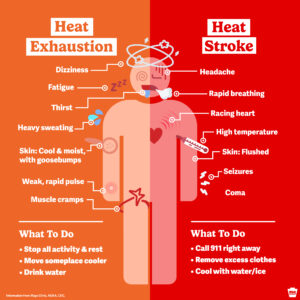
Other signs of heat illness include heat exhaustion and heat stroke.
Heat Exhaustion
According to PEMA, heat exhaustion is typical when exercising heavily or working in a hot, humid place where bodily fluids are lost through heavy sweating.
Symptoms include: Heavy sweating, paleness, muscle cramps, tiredness, weakness, dizziness, headaches, nausea and fainting.
If you experience any of these symptoms PEMA recommends you do the following:
-- Move to an air-conditioned place and lie down.
-- Loosen/remove clothing.
-- Get into a cool shower or bath, or apply cool, wet cloths.
-- Sip water or cool sports drinks. However, if you begin to feel nauseous stop immediately.
-- Avoid caffeine and alcohol.
If you follow these steps and do not see improvements, you are unable to take fluids, vomiting occurs or symptoms become more severe you should seek medical attention.
Heat Stroke
Heat Stroke is considered a life-threatening condition where an individual's temperature control system stops working.
"Body temperature can rise so quickly that it can cause brain damage and even death," PEMA warns.
Symptoms of heat stroke include: body temperature above 103 degrees, hot, dry, red skin; racing heart, rapid breathing, headache, confusion, dizziness or unconsciousness.
If you experience any of these symptoms call 911 immediately, remove excess clothes and attempt to cool with water and ice.