
Trending
There is a general rule in antiques: If it makes a sound (and is supposed to), it's worth something. The rule usually refers to chiming clocks, music boxes, instruments, and noisemaking toys. If you look into the history of these items, you can start to see some similarities. While mechanical musical devices have existed for hundreds of years and appeared in stories even older than that, the music box is believed to be the invention of a Swiss watchmaker in the late 18th century.
The first music boxes used rotating metal cylinders to pluck the teeth on a metal comb, producing tones. In the 1880s, about a century later, German inventors came up with a music box that used a removable toothed disc instead of a cylinder. The discs were changeable, allowing people to play different tunes on the same music box. As more complex music boxes were made, often including expensive details like inlaid decorations, precious materials, and automata, so were simpler versions.
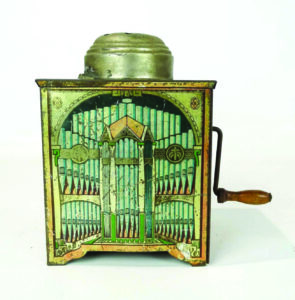
The late 19th to early 20th century was also the heyday of tin toys. Since many of these toys were miniature versions of "adult" devices like vehicles and household appliances, and interactive toys with moving parts and sounds are always engaging, it's no surprise that manufacturers made tin music boxes. Although they appeal to collectors of toys and music boxes alike, they still tend to sell for lower prices than conventional music boxes. A functional 7-inch-tall tin lithograph music box operated by a hand crank sold for $75 at Copake Auction. A colorful, if faded, lithograph of a pipe organ may provide a hint at the music it plays.
------
Q: My grandmother wants to sell her collection of pressed glass. She has a lot of different colors and patterns. Can you help?
A: The best way to sell your grandmother's collection will depend on how many pieces of glass she has and their quality and rarity. If the collection is very large, you might want to sell it all to a local dealer or auction house. However, it may be worth sorting through the collection first to identify the pieces.
Pressed glass is often inexpensive today, but some especially rare shapes, colors, patterns, and very old pieces in excellent condition can sell for thousands of dollars. There are many resources that can help identify your grandmother's glass, including online guides on Kovels.com and AntiqueTrader.com. Check your library for reference books about pressed glass, such as "Pressed Glass in America: The First Hundred Years, 1825-1925" by John and Elizabeth Welker. Glass clubs like the National American Glass Club (glassclub.org), the National Depression Glass Association (ndga.net), or the Early American Pattern Glass Society (eapgs.org) may also have identification guides and additional resources, including advice for selling.
------
Q: I bought a lazy Susan server a few years ago for $10. It has seven dishes total with beautiful, colorful mushrooms on them. There are no chips or cracks noted. The dishes fit onto a brass-colored round lazy Susan tray that measures almost 21 inches wide. The bottoms of the dishes are marked "Laveno Fornasetti-Milano-Made in Italy" with a hand holding a paintbrush stamped on the back.
Could you please give me the age and approximate value of this server? I can't seem to locate it online.
A: Your server is a design by Piero Fornasetti (1913-1988), who is famous for his unconventional ceramics, furniture, and decorative arts from the mid-20th century. His best-known designs feature parts of human faces or bodies, and he also made pieces decorated with landscapes, architectural designs, trompe l'oeil compositions, or fruits and vegetables.
The maker's mark with a hand holding a paintbrush is based on midcentury posters promoting his exhibitions. The Fornasetti brand is still active in Milan, Italy, today, run by his son, Barnaba, and makes new items from his designs. The company can also authenticate vintage Fornasetti pieces. The other name in the mark on your dishes, Laveno, is an Italian town known for its ceramic production. Like many midcentury designers, Fornasetti also made products for other brands.
Your server could be very valuable. Sets of Fornasetti dishes generally sell for at least $200, and a similar piece to yours, a server set with mushroom-patterned dishes, sold at a European auction for about $1,600 in 2024. Not a bad return on a $10 purchase!
------
TIP: To clean lithographed tin, try using Sani Wax furniture polish and 0000-grade steel wool, but use with extreme caution.
------
Kovels answers readers' questions sent to the column. Send a letter with one question describing the size, material (glass, pottery) and what you know about the item. Include only two pictures: the object and a close-up of any marks or damage. Be sure your name and return address are included. By sending a question, you give full permission for use in any Kovel product. Names, addresses or email addresses will not be published. We do not guarantee the return of photographs, but if a stamped envelope is included, we will try. Questions that are answered will appear in Kovels Publications. Write to Kovels, (Name of this newspaper), King Features Syndicate, 300 W. 57th Street, 41st Floor, New York, NY 10019, or email us at collectorsgallery@kovels.com.