Who put all these dinosaurs in my western movies?
-
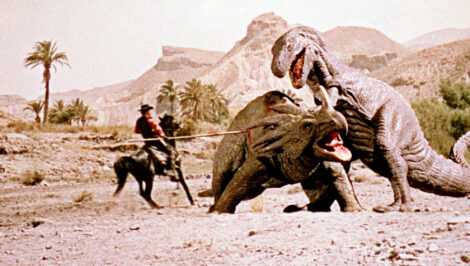
- PHOTO PROVIDED A still image from “The Valley of Gwangi” is shown, depicting a cowboy spearing a dinosaur.
-
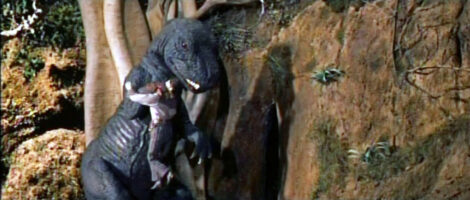
- PHOTO PROVIDED A still image from “The Beast of Hollow Mountain” is shown.
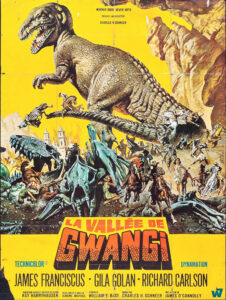

PHOTO PROVIDED A still image from “The Valley of Gwangi” is shown, depicting a cowboy spearing a dinosaur.
If I had a nickel for each movie I’ve watched with cowboys fighting dinosaurs, I would have two nickels. Which isn’t a lot, but it is funny that it happened twice.
Both “The Beast from Hollow Mountain” (1956) and “The Valley of Gwangi” (1969) were adapted from a story by legendary special effects artist Willis O’Brien (King Kong), explaining why each film turned out so similar.
Willis O’Brien fleshed out the concept for a film titled “The Valley of the Mists,” which was scrapped early into production so that he could work on “Mighty Joe Young” (1949). During filming “Mighty Joe Young,” O’Brien worked closely with another special effects artist named Ray Harryhausen. The two formed a strong friendship until O’Brien’s passing in 1962.
The name Harryhausen may sound familiar to some readers. I recently wrote about “One Million Years B.C.” starring Raquel Welch, which Harryhaussen worked on. He is responsible for the special effects for over 15 different creature features, including the “The Valley of Gwangi.” We love connecting the dots!
“The Beast of Hollow Mountain” was the first of the two movies to be produced, and was released a full 13 years before “The Valley of Gwangi.” O’Brien was in talks to do the effects for the film but that responsibility was ultimately given instead to Jack Rabin, Henry Sharp and Louis de Witt.

PHOTO PROVIDED A still image from “The Beast of Hollow Mountain” is shown.
“The Beast of Hollow Mountain” is a very obscure film in cinema history, even considering its ties to Willis O’Brien. It is a very quaint film in all aspects; small production team, small cast, small budget and short runtime. With all of those things considered it is a surprisingly competent film that I enjoyed way more than I thought I would.
The film’s main protagonist is Jimmy, a North American cowboy who owns a ranch in Mexico with his partner, Felipe. When the film opens up, we learn that some of Jimmy and Felipe’s cattle keep going missing in a nearby swamp. They are warned about the curse of the Hollow Mountain, but the two are unconvinced.
Enrique, a competing rancher and the son of the town’s mayor, devises a plot to drive Jimmy out of Mexico and buy his ranch. Enrique is also engaged to a woman named Sarita, who forms a close friendship with Jimmy.
A compelling love triangle forms as tensions between Enrique and Jimmy escalate until the curse of the Hollow Mountain reveals itself — a killer Tyrannosaurus Rex. The t-rex attacks the town and Jimmy and Enrique team up to take down the beast. The day is saved when Jimmy lures the beast into the swamp and traps it in quicksand.
“The Beast of Hollow Mountain” is a delightful film that effectively uses every minute of its breezy 79 minute runtime. Admittedly, the best parts of the film have nothing to do with the dinosaur. The dramatic buildup between Jimmy and Enrique is enough to keep you hooked.

The t-rex doesn’t appear on screen until nearly an hour into the film, and by that point I had forgotten that the title of the movie directly refers to it. The climax involving the beast isn’t all that bad either, but the effects are definitely the worst thing about the film. You can easily tell that O’Brien was not involved in the animation. The film goes from being a dramatic western to cheesy monster movie in a matter of seconds. It was a little jarring.
In direct contrast, “The Valley of Gwangi” is visually impressive from start to finish. Of the two films, “The Valley of Gwangi” is more popularly known and for good reason. Obviously the film benefits from being made 13 years after “The Beast of Hollow Mountain,” using higher quality equipment and better filming technique. It was also a passion project for Harryhaussen, who wanted to make O’Brien’s vision a reality.
Set in Mexico around the turn of the century, “The Valley of Gwangi” revolves around a cowgirl named T.J. who hosts a struggling rodeo. Her former lover, a cowboy named Tuck, wants to buy her out. However, T.J. has an ace that she hopes will boost attendance at her show — a tiny horse named El Diablo. The horse was found inside the “forbidden valley” and is later recognized as a species of prehistoric Eohippus by a scientist named Bromley.
Bromley hires bandits to steal the horse and return it to the forbidden valley, hoping it would lead him to more wondrous discoveries. T.J., Tuck and a group of cowboys chase after the thieves before finding themselves in a valley crawling with prehistoric monsters. The cowboys fight a pterodactyl, a styracosaurus and an allosaurus.
The group wrangled and captured the allosaurus, which they name Gwangi, planning to make him the main attraction at T.J.’s rodeo. However, Gwangi breaks free and rampages through the city. Tuck traps the allosaurus inside a church, which then burns down, killing Gwangi in the process.
“The Valley of Gwangi” is often considered one of the best sci-fi movies in the 1960s and the highlight of Harryhassen’s career. The creature effects are top notch, and the actors interact with the models almost seamlessly. Not to mention the entire concept of cowboys fighting dinosaurs is just pure fun. Although “The Valley of Gwangi” wasn’t the first to do it, the film is celebrated for bringing the concept to a wider audience.
I personally prefer the human elements of “The Beast of Hollow Mountain” much more. The characters interacted on a much more believable level. Despite each film taking place in Mexico, “The Beast of Hollow Mountain” is the only one to use a majority Latino cast, which immerses me into the film more.
However, I can’t deny that the action in “The Valley of Gwangi” is simply better. By the time our heroes make it to the valley, the movie just doesn’t stop showing us dinosaurs. You won’t go more than five minutes without seeing dinosaurs fighting cowboys or fighting each other. Not to mention, the climax with Gwangi inside the church makes for one of the most delightful set pieces in any monster movie.
While I enjoyed both films, if I were to recommend one over the other I would go with “The Valley of Gwangi.” It has the most elements that will appeal to the most people. It is fun and exciting from start to finish. It is very reminiscent of Willis O’Brien’s “King Kong,” where a beast is captured and brought back to the human world only to escape and cause ruin. It worked in that film and it works just as well in “The Valley of Gwangi.”
So, if you’re ever in the mood for a western with dinosaurs, you’re in luck, because these are two great recommendations!
— — — —
Jordan McCloskey is Advertising Manager at The Express.
Arts and Culture

Adults relive the musical camaraderie of their youth at band camps reprised for grown-ups
Songs on the Wind: May
Lately, I’ve been listening to a bunch of new-this-year music. As such, I’m going to give four recommendations ...

A Dynamic Season: Millbrook Playhouse unveils line up for 63rd year; a summer of Broadway hits, rock anthems and bold comedy
Peter Jackson receives honorary Palme D’Or as Cannes flaunts star power despite Hollywood’s retreat
CANNES, France (AP) — The 79th Cannes Film Festival opened Tuesday with politics, artificial intelligence and the ...
Artspace Gallery announces opening of ‘Dissonance’; Exhibit open from May 14 to June 27