
KC board approves no tax-increase budget for 26-27; Members debate potential changes before adoption in June
Trending
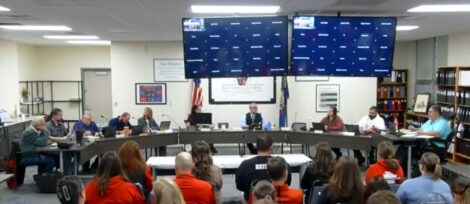
MILL HALL -- Though it approved a $94 million budget with no tax increase for its 2026-2027 fiscal year, many on the Keystone Central School District Board of Directors noted changes might need to be made given the projected deficit of over $3 million and the phantom of Pennsylvania Department of Education's control looming.
It was noted by Superintendent Dr. Francis Redmon the board couldn't vote to change the proposal on Thursday night, but could make changes prior to adoption on June 18.
"We need to pass the budget as presented because it was the direction from the board to Joni (MacIntyre) to do this," he said.
During discussion about the budget, many members of the board spoke about their concerns surrounding the deficit and how best to curb it.
Dr. Bill Baldino suggested a spending freeze and setting the budget at the $92 million that was in place for 2025-2026.
"I think we need to make a legitimate effort to cut spending. We're raising our budget from last year -- that's what the proposal is -- by about $2 million. I would propose that we freeze the budget at what we have this year and see how we do," Baldino said. "It may not be enough. We have to be able to adjust as things go along. But until we see that it's not enough. I think it's legitimate to assume we've got some wasted money that can be eliminated. And until we put some pressure on us, it's not going to happen."
Much like during the work session, Baldino also noted the district needed to cut its expenses but also potentially increase its revenues.
"I sincerely and strongly believe we have to address both spending and revenue. We are not a business. We can't sell anything. We have one way of raising revenue, and that's increasing taxes," he said. "Which is, I find it is distasteful like most of you do, but sometimes you have to do things that are distasteful."
He added he wasn't entirely certain whether or not he'd be open to adjusting the budget to include a tax increase just yet.
Jason Smith said, due to the potential of entering a receivership and losing control to PDE in Harrisburg, he felt a tax increase might be necessary.
"My concern is that by refusing to do this we're really on the cusp and what I understand of receivership, Harrisburg will appoint a receiver if we deplete the general fund, we are reduced to an advisory board. (The receiver) does not have the authority to necessarily raise taxes directly but they can appeal to the court and the court, I believe, will likely side with them," he said. "Meanwhile all the collateral damage that will happen to the district as the receiver does what they are tasked to do by the state."
Smith's comments regarding receivership are in reference to the state's Financial Recovery System.
According to the Pennsylvania Department of Education, Financial Recovery for public school districts in the state involve three components: Financial Watch; Financial Recovery and Receivership.
According to PDE, the district isn't listed as being under Financial Watch.
Smith said he'd lean towards the proposal of a 3.5 percent tax increase as a way to attempt to get through the next year as the board works to cut spending.
"If we can show the public there's a concentrated effort to provide transparency, to show we are trying to negotiate these things, trying to work with administration and also explaining we are working on this. I think, and I hope, the public will be understanding but at the same time recognize there's something in the works here we'd like to do," he said.
Roger Kshir noted the district is looking at extremely low revenues going into 2027-2028 which concerned him.
"I don't want to put any more burden on our tax payers but even our smallest increase, 0.88 percent, is at least keeping us in the positive for one more year," he said.
Rich Wykoff again encouraged the board and public to research the Chester Upland School District, which went into receivership in 2012. Though located near Philadelphia and with a different demographic, he noted many of the indicators leading to entering receivership mirror what KCSD is facing.
"It's really not an easy call but we're that close to the edge that we've got to do something much stronger," he said. "I'm on a fixed income, too, but I can't see any other way."
He said he would consider the 3.5 percent tax increase as a means to continue to push the district forward while it looks at ways to fix its budget in the future.
As a former teacher, he noted cuts sometimes aren't always as effective and added they've already been made and are affecting staff in the district.
"We're like into the bone, not just to the bone," he said.
Shelby Bohartz said she would be in favor of the 1.75 percent increase and finding more ways to reduce expenses moving forward.
"I agree we need to cut a lot but I don't think it is our job personally to decide where the cuts are made. I think if somebody in the community or a staff member comes to us and specifically says something then it is our time to do something," she said. "I don't think it is our job to be the decider. I feel like that's Dr. Redmon and his team's job."
Members Chris Scaff, President Elisabeth Lynch and Vice President John Miller said they were still in favor of the proposal as presented.
Scaff noted he's been working with staff to develop individual budgets for each building and, again, encouraged the board to look to them to find ways to save money.
"There's one guaranteed way we're going to be in receivership and that is if nobody is doing homework to try to see where we can save and stop spending. I agree there needs to be a freeze on spending," he said. "I, for one, will not vote for anything to cut more programs for the students. The students need those programs. These students are the one that's going to be coming up and sitting here one day."
Miller said he was looking at both sides of the issue, but agreed more with Scaff and LYnch.
"There's so much out there that we can get rid of to raise our money as opposed to taxes. I stand at zero percent," he said.
The school board will consider adoption of the ordinance, with or without changes, during its voting session on Thursday, June 18 at 6:30 p.m.