
Board debates Act 93 agreement changes; Vote to take place tonight
Trending
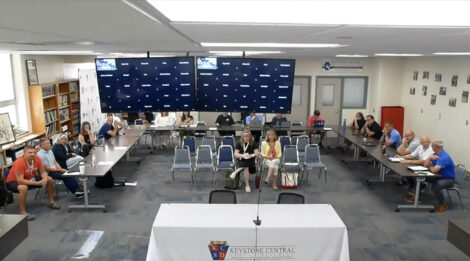
MILL HALL -- The Keystone Central School District Board of Directors will consider approval of an updated Act 93 agreement tonight, following a special meeting earlier in the week.
The meeting was scheduled following the board's work session last Thursday, where some of its members raised concerns over whether or not proper discussions had taken place between the board and Act 93 representatives prior to the proposed agreement appearing on the agenda.
Act 93 personnel fall under administrative staffing such as building principles and other supervisory positions within the district.
At the time, it was noted members of the board and Act 93 representatives had met three times. However, some members noted those who fall under Act 93 did not seem satisfied with the draft proposal.
Board President Elisabeth Lynch said if another meeting were to take place, and changes to the proposal made, it would have to be in a public meeting unlike the previous ones where the board simply listened to representatives.
"This is not a negotiation. We sit there and listen, that's it. We've heard all of their wish list. We've met with them twice. There's no negotiation. We sit in a room and we listen," Lynch said during the work session.
During the special meeting, held Tuesday night, that did not seem to be the general consensus of Act 93 personnel.
Robb Elementary School Principal Tyler Barth and Central Mountain High School Principal Nick Verelli spoke on behalf of Act 93 during the meeting.
Barth told the board the request for another meeting came down to one thing.
"It's to ensure the intent and spirit of a good faith meet and discuss process has been fully realized before the board takes final action on a new Act 93 agreement," Barth said.
Barth noted Act 93 representatives have approached the discussions with a commitment to collaboration, transparency and finding common ground.
"We recognize the board's responsibility to balance the interests of employees, taxpayers and the long term financial stability of the district," he said. "Likewise, we believe the meet and discuss process is most effective when it provides an opportunity for meaningful dialogue, clarification of concerns and the exchange of ideas before a final proposal is presented for approval."
Barth also acknowledged Lynch's concerns during the work session about meet and discuss meeting potentially violating the Pennsylvania Sunshine Law.
He noted discussions can be had outside of public meetings, but said any final decisions by the board must take place in public.
"Meet and discuss sessions are for discussions and information sessions only and any final decisions will be made by the full board in public," he said. "As a result, the mere fact that Act 93 representatives meet with board members to discuss a proposed Act 93 agreement does not violate the Sunshine Act. The key fact in this is the meeting is used for discussion and information exchange only. Not for the board to make a final decision outside of a public meeting."
Verelli's comments focused on the timeline of events leading to Tuesday's meeting.
He said meetings between the board and Act 93 representatives for the new agreement began on March 31 where it was requested by board members a Redline version of the current 2021-2026 agreement be provided.
That agreement was sent on April 2 to Lynch and distributed to the full board on April 8.
Following this, on April 9, Verelli said an Ad Hoc committee for negotiation was created by Lynch with Vice President John Miller and Chris Scaff appointed as members.
Verelli said the committee was a point of concern as to whether or not it properly advertised and conducted meetings per the Sunshine Act.
"Formation, operation of this committee created concerns of whether this was being conducted openly and also in good faith," Verelli said.
According to Verelli, Lynch emailed representatives on May 1 and stated the ad hoc committee met and would send information to the full board for review regarding the agreement.
On May 5, a hard copy of the proposed new Act 93 agreement was hand delivered to representatives by Lynch and Miller.
"This proposal was a complete re-write of the original redline document that we were asked to give. That's a document that we have been using for years, plus it's a document that most recently has been used for a contract that is being approved this Thursday," Verelli said. "I'm a little concerned why we were asked to provide this document and then, in return, we got a completely rewritten document."
Verelli asked questions such as who drafted the document, when and where it was developed and if it was substantially revised in an ad hoc meeting, was it properly advertised.
With this proposal, the Act 93 representatives requested another meeting, which was held on May 21. He noted this meeting included a productive collaboration and positive exchange of ideas.
However, on May 29, a final plan was submitted to the Act 93 group only after it was requested and the revisions again raised concerns.
Verelli said multiple discussion points brought up during the May 21 were not included, which the representatives thought were agreed upon.
A third meeting was held on June 2 and another revised draft was distributed and included in the board's agenda during its work session. That agreement, again, was not what the representatives felt accurately represented previous meetings with board members.
"This continued to undermine the confidence of the process," he said.
So, again, there was a request to meet for a fourth time, which was held Tuesday night in a public setting.
He noted on June 8, both instructional and non-instructional groups under Act 93 declined to sign the proposed agreement.
Barth noted this request was meant to strengthen collaboration, not stifle progress.
"This request is not intended to delay this process but strengthen it. Taking the time for one more conversation demonstrates a collaboration and good faith agreement," he said, noting representatives were asking for consensus of the board on a variety of topics.
Other Act 93 staff questioned the board as to why the redlined agreement was requested and if there had ever been any feedback from board members, as they hadn't received anything before the draft of the new agreement was provided.
Following these comments and questions, and before entering an hour and a half executive session to further discuss matters, Board Member Chris Scaff cleared up the matter of an ad hoc committee.
Scaff stated no ad hoc committee was actually created and that the discussions between Act 93 and the board has involved all of its members and not a select few.
"The board members were never asked to sit on an ad hoc committee. We never had an ad hoc committee meeting, the three of us sitting down with these members and doing it like that. Every meeting we've had has been a full board," he said. "We never voted with the board to have an ad hoc. We never voted for a chairman of it. The full board has been involved in every meeting that's happened. So the ad hoc stuff just needs to disappear."
Following this and the board's executive session, held from 6:08 p.m. to 7:25 p.m., the board went item by item to discuss changes it spoke about with Act 93 representatives.
The biggest point of contention centered around post-retirement insurance benefits.
The discussion about whether to drop the 8 years of benefits following an Act 93 employees retirement or not was opened by Lynch. She noted she has only ever heard positive feedback from community members about the move, which would ease the strain on district finances.
"I have gotten praise, after praise, after praise and gotten a few personal phone calls," she said.
Board member Rich Wykoff said he would prefer to see this portion of the agreement be discussed further.
He compared taking this insurance benefit away from long-time employees as "pulling the rug out from under people."
"That's my beef with this. There's got to be a way to figure this out for people," he said.
Scaff agreed with Wykoff, noting there were a few staff members with two decades or more time at the school district who are considering retirement in the next year or so.
"We talked to one individual here who has been here 27 years and he, if we just cut this off tonight, has to decide within the next two weeks if he wants to retire," he said. "I don't think that's fair. We have to come up with a step-down and how we can do that."
He noted there are three individuals who are considering retirement following the 2026-2027 school year, each who have been with the district for 20-plus years.
"To pull the rug out from under them isn't fair to anybody," he said. "But we have to have a plan to where we cut off and where we stop" these benefits.
Board member Jason Smith was also in agreement to finding a solution for the removal of the 8-year post-retirement benefits package.
He acknowledged it wasn't a common occurrence in the private sector, and it was unfair of taxpayers to foot the bill for multiple retired staff members.
"For me, I want to respect loyalty, I think that is an admirable trait for the district. I think that's taxpayer dollar worthy," he said.
Board members Roger Kshir and Manny Rodriguez also agreed that long-time staff deserved the opportunity for the benefits they'd been promised for decades.
Rodriguez spoke about an instance in his own life when he was terminated from a position after his daughter's health insurance increased.
"It wasn't said directly, but you have an inkling of what happened," he said. "So telling people they worked so long, but everything they worked for is not totally gone? I do understand that part. I feel like there has to be a soft landing for this. We have to figure something else out instead of just dropping the guillotine."
Lynch said she could contact the lawfirm assisting with the agreement, King Sprye, to see if a Memorandum of Understanding (MOU) could be drafted for those Act 93 members who will be retiring in the next year or so.
A general consensus was reached with board members that this would be a good way to move forward.
The board will consider its next steps regarding the Act 93 Agreement, which would run from July 1, 2026 to June 30, 2029, at its voting session tonight. The meeting will be held at 6:30 p.m. in person and available via Zoom on the district's website.