
Gettysburg held the nation together through blood, tears
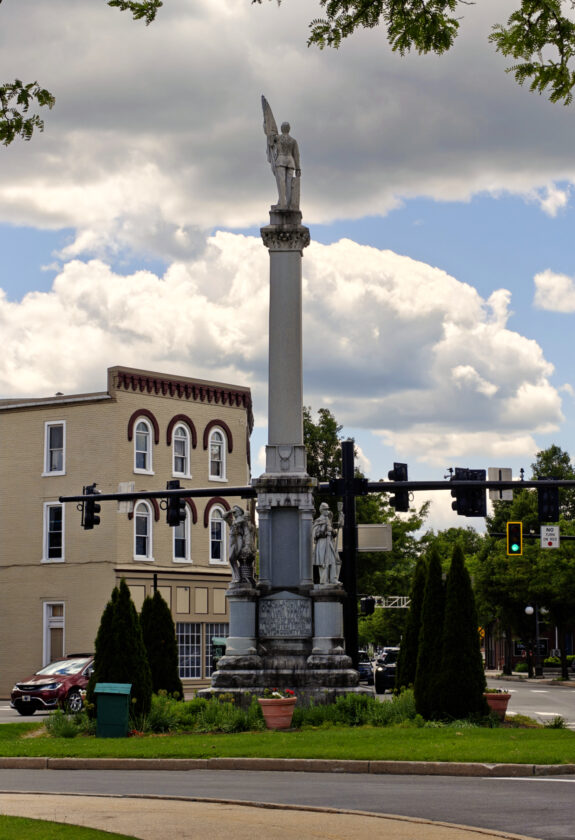
Lock Haven’s Civil War Memorial — officially named The Soldiers’ and Sailors’ Monument — is pictured in one of the city’s most visible intersections. ARIANNA McKEE/THE EXPRESS
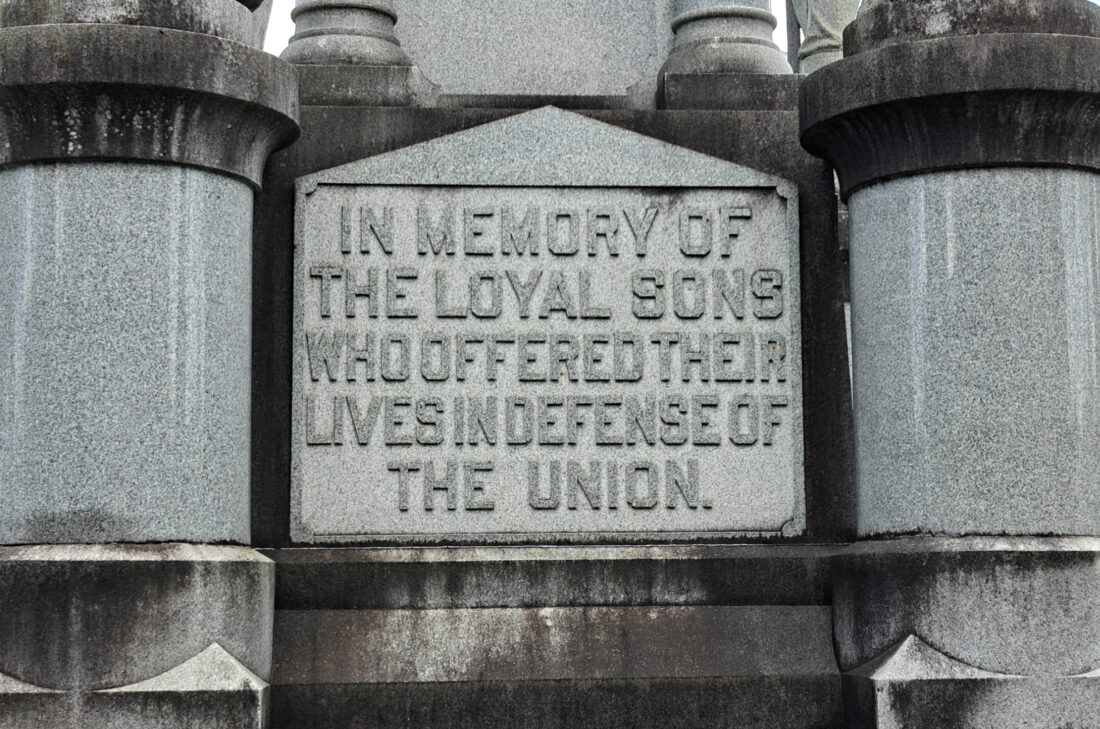
ARIANNA McKEE/THE EXPRESS Inscriptions on Lock Haven’s Civil War Memorial — officially named The Soldiers’ and Sailors’ Monument — provide information and dedication on Clinton County’s contribution to the Civil War.
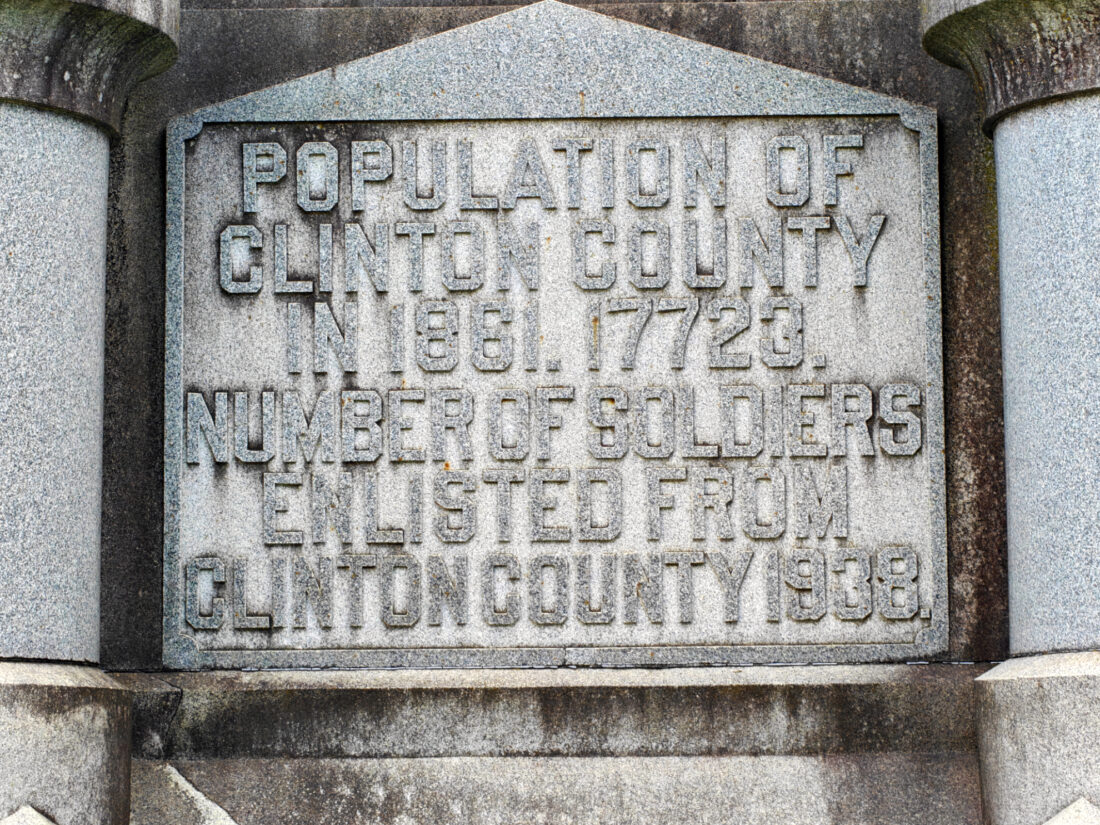
ARIANNA McKEE/THE EXPRESS Inscriptions on Lock Haven’s Civil War Memorial — officially named The Soldiers’ and Sailors’ Monument — provide information and dedication on Clinton County’s contribution to the Civil War.
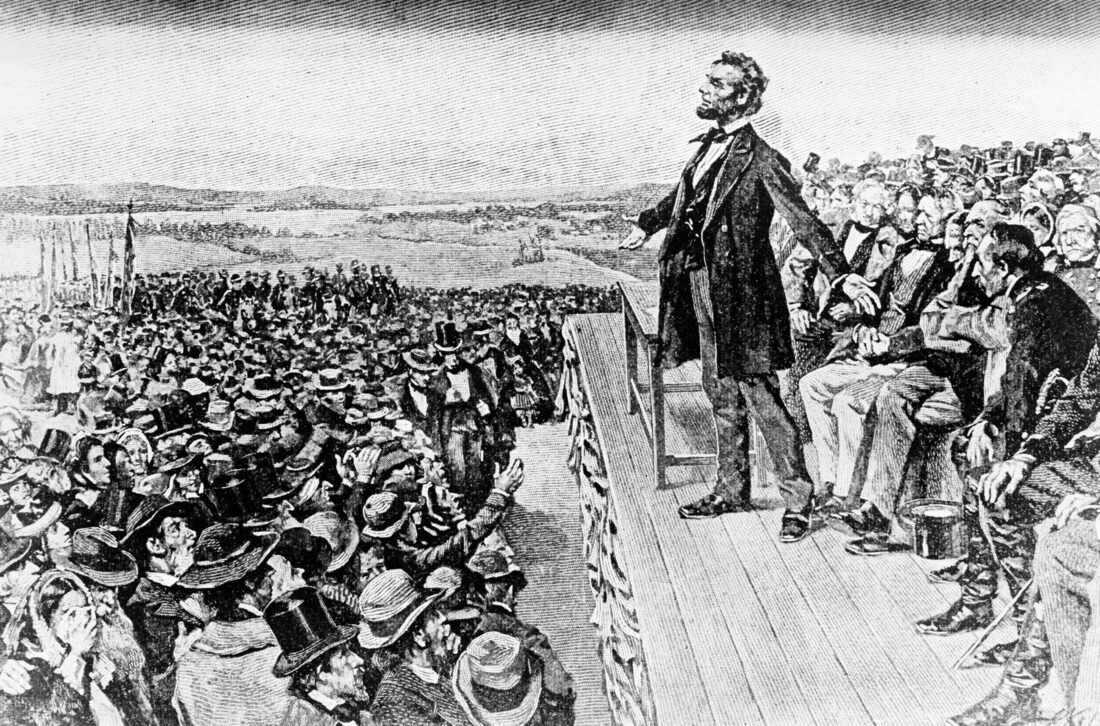
AP Photo This undated illustration depicts President Abraham Lincoln making his Gettysburg Address at the dedication of the Gettysburg National Cemetery on the battlefield at Gettysburg, Pa., Nov. 19, 1863. The cemetery commemorates soldiers who died in the American Civil War Battle of Gettysburg in July. In moments of crisis, American presidents have sought to summon words to match the moment in the hope that the power of oratory can bring order to chaos and despair.
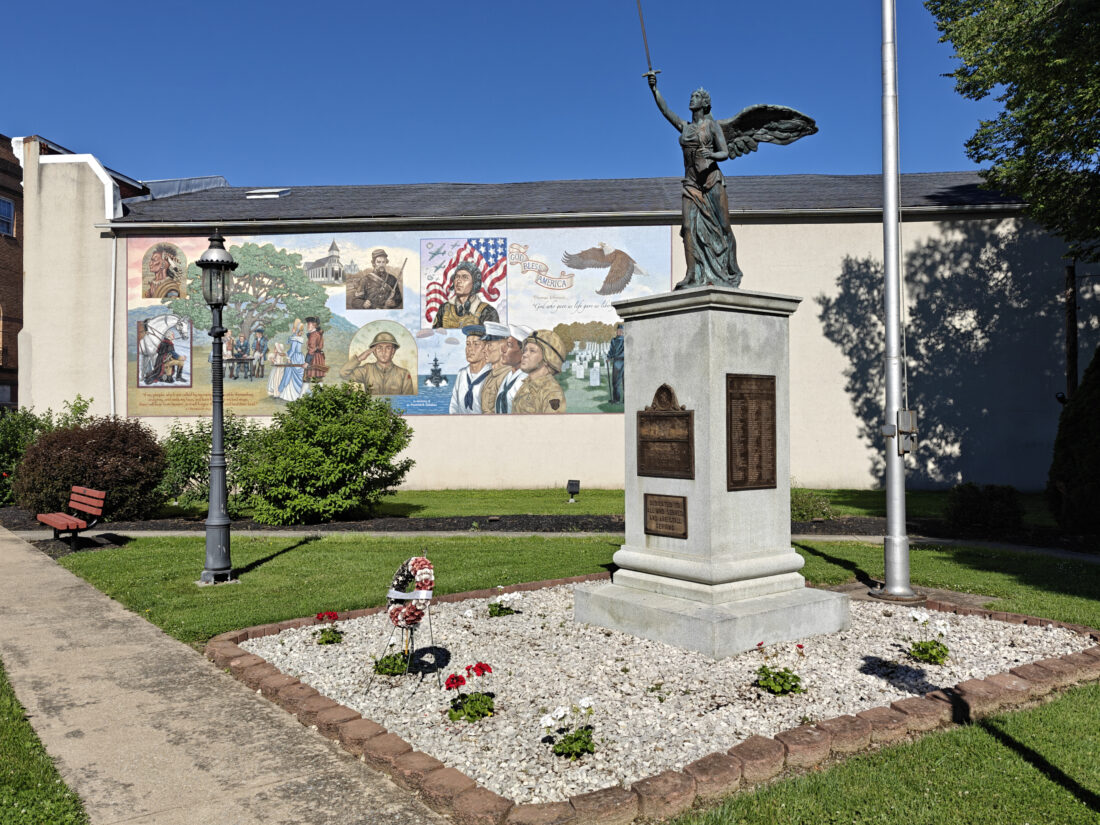
ARIANNA McKEE/THE EXPRESS The monument in Jersey Shore’s Veterans Park is pictured, with the mural on the side of the building adjacent to it displayed. A depiction of a Union soldier, at center of mural, is among those honored here.
Lock Haven’s Civil War Memorial — officially named The Soldiers’ and Sailors’ Monument — is pictured in one of the city’s most visible intersections. ARIANNA McKEE/THE EXPRESS
ARIANNA McKEE/THE EXPRESS Inscriptions on Lock Haven’s Civil War Memorial — officially named The Soldiers’ and Sailors’ Monument — provide information and dedication on Clinton County’s contribution to the Civil War.
ARIANNA McKEE/THE EXPRESS Inscriptions on Lock Haven’s Civil War Memorial — officially named The Soldiers’ and Sailors’ Monument — provide information and dedication on Clinton County’s contribution to the Civil War.
AP Photo This undated illustration depicts President Abraham Lincoln making his Gettysburg Address at the dedication of the Gettysburg National Cemetery on the battlefield at Gettysburg, Pa., Nov. 19, 1863. The cemetery commemorates soldiers who died in the American Civil War Battle of Gettysburg in July. In moments of crisis, American presidents have sought to summon words to match the moment in the hope that the power of oratory can bring order to chaos and despair.
ARIANNA McKEE/THE EXPRESS The monument in Jersey Shore’s Veterans Park is pictured, with the mural on the side of the building adjacent to it displayed. A depiction of a Union soldier, at center of mural, is among those honored here.
Trending
(Editor's note: This is a bonus, 13th entry in a series of 12 weekly stories focusing on America's 250th birthday.)
Gettysburg. The very name is etched in the American experience -- in our hearts, in our souls and in the memory of our towns.
The site of a three-day battle, Gettysburg was the high water mark for the Confederacy -- the boldest strike north they ever made -- and their defeat there foretold the beginning of the end of the conflict.
By this point in the war, the Confederate Army, under the command of Robert E. Lee, was largely outmanned and outgunned, as the more industrialized northern states were able to keep up the war effort far better than the more agricultural south.
Despite this, the Union suffered from a series of underwhelming generals whose poor decision making allowed Lee room to produce substantial victories, especially on Lee's home territory in Virginia -- notably Chancellorsville.
Lee saw an opportunity to seize northern territory -- Harrisburg was a likely target -- in an attempt to pressure the Union government to end the war.
History shows that he failed.
Few individual battles carry as much weight as Gettysburg. While military historians and hobbyists will review and dissect most battles, every aspect of Gettysburg has been examined from every angle.
Despite that -- perhaps due to the efforts of the Lost Cause mythology -- there remains frequent conversational debate with regards to whether Lee lost Gettysburg or whether the Union Army, under the command at the time of General Gordon Meade, won it.
Similarly, Gettysburg evokes plentiful historical fantasy -- what if scenarios that range from whether an ascendent General Grant could have decisively crushed Lee's army, or whether Lee would be victorious had his critical second-in-command, Thomas "Stonewall Jackson," not been killed by friendly fire at Chancellorsville.
Gettysburg is more than a battle -- it's a concept that endures.
By far the bloodiest battle on American soil, Gettysburg saw a combined total of over 165,000 troops on both sides, with over 50,000 combined casualties recorded. For a particularly horrifying fact, consider that the American casualties in the Revolutionary War were around 32,000 and in the War of 1812, around 20,000. The individual battle of Gettysburg nearly matches those two entire wars in terms of casualties.
Gettysburg's impact didn't stop with the battle, either. Four months later, President Lincoln delivered his Gettysburg Address -- a speech given to formally designate what is now known as Gettysburg National Cemetery -- which has gone on to be one of the most significant speeches in American history. At a brisk 271 words, the Address is as follows:
"Four score and seven years ago our fathers brought forth on this continent, a new nation, conceived in Liberty, and dedicated to the proposition that all men are created equal.
Now we are engaged in a great civil war, testing whether that nation, or any nation so conceived and so dedicated, can long endure. We are met on a great battle-field of that war. We have come to dedicate a portion of that field, as a final resting place for those who here gave their lives that that nation might live. It is altogether fitting and proper that we should do this.
But, in a larger sense, we can not dedicate--we can not consecrate--we can not hallow--this ground. The brave men, living and dead, who struggled here, have consecrated it, far above our poor power to add or detract. The world will little note, nor long remember what we say here, but it can never forget what they did here. It is for us the living, rather, to be dedicated here to the unfinished work which they who fought here have thus far so nobly advanced. It is rather for us to be here dedicated to the great task remaining before us--that from these honored dead we take increased devotion to that cause for which they gave the last full measure of devotion--that we here highly resolve that these dead shall not have died in vain--that this nation, under God, shall have a new birth of freedom--and that government of the people, by the people, for the people, shall not perish from the earth."
-- Abraham Lincoln
Having read that speech, with it fresh in your mind, consider that the three days of the Battle of Gettysburg were July 1, July 2 and July 3.
With the gift of hindsight, historians can now say that, as of July 4, 1863, the Union was freshly on the course which would allow the nation of the United States of America to persist to its 250th birthday, and not be torn asunder by traitors and slavers.
And yet, we still bear the wounds of the past. Gettysburg brands us, brands our towns, with echoes of the some 8,000 souls who died that day -- some of whom were from the hills we call home.
They are memorialized on street corners, in cemeteries and emblazoned on buildings. Records abound of men from Centre, Clinton and Lycoming Counties who left their homes and families to fight to keep the dream of America alive.
Many never returned home -- but their legacy endures.
It is a legacy of service; of democracy; of doing the right thing. A legacy of fighting for a better tomorrow.
It is a legacy we should all be proud of.