
Jaime Castillo’s love of music is as alive as when he was a child
His Passion
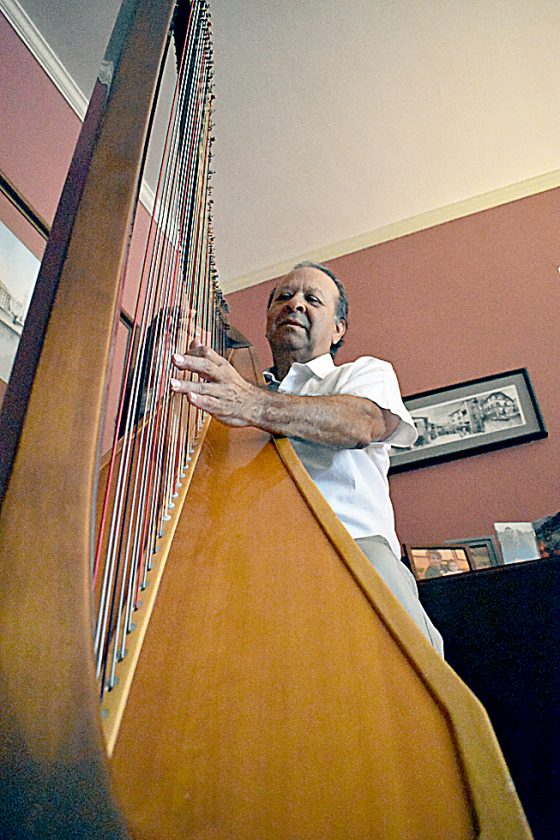
LAURA JAMESON/THE EXPRESS Jaime Castillo performs a piece on his classical harp in his Woolrich home.
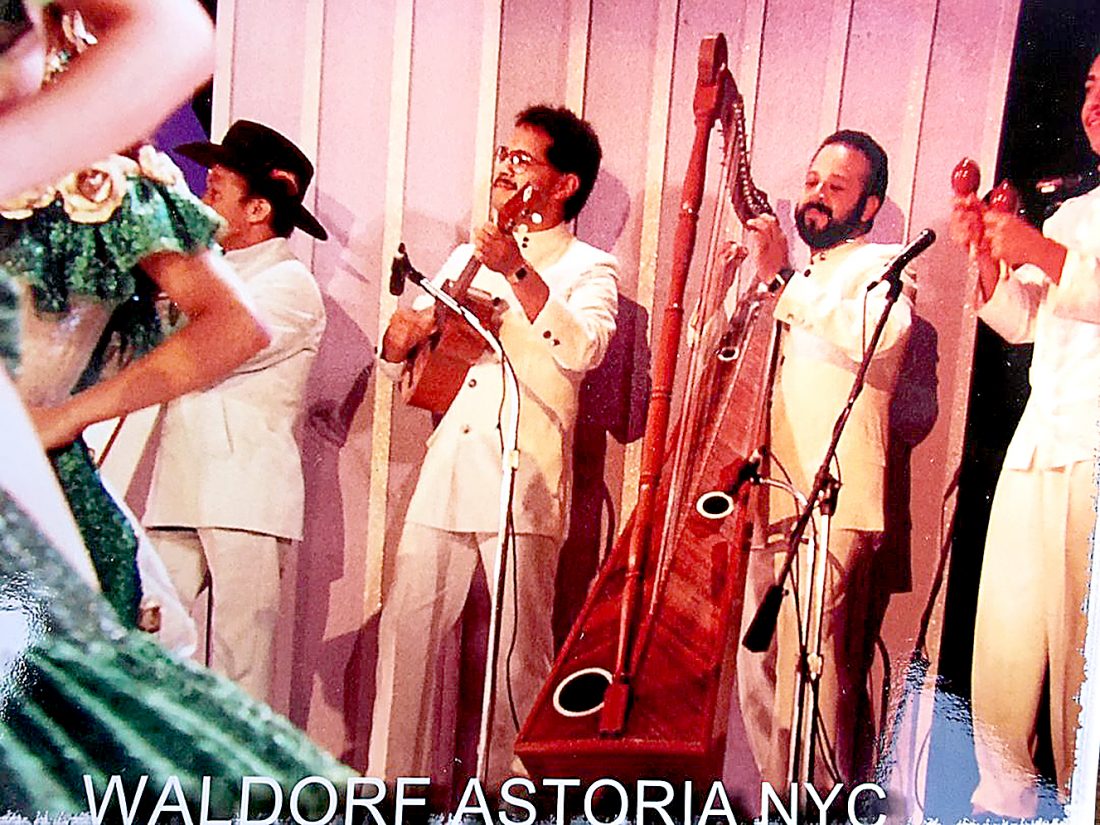
PHOTO PROVIDED Jaime Castillo, third from right, and his band Cafe y Petroleo perform at the Waldorf Astoria in New York City. This famous venue is one of many that Castillo would have the chance to play at during his career.
LAURA JAMESON/THE EXPRESS Jaime Castillo performs a piece on his classical harp in his Woolrich home.
PHOTO PROVIDED Jaime Castillo, third from right, and his band Cafe y Petroleo perform at the Waldorf Astoria in New York City. This famous venue is one of many that Castillo would have the chance to play at during his career.
Trending
WOOLRICH -- You can see it in his face as his fingers pluck away at the strings of his harp. Even when he isn't playing, Jaime Castillo's eyes light up and there's passion in his voice as he talks to you about his favorite instrument -- the harp.
Music in general is truly a passion for Castillo, one that has been a part of his life for as long as he can remember.
Castillo was born in Bogota, Colombia surrounded by a love of music.
"I grew up in a music family from my father's side of the family," Castillo said. "My dad himself -- he was not a professional musician -- but he played the saxophone and violin and he directed choirs. He was an engineer by trade but he loved music."
This trait is something that the engineer would pass along to his five children.
"I remember my dad hired a couple of music teachers and they would come once a week, typically on a late Friday or Saturday morning, and teach us acoustic instruments," he said.
Music is the heart of South America, especially folk music, which was always apparent at family gatherings, he said.
"Every time the family got together for Christmas or a picnic everyone brought their instruments. It was just jamming," he said with a smile.
Castillo learned how to play acoustic guitar and even the accordion while living in Bogota. It wasn't until his family moved to New York City in 1971 that he would purchase his first harp.
"My dad at the time was working for an American design company in Long Island and he had the opportunity to bring the family over and decided to stay," he said.
In 1972 he purchased his first harp, something he'd always wanted to do.
"I always wanted to play. I had heard harp back in my hometown and we had a friend that was a professional harpist," he said.
Castillo has spent his life learning various compositions and styles on a variety of harps.
He explained there are generally two types of harps -- classical and folk. Folk harps can be broken down even further.
"Just about every country in the world has their own version of the folk harp," he said.
In the 15th Century when the Spaniards arrived in South America they brought small harps and other acoustic instruments to use as a way of converting the natives to Christianity and learn Spanish, Castillo said.
"They brought all of these acoustic instruments, all kinds of guitars and harps," he said. Over time each region in South America created their own versions.
"They adopted the instruments to their regions, depending on the type of wood they could get… so as a result today there are probably four different types of harps in South America," he said.
Castillo spoke about three folk harps that dominate the area: Paraguayan, Peruvian and the Colombia/Venezuelan harps.
"The Paraguayan harp has three or four more strings and the distance between them is very narrow so they play at phenomenal speeds," he said. "It has a really brilliant sound."
The Paraguayan harp is used mostly in Paraguay, Uruguay, Argentina and Brazil.
Another version was created in the high mountains of Ecuador, Peru and Bolivia.
"The Peruvian harp… the sound box is wider. It is almost not in proportion with the instrument," Castillo said. "But they use a lot of the base lines to mix their music with Spanish music."
The Colombian/Venezuelan harp is one that Castillo himself plays often.
"I think it is very acoustic and fun to play with. The tension on the strings is softer," he said.
Over all the harp is a large part of South American folk music.
"The harp is a pretty alive instrument in Latin America," Castillo noted.
For years Castillo focused on playing South American folk music, through college and when he formed his band Cafe y Petroleo nearly 30 years ago. But that doesn't mean he hasn't expanded his musical horizons to include other genres.
"My satisfaction is more to contribute a little bit to the diffusion of this wonderful music," he said.
For the past 10 years he's made an adjustment he feels is a positive one.
"Instead of just playing folk music -- South American folk music -- I began to play a little bit of Latin jazz," he said. "It's still with the folk music theme and all the right syncopation of the rhythm."
Since he began infusing jazz elements with his music he's found the two share a connection.
"I've been finding out that jazz and folk music in general are intertwined so I'm having a blast doing that," he said.
In 2019 Cafe y Petroleo performed some of this fusion of Latin jazz and South American folk music at the 4th Annual LH JAMS festival.
"When Steve Getz called me and said 'Jaime I've heard some of the recordings of your band would you come to the festival?' I said 'yea'," he explained.
"That whole experience to work for nine months trying to make adaptions to make a mix of folk and jazz… (the band) had a wonderful time doing that," he said.
Castillo said it's people like Getz who promote a variety of arts that makes Lock Haven a special place.
"As you can see the little town of Lock Haven is pretty unique. Just about every month even before the pandemic you can really find the right people, the right mix," he said.
When it comes to future harpists and musicians, Castillo said he's always thrilled to see young people getting involved.
"I was 17 when I arrived in New York… I bought my first harp when I was 18. Today kids are learning at the age of five, six or seven," he said. "I would have been considered an old man!"
Castillo said that when it comes to teaching kids, finding a mixture of genres and styles is important.
"When you teach music, don't just teach classical, it has to be a mix so they really get the passion of learning their own music," he said.
Even though he's been retired from his position at chemical company DuPont for many years, he'll never retire from music.
"To me it's been a wonderful journey and as long as I can I'm going to continue to play," he said.
That journey is one that will continue even after Castillo in his family.
"We have a wonderful grandson, Leo, he's five… he'll say 'Abuelo will you play the harp for me?'," Castillo said. "He would pull up a little chair and just watch… and he would say 'can I play?'"
Castillo said he was more than happy to sit with Leo and show him the strings and notes. After a bit the young boy asked if he'd get him a harp.
"I told him I'd build him one," Castillo said. "I bought a kit and I built him that harp. It's red in color."
He explained that he created a fall theme for the box after noticing the vibrant colors near his Woolrich home one year.
"That kid… he goes home and he's just plugging the strings," Castillo said, pride evident in his voice. "I know that at five years of age that he already has that little seed inside of him. That's all I've wanted, that to me is priceless."