
Little Pine reminds me of our responsibility to nature
Trending
HUNTER SMITH/THE EXPRESS
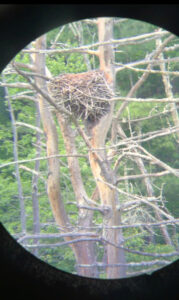
An eagles' nest is visible through mounted binoculars at Little Pine State Park's Eagle Watch on Wednesday, May 27.
I remember, as a boy, balancing on the slick, moss-covered rocks along Little Pine Creek while listening to a park ranger explain the hidden world just beneath the surface of the rippling water.
She explained how macroinvertebrates -- mayflies, caddisflies, stoneflies, midges -- clung to the undersides of smooth river rocks, and how their presence signaled that the water was healthy enough to support life so vulnerable to excess nutrients, pollutants and sediment.
In other waterways, toxins had wiped out these, admittedly creepy, crawlies, leaving entire ecosystems to unravel in their absence. At the park on a school field trip, my classmates and I learned how disruptions at the bottom have a way of working their way to the top, ultimately harming the living things we profess to care about most.
The bald eagle, our national bird and a symbol of pride across the country, is one of them. Since I was a child, bald eagles have nested at Little Pine, and on school trips to the park I remember watching them soar overhead in awe. Learning that they had nearly been driven to extinction by DDT use in the 1970s and 1980s left a lasting impression on me. I was struck by how something so quintessentially American -- our national symbol -- could be so imperiled by human carelessness.
This week, I visited Little Pine again. Though I didn't see any eagles, I was reminded of their magnificence and how close we came to losing them. Their disappearance would not have been theirs alone. To lose them would have been to lose part of ourselves.
At the same time, I was raised to understand that human beings are not separate from nature, but participants within it. The Indigenous peoples of the Little Pine region -- the Iroquois and Algonquin nations -- understood that if life is to continue thriving, what we take from the land must be taken with care.
Because of the park, those same lessons in stewardship are still being taught. Little Pine was where I learned to fly fish, but the lessons were never just about catching trout. My Boy Scout leaders taught me to respect the water and to take only what it could continue to provide. A good outdoorsman, they said, understood that nature was not endless. If you wanted the stream, the forest and the wildlife to remain, you had a responsibility to act with respect and restraint.
As a Penn Stater, the loss of the Pennsylvanian mountain lion has always felt especially poignant to me. It serves as a reminder that when we take too much from the natural world, when we ignore its balance, we risk losing pieces of our identity along with it.
Little Pine State Park was where I, and I'd venture others, learned that responsibility first begins with our own choices. During a hike with my childhood youth group, Abe, a member of our church, gave me my first pocket knife. The blade was small, barely large enough to cut an apple, but I was immensely proud of it.
Before handing it to me, Abe explained that he was giving it to me because he believed I was old enough to be trusted with it. But with that trust came responsibility. A pocket knife, he told me, was a tool that could be useful or dangerous depending on how it was handled, and carrying one meant understanding the importance of care, restraint and respect.
Over time, I came to realize that lesson extended far beyond a pocket knife. For me, Little Pine is a reminder of the fragility of our natural world, and of our responsibility to wield our power with care. Because when we fail to do so, the damage we cause does not stop with us.
-- -- -- --
Hunter Smith is a news reporter for The Express.