
A Christmas tree without needles?
Trending
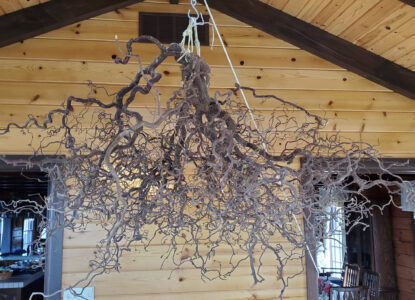
PHOTO BY DEBRA BURROWS
The twisted and gnarled branches of the contorted filbert are visible as it hangs from a pulley before being decorated.
Last month, this column focused on the desirable characteristics of Christmas trees, one of which is good needle retention. After all, branches without needles would be rather unattractive. Or would they? Two years ago, I tried something new -- a needleless Christmas tree. It turned out to be one of the best decorating decisions I have ever made.
Rather than a pine or fir, I choose a contorted filbert, a deciduous shrub that had outgrown the space along a walkway around our home. It had to be removed, but it was too big to transplant and too beautiful to throw away.
Contorted filbert (Corylus avellana contorta), also called contorted hazelnut or Harry Lauder's walking stick, is known for its twisted and gnarled branching. To me, it looks like something from a fairy tale. It usually grows to about 10 feet tall and wide, although some can reach as much as 15 feet in height. Native to Europe, Asia and Africa, contorted filbert prefers full to part sun, and moist, well-drained soil. It is a member of the Birch family and is hardy in USDA Hardiness Zones 4-8.
Both branches and leaves appear twisted, or contorted, as the name suggests. Leaves are dark to medium green, somewhat oval with serrated edges and an uneven or crumpled appearance. During the growing season, they tend to cover the branches completely. In autumn after the leaves have fallen, the unique branching structure becomes apparent, making contorted filberts noteworthy specimens for winter interest in the landscape. In spring, they produce tiny flowers which form showy yellow catkins that hang from the branches like soft narrow tubes.
The contorted filbert we had to remove was approximately six feet high and wide. After cutting it down, we tied a rope to the trunk and hung it upside down on a pulley in our barn where it remained for several years. It looked a little like a large, intricate chandelier.
In 2023 I was recovering from some serious health problems and knew I wouldn't be able to decorate a large Fraser fir, which had long been our traditional Christmas tree. I needed to stay off my feet but was determined to find a way to decorate a Christmas tree. I started thinking about the contorted filbert in the barn. I mentioned it to my husband, and he agreed to try it. Fortunately, we have a cathedral ceiling, which gave us plenty of room to hang a pulley from one of the exposed beams.
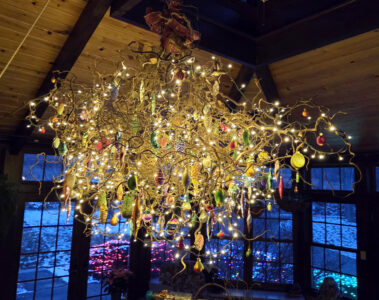
The contorted filbert had dried out over the years and wasn't nearly as heavy as it was when first cut down. My husband brought it in, hung it on the pulley, and hoisted it up just high enough that I could sit in a chair underneath it to decorate it. We added tiny, warm, white LED light strings and waited until dark to see how it looked. We were not disappointed.
The next day, I sat underneath it and added some of our Christmas ornaments, especially those in the shape of flowers, fruits, vegetables and icicles. When I was finished adding ornaments, we hoisted it up to the ceiling. We loved it. When we had friends over, we asked their opinions, and they loved it too. It has now become a Christmas tradition we look forward to each year.
In addition to the ease of decorating, there are several aspects of our unusual tree that we appreciate. It doesn't have to be watered, it doesn't take up any floor space because we can walk right under it, there are no needles falling off that require constant clean up and it's reusable year after year, eliminating the need to go out in the cold and cut one down. It doesn't get much easier than that!
Best wishes to all for a happy and healthy New Year.
-- -- -- --
Debra C. Burrows, PhD, is a retired Penn State Extension Educator and a certified Master Gardener. She can be reached at dcb3@psu.edu.