
Kitchen gardens in colonial Pennsylvania
Trending
With the 250th anniversary of the signing of the Declaration of Independence approaching, let's look back at kitchen gardens, which were widely utilized by colonists in Pennsylvania around the time of the American revolution. Back then, kitchen gardens were a necessity and nearly every home had one. There were no grocery stores as we know them today and refrigeration had not yet been invented, so families planted, harvested and stored their own vegetables and herbs.
A kitchen garden is loosely defined as a sunny plot of land located just outside the kitchen door which is used to grow vegetables and herbs. It is usually surrounded by a fence to keep animals out and is divided into a series of ordered, rectangular beds separated by paths for easy access and cultivation. Kitchen gardens are typically tightly planted to make use of all available space, with a focus on practicality, rather than visual appeal. When space allowed, flowering plants might be interspersed with the vegetables and herbs.
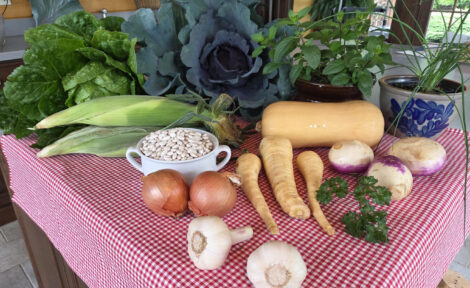
In 1776, a kitchen garden likely contained beets, carrots, parsnips, horseradish, onions, leeks, turnips, cabbage and radishes. Most plants were started from seed which had been imported from Europe or saved from the previous year. Seeds were also traded with neighbors. In some cases, they were obtained from botanist John Bartram who sold seeds from the extensive gardens he established near Philadelphia.
Colonists learned about indigenous vegetables from native people who shared seeds and cultivation information. One such method, used by the Iroquois, was to plant maize (corn), beans and squash together. Today we refer to this as companion planting. The beans used the corn stalks for support and fixed nitrogen in the soil, while the squash vines shaded the soil, helping it to retain moisture and suppressing weed growth.
Kitchen gardens often included a variety of greens such as lettuce, dandelions, kale, mustard greens, turnip greens and Swiss chard. Dandelions were valued for both salad greens and for making dandelion wine using their flowers. Colonists brought dandelion seeds with them from Europe and introduced them to North America.
Herbs were grown for both culinary and medicinal purposes. Mint, parsley, dill, sage, chives, rosemary, garlic, chamomile, fever few, thyme, bee balm and horehound were often found in kitchen gardens. In addition to flavoring various recipes, herbs were used to make teas, tonics, poultices, syrups and lozenges. Many herbs were dried for later use.
Some of the plants we routinely include in our home vegetable gardens today were not contained in colonial gardens. For example, tomatoes and potatoes originated in South America and did not become widely used in Pennsylvania gardens until after the Revolutionary War.
In addition to the produce from their kitchen gardens, colonists planted apple and pear trees and harvested the fruits of native pawpaw trees, as well as native blueberries, blackberries and cranberries. Nuts came from native walnut, hazelnut and chestnut trees.
Colonists used methods such as pickling, fermenting, drying and storing in a root cellar to preserve vegetables and herbs for use after the growing season ended. Root cellars are cool, underground areas for storing turnips, carrots, parsnips, beets, apples, pears, etc. They can be small enough to hold just a few boxes of produce or as large as a full basement. Beans and herbs were often dried by hanging them in a dark, well-ventilated location. Cabbage was fermented in crocks to make sauerkraut.
In 1776, Pennsylvanians were both patriots and gardeners. As we celebrate 250 years of independence, let's remember and honor them for their many contributions.
------
Debra C. Burrows, PhD, is a retired Penn State Extension Educator and a certified Master Gardener. She can be reached at dcb3@psu.edu.