Still a Nittany Lion: Alumna, Verna Dotterer, 99, reflects on life at PSU during WWII
-

- HUNTER SMITH/THE EXPRESS Verna Dotterer, 99, at her home in Lamar. Dotterer graduated from the Pennsylvania State College in 1945
-
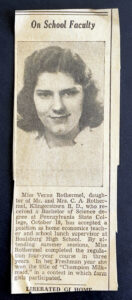
- PHOTO PROVIDED A newspaper clipping from the mid-1940s announces Dotterer’s graduation and her acceptance of a home economics teaching position at Boalsburg High School.
-
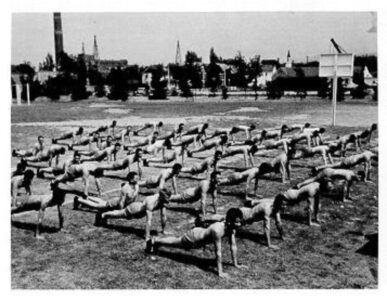
- PHOTO PROVIDED Military trainees perform push-ups on campus as part of their drills, courtesy of “Penn State: An Illustrated History” by Michael Bezilla.
-
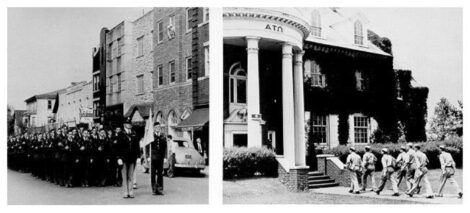
- PHOTOS PROVIDED Several campus fraternities, including Alpha Tau Omega (pictured), were converted into barracks during the 1940s. Image courtesy of “Penn State: An Illustrated History” by Michael Bezilla.
-
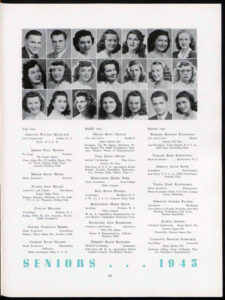
- PHOTOS PROVIDED A page from “La Vie,” Penn State’s yearbook, shows members of the senior Class of 1945. Dotterer appears in the middle column of the bottom row.
-
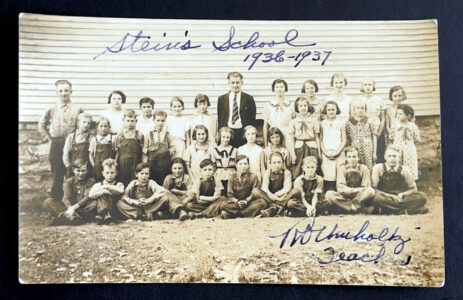
- PHOTOS PROVIDED Verna’s class at her one-room, Pennsylvania Dutch-speaking school in Mahantongo Valley, Schuylkill County, is pictured.

HUNTER SMITH/THE EXPRESS Verna Dotterer, 99, at her home in Lamar. Dotterer graduated from the Pennsylvania State College in 1945
LAMAR — While new graduates look ahead to their futures, Verna Dotterer, 99, is reflecting on her past. 80 years ago, she finished her studies at Penn State, a milestone made all the more remarkable by the challenges of World War II.
Today, Dotterer is among the final generation of graduates who remember the campus transforming to meet the demands of a nation at war.
Before college, Dotterer — then Rothermel — attended a Pennsylvania Dutch-speaking, one-room schoolhouse in Mahantongo Valley, Schuylkill County.
There she completed her schooling early, graduating at the top of her class.
She was just 16 when she enrolled at Penn State in the fall of 1942 — then known as the Pennsylvania State College — making her one of the youngest students on campus. Her age often surprised her older classmates, most of whom were two or three years ahead of her.
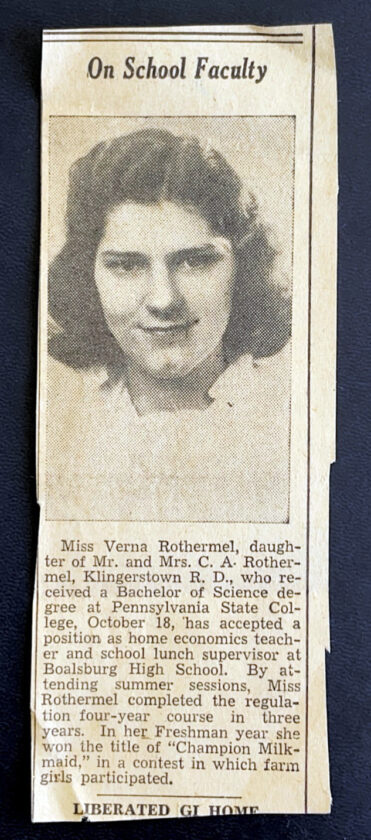
PHOTO PROVIDED A newspaper clipping from the mid-1940s announces Dotterer’s graduation and her acceptance of a home economics teaching position at Boalsburg High School.
Verna’s first semester began less than a year after the Japanese attack on Pearl Harbor thrust the United States into World War II. Because of the conflict, the university had smaller classes, which for the first time were dominated by women as America’s young men instead departed for the front lines of the Pacific and European Theaters. Many of those classmates have since passed, making Dotterer one of the last living links to that wartime generation.
At PSU, Verna studied home economics — a path she was inspired to follow after attending a 4-H event at the school as a girl, where she was invited to display a dress she had sewn.
Although most programs at the time were geared toward boys, Verna said they welcomed girls like her who showed interest.
In her home economics courses, she conducted experiments on rats to study nutrition, reflecting the broader scientific push of the time to identify and synthesize essential vitamins and minerals — research that, in the shadow of the Great Depression and the throes of World War II, took on new urgency.
At the time, Penn State had three semesters a year, “and they did them short and sweet because of the war,” Dotterer said.
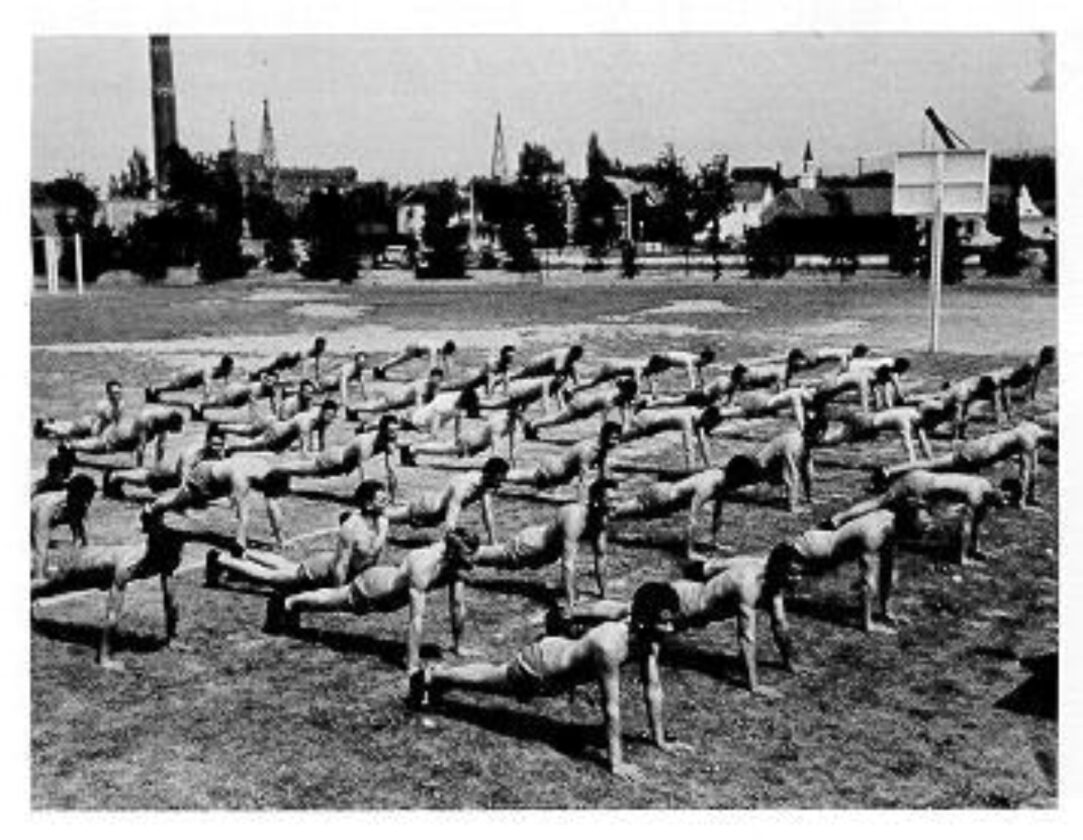
PHOTO PROVIDED Military trainees perform push-ups on campus as part of their drills, courtesy of “Penn State: An Illustrated History” by Michael Bezilla.
Early in 1942, under the presidency of Ralph Hetzel, Penn State, along with many other schools, shifted to a year-round academic calendar to maximize efficiency during wartime.
Among the changes, administration cut Easter break and moved graduation up to May 9. From then on, the college ran on sixteen-week terms, enabling students to complete their degrees in about two years and eight months instead of four, according to historian Michael Bezilla, author of “Penn State: An Illustrated History.”
“When I went there, you didn’t report with much in hand. You went (to the university) and said, ‘I want to take this course, are you offering it this semester,’ and they would sign you in,” said Dotterer. “You didn’t make arrangements ahead of time, and they didn’t have many things they told you that you had to bring.”
Since her time as a student, much has changed, even the campus itself.
“They didn’t have many buildings there at the school when I was there,” she said. “It was not like anything now.”
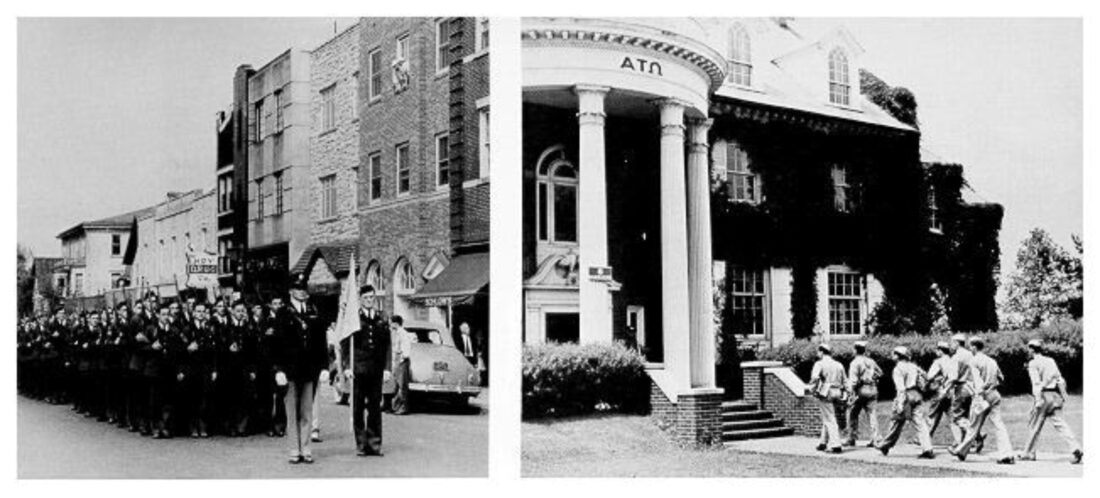
PHOTOS PROVIDED Several campus fraternities, including Alpha Tau Omega (pictured), were converted into barracks during the 1940s. Image courtesy of “Penn State: An Illustrated History” by Michael Bezilla.
Though tuition was only about $60 then as she recalls, Dotterer got a campus job to help pay for her education, which her father, a modest farmer, was working hard to scrape together.
She hoped to work in the campus library, but the recent, and yet unsolved, murder of a freshman co-ed in the spring of 1940 worried her family.
“My parents didn’t want me to because Rachel Taylor had been murdered there a short time before I got there,” said Dotterer.
The 17-year-old from Wildwood Crest, N.J., had been returning to campus at the end of Easter Break when she was last seen around 1:30 a.m., getting into a car near her Atherton Hall dorm. Her body was found naked and mutilated the next morning, not far from the campus.
“But they did leave me finally, and I got a job there for 10 cents an hour,” Verna said. “I was so delighted to have that much money.”
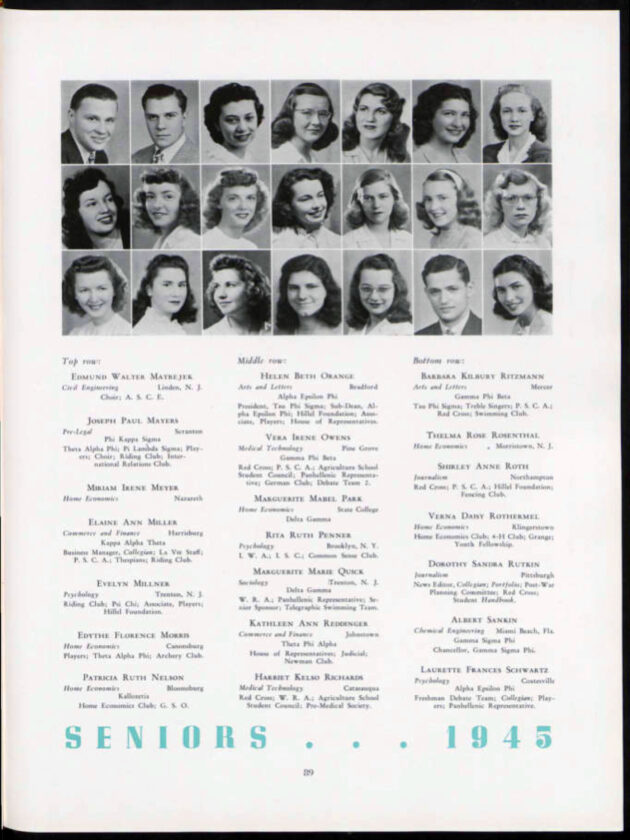
PHOTOS PROVIDED A page from “La Vie,” Penn State’s yearbook, shows members of the senior Class of 1945. Dotterer appears in the middle column of the bottom row.
Her persistence paid off with a job handling film reels in the library basement, which were sent to farmers around the state to teach them how to best grow certain crops. Because of wartime paper shortages, they used these educational films instead of pamphlets, distributing them to various extension offices and farm groups.
“I did anything I could to earn a couple cents,” said Dotterer. “Money was scarce, and it was more scarce at Penn State at that time.”
Indeed, life during that time was marked by scarcity of even the most basic necessities.
“It was the war years,” said Dotterer. “Everything was geared for war, and if you wanted something that they were getting short of — too bad.”
Materials like elastic, vital in making gas masks and parachutes, were in short supply, so even basic items like underwear had to be retrofitted with drawstrings to support the war effort.
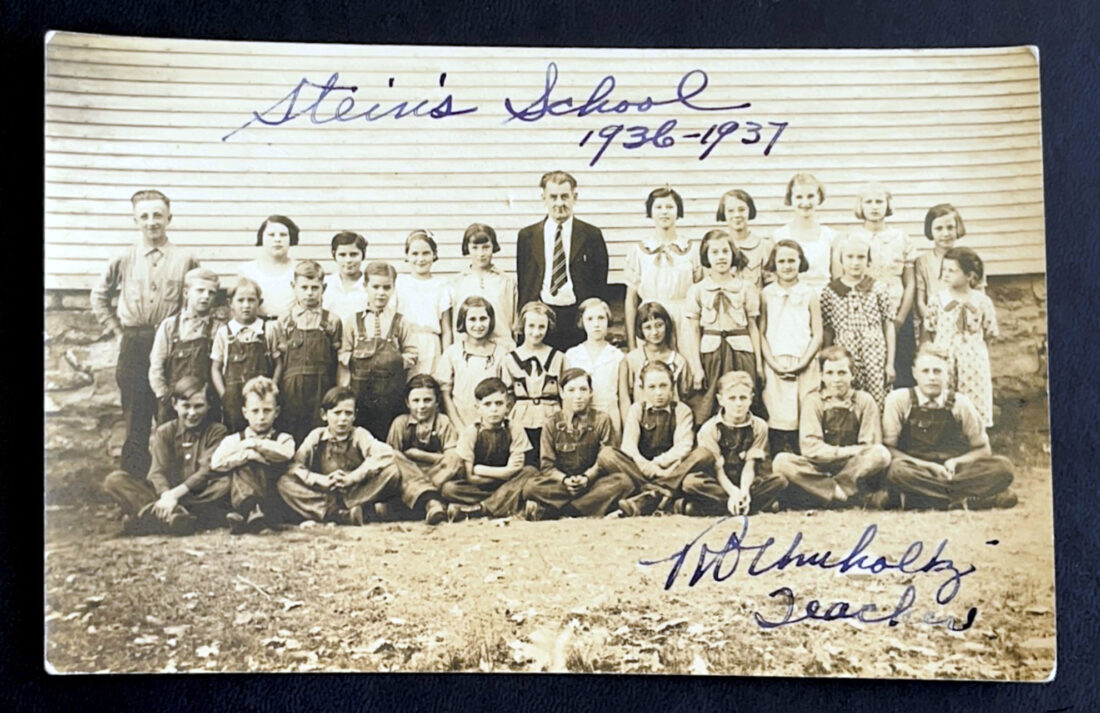
PHOTOS PROVIDED Verna’s class at her one-room, Pennsylvania Dutch-speaking school in Mahantongo Valley, Schuylkill County, is pictured.
Rationing and sacrifice touched every aspect of daily life. Visiting the dining hall with a ration card or leaving your car at home because gasoline required permission from the War Office was not unusual.
At the dining hall, Verna also worked as a meal card checker, “I was reading the cards — you had a card to come in to eat — and it gave you permission to get a meal,” she said.
There were many things you could not do during the war, Dotterer explained.
“Some of the students were smokers and wanted this and that. If you wanted it, you had to find somebody who might have the ration coupons,” she said. “They were really tight with the students.”
While at school, Verna, like most college students, had roommates. One of them, in the six-bedroom house near campus where she stayed, was a Jewish girl from New York City who primarily spoke Yiddish.
“She was difficult to understand,” said Dotterer, “but because I was Dutch, she knew what I was saying.”
Verna’s first language was Pennsylvania Dutch — a dialect of German spoken by many, primarily Amish, families in the state.
Because of that, she said, “She thought I was one of the mean, nasty people because of the war — angry at the Jewish people.”
Despite Verna’s assurances that she meant no harm, her roommate was never fully convinced.
“She was scared,” Dotterer said. “The war was at its worst during the years I was there.”
At the time, the wider world was only beginning to learn that Germany was actively carrying out the horrors of the Holocaust, which claimed the lives of approximately six million Jewish people.
“It scared people because the Germans were at war, and when they heard me talk, they thought I was German,” said Dotterer.
Although nobody was openly hostile, she endured teasing and mockery.
In her studies, because of her struggles with the language, she had to take English twice.
“They finally quit because they said, ‘I guess we just can’t get you (fluent) in English,” Verna said.
Despite repeatedly failing her English classes, her coursework earned her a minor in the subject.
“I was laughing when I saw that,” said Dotterer. “I thought, I hope nobody asks me because I still don’t know all of the fragments I had in grade school.”
The following semester introduced Verna to a roommate who was quite unlike anyone she’d met before.
“The next semester though, I got a roommate that had a voice like a boy and was tall,” said Verna, of her roommate June, who she described as rough around the edges.
Though they often clashed, one evening just before Verna was set to go home for break, June insisted they go out to look at flowers together. Despite Verna’s protests that she was already in bed and it was dark outside, they went anyway. When they returned, Verna discovered muddy footprints across her bed leading toward the bureau — someone had broken into their room.
“He didn’t take my purse, just my underwear,” Verna recalled, noting she had everything packed to leave for home the next day.
Brave and headstrong, June chased after the thief, caught him and recovered the stolen items. “The police were so relieved that finally someone caught him,” she said. “He had been doing this for a while, and nobody knew how to stop him.”
A few years later, June moved to Canada to have a gender reassignment operation, a procedure which was not yet available in the United States.
“I thought of him as a he,” Verna said, “But I was surprised when he told me he planned to get the operation in Canada after another year.”
It was at Penn State that Verna would also meet her future husband.
A devout woman, she regularly attended Faith United Church of Christ on College Avenue. One day, while walking with friends the several miles to a church retreat in Boalsburg, her pastor pulled up beside her with a stranger in the car.
“He pulled over and got out, asking, ‘Are any of you tired of walking and having this mountain to climb?'” she recalled. “I looked into the front seat and saw Ralph — and thought, hmm, maybe I could meet him.”
Ralph wasn’t a student like Verna. Though he had enrolled for two years at Penn State, he had to leave to help on the family farm.
“His oldest brother was working there, but when the other brother left for the war, Ralph had to come home, so he dropped out after his second year,” she said.
Verna and Ralph married on June 6, 1946, shortly after she graduated. They would go on to share more than 60 years of marriage before his passing.
Before she could graduate, though, things were complicated during Verna’s fifth semester when her mother was bedridden with a severe case of poison ivy, forcing Verna to temporarily step away from her classes.
“I was so excited to take a semester off because five continuous semesters kept you pretty busy,” Dotterer said.
Around that time, Verna herself came down with the measles — a common illness in the era before the MMR vaccine. Still, she pushed forward with her studies and graduated in 1945, just as the first wave of returning servicemen began enrolling under the newly enacted GI Bill.
With the sudden influx of students, Penn State faced a significant housing shortage.
“They put up trailers in the field across from the highway and soldiers that wanted to start college but didn’t have a room had one of those to stay in,” she recalled. “Things changed radically in a hurry.”
However, Verna wouldn’t be around much longer to experience those postwar changes firsthand. By her final semester, Verna had already begun teaching home economics, a profession she would devote herself to until her retirement.
Today, Verna lives a peaceful life on her family’s farm in Lamar, where she spends much of her time lovingly tending to her garden.
“Mom married into a family where education was really important,” said Ralph Dotterer, Jr., her son. “We’re looking at six generations of college graduates. I would challenge you to find many non-farming families with six generations — and five generations connected to Penn State.”
The Dotterer family’s educational legacy dates back to the early 1870s, shortly after the Civil War and just a generation after Penn State’s founding.
Today, the family proudly counts more than a dozen college graduates among its members and looks forward to raising future generations of Nittany Lions.
Local news
KC board grapples with deficit; may consider no tax increase for 26-27
‘Amazing people’: Leadership Clinton County celebrates 12 at graduation ceremony
Pennsylvania is getting $193M for rural health. What comes next?
Centre Foundation raises $3.07M for local nonprofits
BELLEFONTE — In the final hours of Centre Gives, the Centre Foundation’s 36-hour online fundraising campaign, ...
City announces line up for 2026 Summer Concert Series