
Woodward Twp. Zoning denies requests from Project Transition
Trending

LAURA TARANTELLA/THE EXPRESS
Woodward Township Zoning Hearing Board members Terry Shultz, at left, Brenda Dunlap, Edward Cox and Jeff Raymond following the May 12 meeting.
DUNNSTOWN -- The Woodward Township Zoning Hearing Board denied an application by Project Transition for a proposed residential behavioral health facility along Coudersport Pike after hearing continued testimony from the company along with residents and school officials who voiced concerns about safety, property values and the project's proximity to Woodward Elementary School.
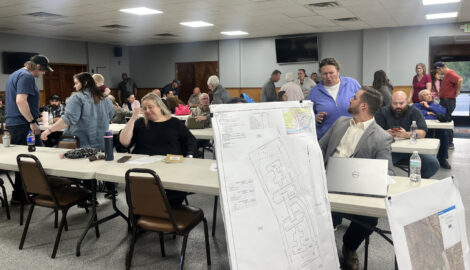
The May 12 hearing was a continuation of proceedings first held March 24 regarding an application filed by Project Transition for a special use exception to construct what was described as an "institutional residence" in the township's RL residential district.
Board Solicitor Frank Micelli reviewed the procedural history at the start of the meeting, noting the original hearing lasted approximately three hours and included testimony from applicant witnesses, township officials and community members before being continued.
"In between, the township planning commission met last week," Micelli said, adding that the board also received the planning commission's written recommendations before the hearing resumed.
During the hearing, the board granted party status to nearby residents Eric Jacobs and Marlene Gladden, whose properties are adjacent to the proposed site, as well as Keystone Central School District Superintendent Dr. Francis Redmon, representing the school district.
Redmon said the district only recently became aware of the proposal.
"I feel like I'm coming a little bit late to this," Redmon said. "Something of this impact should have been a concern in the district much earlier on."
Redmon said one of his primary concerns is the facility's proximity to Woodward Elementary School, which was estimated to be roughly 550 feet away.
"I think putting it in proximity of children, and especially concentrations of children like this elementary school, could be problematic," he said.
Redmon stressed that he supports treatment services in the community but questioned whether enough information had been provided about safety protocols, resident supervision and law enforcement involvement at similar facilities, concerns many residents in the township agreed with.
According to Redmon, the district does have a police force but does not have a full time officer at Woodward.
"My stance is we don't have enough information, and I'm concerned that I can't guarantee the safety of my students because I just don't have the information," he said. "Let's get the data first before we make a decision about whether or not to put this within 550 feet of school children."
During public comment, multiple residents spoke against the proposal, arguing the facility would alter the character of the neighborhood and place additional burdens on local infrastructure and emergency services.
Gladden questioned whether the applicant had sufficiently demonstrated compliance with ordinance requirements.
"They haven't done anything," she stated to the board. "They only say they're going to. Therefore, you do not have to approve it."
Others raised concerns about lighting, traffic and the scale of the project.
"This proposal is not a small residential use," resident Suzanne Miller said. "It's a high-intensity, institutional-scale facility being placed in a residential neighborhood directly near an elementary school."
Miller argued the project was incompatible with the township's rural residential zoning district and cited concerns over "large parking lots, intensive exterior lighting and commercial-grade, non-residential architecture."
Several neighboring residents also discussed existing drainage and stormwater issues on the hillside property where the facility would be constructed.
"My husband and I live directly adjacent to the property," resident Dawn Gill told the board. "For years, we've had water issues and I'm concerned it could get worse."
Another resident, Tracy Shade, said excavation work on the site had already contributed to drainage problems on nearby properties.
"If he (property owner Dave Harger) doesn't fix it now for me and he's building this project, why would he fix it for me then?" Shade asked.
Residents additionally questioned how the project would impact views from surrounding homes after trees were cleared from the site.
"We have decks on the back of our house," resident Katie Bastian said. "I could not imagine the amount of trees you would have to plant that would ever revive that hill or the view from my deck."
Attorney Steven Ahlbrandt, representing Project Transition, argued the application satisfies all requirements for a special use exception under the township zoning ordinance.
"At the outset, this is not a prohibited use," Ahlbrandt said. "This is a use that is expressly permitted by special exception in the RL district."
Ahlbrandt repeatedly emphasized the board's role is limited to determining whether the project complies with the ordinance's objective standards.
"The township board of supervisors already made that policy decision when it adopted the ordinance," he said. "The board's role is not to decide whether institutional residences should be allowed in the RL district as a policy matter."
According to testimony presented by the applicant, the proposed facility would include 24-hour staffing, security systems, alarm monitoring, cameras and public water and sewer service. Ahlbrandt said residents would typically stay between 12 and 18 months and also disputed claims that the facility would function as a halfway house or correctional facility.
"The mere fact that some residents may have contact with the court system, or may be encouraged by a court to participate in treatment, does not transform a clinical treatment residence into a prohibited correctional use," Ahlbrandt said.
Ahlbrandt also addressed concerns raised by the township planning commission, which questioned whether the project resembled a multi-family residential development rather than an institutional residence.
"This is not a multi-family dwelling structure," he said. "It is an institutional residence, and the ordinance treats institutional residences separately from multi-family dwellings."
The proposal originally included a second phase of development, including additional space to house 30 adults, but Ahlbrandt indicated the applicant may be willing to limit approval to only the first phase.
"If it makes the board feel more comfortable to just approve phase one as a condition, we would be open to discuss it," he said.
The hearing included debate over emergency service calls associated with other Project Transition operations in Berks County, though Ahlbrandt disputed whether those records accurately reflected its facilities.
Residents also challenged statements about buffering and screening around the site, noting that much of the wooded hillside had previously been cleared.
Township Zoning Officer Jackie Bartlett testified that the proposed building would sit prominently above neighboring homes and questioned whether the project could remain visually compatible with the surrounding residential area.
"There are approximately 100 houses to the east in plain view of this proposed facility," Bartlett said.
At several points, emotional testimony centered on personal experiences with addiction treatment programs and concerns about locating such a facility near families and children.
"I do think the world needs places like this," Shade said. "This is not the place for one of these."
Following testimony and public comment, the zoning hearing board broke to have a 12 minute executive session.
After public testimony concluded, the board entered into public deliberations, with Micelli guiding members through the standards required under the township zoning ordinance.
Micelli reminded attendees that zoning hearing board deliberations must occur publicly and explained that the board needed to determine both factual findings and how those facts applied to township ordinances and Pennsylvania law.
The board first discussed whether the proposed use qualified as an "institutional residence" under the ordinance. Members ultimately agreed that the proposed facility fit the ordinance definition as a residential alcohol and drug rehabilitation center with incidental health care and mental health treatment services.
Board members then reviewed the project against the criteria outlined in Sections 508 and 1102 of the zoning ordinance.
The board found the project met some requirements, including minimum lot size, 24-hour supervision and residency duration standards. However, members repeatedly expressed concerns about several other ordinance requirements, including public safety, compatibility with the surrounding residential neighborhood, landscaping and screening plans, sewage and water capacity and the lack of detailed site and building information.
Board members also cited concerns regarding the facility's proximity to Woodward Elementary School and the absence of evidence addressing potential impacts on the surrounding community.
"There's an awful lot of unknown factors here," Board member Terry Shultz said during final deliberations.
The board additionally questioned whether the applicant had provided enough evidence regarding landscaping, traffic impacts, stormwater concerns and overall compatibility with the township's low-density residential character.
Following deliberations, Shultz made a motion to deny the application for the proposed institutional residence, stating that while members recognized the need for treatment services, the application did not sufficiently satisfy zoning requirements. It was seconded by board member Brenda Dunlap and unanimously approved.
The board also voted to deny the applicant's separate request for signage associated with the project. Since the application was denied, the board did not address the requested time extension tied to the proposal.
Micelli said a written decision outlining the board's findings and conclusions would be prepared and distributed to the parties involved in the case before adjourning.