
Trending
The Continental Congress established the design of the United States flag on June 14, 1776. There are several stories about the first Flag Day celebration, such as that it was in Hartford, Connecticut, in 1861, or that a New York kindergarten teacher celebrated it with his class in 1889, but it is generally agreed that the holiday was observed on June 14 in individual states by the late 1800s. It became particularly popular in schools, where students celebrated by writing essays about what the American flag meant to them, or held assemblies where they carried flags and sang patriotic songs.
People in different states worked to make the holiday a national observance, including Bernard J. Cigrand, a young teacher in Wisconsin, and Pennsylvanian William T. Kerr, who founded the American Flag Day Association in 1888. The enthusiasm reached the federal government by 1914, when Franklin K. Lane, Secretary of the Interior, delivered a speech on "Makers of the Flag," which has been printed in students' textbooks since then.
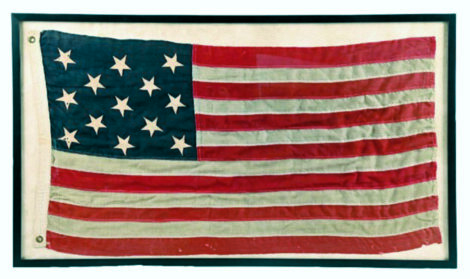
In 1916, President Woodrow Wilson made the holiday official. For a collector, Flag Day is an opportunity to display or reflect on the many designs the American flag has taken over the years. An antique 13-star flag, housed in a protective frame, sold for $2,952 at Morphy Auctions. It does not necessarily date to the 18th century, however; copies of early flags were made later for decorative or historic purposes.
------
Q: We are trying to find out the value of a set of dinner dishes marked "Mintons." Can you help?
A: Your dishes were made by Minton & Co., a British pottery founded by Thomas Minton in Stoke-on-Trent in the 1790s. They used the "Mintons" mark from about 1873 to 1912, which helps narrow down the date of yours.
At the time, Minton was making many fine types of porcelain, such as Parian ware and pate-sur-pate. The Minton pottery became part of the Royal Doulton group in 1968, and they continued using the Minton mark.
Values for complete sets of dishes marked "Mintons" will vary; one set recently sold for about $50, another for over $2,000. The value for a set of dishes will depend on its pattern and condition.
Websites like The Minton Archive (themintonarchive.org.uk) and The Minton China (themintonchina.com) can help you identify the pattern of your dishes. A designer's signature increases the value of Minton dishes. A retailer's mark may do so, too; some were sold by high-end retailers like Tiffany & Co.
------
Q: My family has an unusual metal piece of furniture that looks just like one you pictured in an article on your website. The article said it was a telephone cabinet by Oscar Bach, and it was worth more than $1,000. It was published years ago, so would the cabinet have the same value today, or has it changed?
A: Oscar Bach was an influential German-born metallurgist who opened a design studio in New York in 1911. His designs were extremely popular in the 1920s-1930s. However, attribution can be tricky because some of his designs were reproduced by his business partner.
The Kovels 2013 Price Guide lists a metal telephone cabinet attributed to Bach for $1,416. It was made in the 1920s and has gilt bronze and iron Gothic-style strapwork. It was also featured in a sale report on metal furnishings in our March 2012 Kovels On Antiques and Collectibles newsletter. However, telephone cabinets like this one have lost popularity, and thus value, since then.
We have seen similar pieces sell at recent auctions for merely $500-$600. However, other Oscar Bach designs, such as sets with a cabinet or table and chair, have sold for about $2,500.
------
TIP: If your American flag is tattered and can no longer be used, be sure to dispose of it in the official way. Give it to a Boy Scout, Girl Scout, American Legion post, or the U.S. military. They can do the official ceremony that includes burning the old flag.
------
Kovels answers readers' questions sent to the column. Send a letter with one question describing the size, material (glass, pottery) and what you know about the item. Include only two pictures: the object and a close-up of any marks or damage. Be sure your name and return address are included. By sending a question, you give full permission for use in any Kovel product. Names, addresses or email addresses will not be published. We do not guarantee the return of photographs, but if a stamped envelope is included, we will try. Questions that are answered will appear in Kovels Publications. Write to Kovels, (Name of this newspaper), King Features Syndicate, 300 W. 57th Street, 41st Floor, New York, NY 10019, or email us at collectorsgallery@kovels.com.