
Trending
As the weather grows warmer, many of us like to set up furniture outside to enjoy the sunlight and spring breezes. Some of the best outdoor furniture, especially among antiques, is made of wicker. Wicker furniture has been made for thousands of years. Like many classic types of furniture, it experienced a renewed popularity in the 19th century. New tools and manufacturing processes revolutionized the furniture industry, and many people recognized the lightness, durability, and beauty of wicker. It could be easily bent or woven into the complex shapes and decorations that were fashionable at the time.
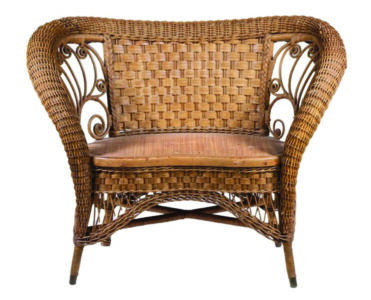
The most famous wicker furniture was made by the Heywood-Wakefield company, like an ornate settee that seats two, made about 1900, that sold for $562 at Thomaston Place Auction Galleries. Its curved shape, woven back, and curled side panels show how the properties of the material were a match for the styles of the time.
Heywood-Wakefield was the result of the merger of two furniture companies, Wakefield Company and Heywood Brothers, in 1897. Cyrus Wakefield was originally a grocer who realized that the rattan used to hold cargo shipments in place could be made into stylish, durable furniture. The Wakefield Rattan Company was incorporated in 1873. Heywood Brothers, founded by Levi Heywood in 1861, bought rattan seats from Wakefield, but also made their own wicker furniture. The two companies merged after years of competition.
Heywood-Wakefield continued operating into the mid-20th century, when the company made streamlined furniture from blond wood. After it went out of business, the South Beach Furniture Company bought the rights to the name. They continued making blond wood furniture from the company's original designs, but antiques enthusiasts still look for the early wicker pieces.
------
Q: Can you help me find out the origin and value of my china tea set? I have a tall pot, sugar bowl, and a cup. They have a raised dragon design with gold trim. There is a red mark on the bottom of the cup that looks like the outline of an animal's head inside a circle. Any information will be appreciated.
A: Your tea set is decorated with a technique called moriage, where clay mixed to a thick liquid consistency, like toothpaste, is trailed on a ceramic piece to create a raised decoration. Other colors were added over these raised shapes. It became popular in Japanese ceramics, especially those made for export, about 1900.
Designs with dragons, like yours, are known as dragonware. Some have an additional picture at the bottom of the cup, called a lithophane, that is visible if you hold it up to a light. The mark on yours is for Emerson China, an importer that was active in the mid-20th century.
Dragonware tea sets can be worth about $50 (for a teapot, sugar bowl, and creamer) to $150, depending on their size and condition. Individual cup and saucer sets can sell for about $10 to $20. For more information, you may want to contact the International Nippon Collectors Club (INCC, nipponcollectorsclub.com), a club for collecting Japanese export porcelain from the late 19th to early 20th century.
------
Q: I am trying to find information on a back-painted chessboard that I purchased from a neighbor in 1975. It looks exactly like it did that day 50 years ago. It has green and black squares and a border of red and blue flowers. It is in a wooden frame with the words "A winner never quits" and "A quitter never wins" on the sides.
A: Decorated chessboards like yours are collected as folk art. The quote immediately helps date yours. It is attributed to author Napoleon Hill in his best-selling self-help book, "Think and Grow Rich," which was published in 1937. That would place it a little bit later than most folk art game boards, which were at their height from about 1850 to 1920. Of course, these dates are approximate, and there is always the possibility that the frame or the quote was added later.
Back painting, or reverse painting, was popular in the United States in the 18th and 19th centuries. Reverse-painted game boards were especially popular in English and Scottish taverns. Today, reverse-painted game boards sell for about $75 to $200 at auctions. Because they usually sell as folk art, their age or maker are not necessarily as important as their look. Collectors generally want to see the original paint or finish, and signs of wear are often part of the appeal, but clear designs, legible words, and bright colors are always desirable.
------
TIP: If you keep wicker furniture inside, be sure to have a humidifier or lots of plants nearby. The wicker will crack if it is too dry.
------
Kovels answers readers' questions sent to the column. Send a letter with one question describing the size, material (glass, pottery) and what you know about the item. Include only two pictures: the object and a close-up of any marks or damage. Be sure your name and return address are included. By sending a question, you give full permission for use in any Kovel product. Names, addresses or email addresses will not be published. We do not guarantee the return of photographs, but if a stamped envelope is included, we will try. Questions that are answered will appear in Kovels Publications. Write to Kovels, (Name of this newspaper), King Features Syndicate, 300 W. 57th Street, 41st Floor, New York, NY 10019, or email us at collectorsgallery@kovels.com.